What Independent Practices Need to Know
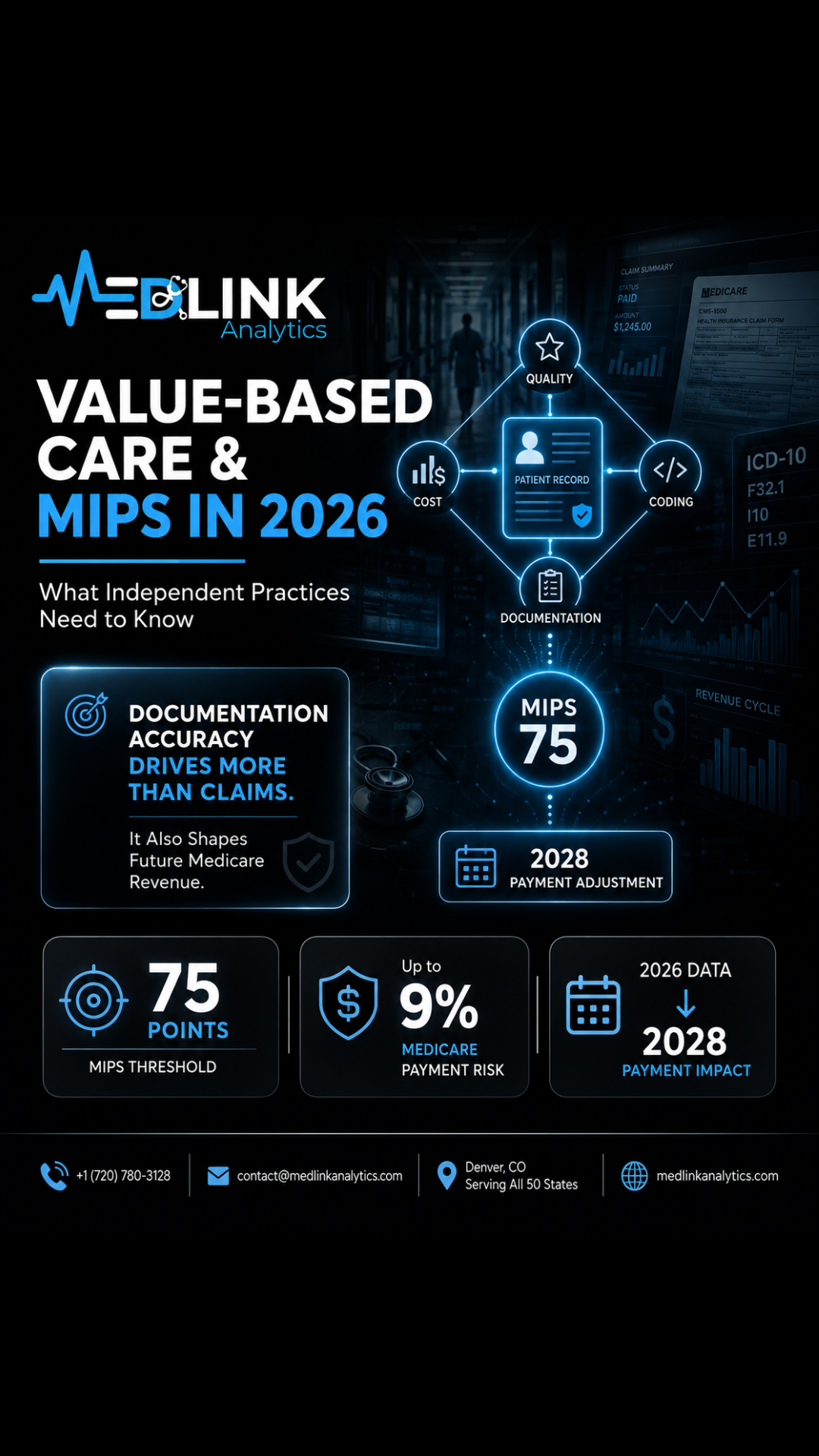
CMS’s CY2026 Medicare Physician Fee Schedule Final Rule keeps the MIPS performance threshold stable at 75 points through the 2028 performance period, with category weights unchanged: Quality 30%, Cost 30%, Promoting Interoperability 25%, and Improvement Activities 15%. Scoring below 75 risks a negative Medicare Part B payment adjustment of up to 9%, applied two years after the performance year. For 2026, CMS added 5 new quality measures, substantively changed 30, and removed 10, while continuing its push toward MIPS Value Pathways (MVPs) as the intended future of reporting. The part most practices underestimate: your MIPS score depends heavily on the same documentation and coding accuracy that drives your clean claims rate, making value-based care performance and revenue cycle management far more connected than they’re usually treated.
Why Value-Based Care Belongs in This Series
Everything we’ve covered so far, denial management, clean claims rate, ICD-10 updates, has focused on fee-for-service billing accuracy. Value-based care adds a second, parallel layer: how well-documented and coded that same clinical data is now directly determines a meaningful slice of Medicare reimbursement, independent of whether any individual claim was paid correctly.
This is also where the timing lag catches practices off guard. Your 2026 Medicare payment adjustment is based on data submitted back in 2024. If documentation gaps or coding inconsistencies quietly dragged your score down two years ago, you’re absorbing that penalty right now, regardless of how much this year’s charting has improved. That two-year delay is exactly why MIPS performance can’t be treated as a year-end scramble.
What’s Actually Changing in the 2026 MIPS Final Rule
- Performance threshold: Held stable at 75 points through the 2028 performance period. Score below 75, risk a negative Part B payment adjustment of up to 9%.
- Category weights unchanged: Quality 30%, Cost 30%, Promoting Interoperability 25%, Improvement Activities 15%.
- Quality measures: 5 new measures added, 30 substantively changed, 10 removed. CMS also removed “health equity” from the definition of a high-priority measure.
- Cost category: Held at 35 total measures, no additions or removals. The Total Per Capita Cost (TPCC) measure was updated to reduce misattribution to highly specialized groups.
- MIPS Value Pathways (MVPs): CMS is modifying all 21 existing MVPs and continuing its deliberate shift toward MVP reporting as the intended long-term replacement for traditional MIPS. MVP reporting isn’t mandatory yet, but CMS’s direction is unambiguous.
- CAHPS for MIPS Survey: Groups administering this survey for the 2026 performance period must register between April 1 and June 30, 2026.
CMS itself has described this year’s approach as prioritizing “stability” in the program, fewer sweeping changes than prior years, but the underlying direction toward MVPs and specialty-aligned reporting continues regardless.
The Administrative Burden Is Real, and CMS’s Own Data Confirms It
This isn’t just a practice-owner complaint. According to MGMA’s 2026 Regulatory Burden Report, 95% of practices report their regulatory burden has grown over the past three years, and 86% say MIPS reporting specifically adds significant administrative work. The intent behind value-based care, rewarding quality outcomes, hasn’t changed. The operational cost of proving those outcomes to CMS’s satisfaction has grown alongside it.
Where MIPS and Your Revenue Cycle Actually Overlap
This is the connection most practices miss: MIPS scoring draws directly from the same documentation and coding data that determines your clean claims rate and denial exposure.
- Quality measures rely on accurate, specific diagnosis and procedure coding, the exact accuracy problem we covered in our clean claims rate article.
- Cost measures are calculated from Medicare administrative claims data, meaning coding specificity and documentation completeness feed directly into your Cost category score, not just your reimbursement per claim.
- The FY2027 ICD-10 update we covered recently isn’t just a denial risk, outdated or imprecise codes used after October 1 could also distort the documentation basis for your 2027 MIPS reporting period.
- Improvement Activities and Promoting Interoperability both depend on consistent workflow documentation, the same operational discipline that keeps Days in A/R and denial rates under control.
A practice with a strong, disciplined revenue cycle process is, almost as a byproduct, better positioned for MIPS performance. A practice with coding gaps or inconsistent documentation is exposed on both fronts simultaneously, and won’t see the second exposure (the payment adjustment) until two years later.
What Independent Practices Should Do Now
- Confirm your current MIPS reporting method (traditional MIPS vs. MVP) and understand whether your specialty has a relevant MVP pathway worth adopting proactively rather than waiting for it to become the default.
- Review the 2026 quality measure changes relevant to your specialty specifically, not the full national list, five additions and thirty substantive changes rarely all apply to any single practice.
- Treat documentation and coding accuracy as dual-purpose, improving both your clean claims rate today and your MIPS score two years from now.
- Register for CAHPS for MIPS Survey between April 1 and June 30, 2026 if applicable to your group.
- Don’t wait for the payment adjustment to arrive to investigate a low score. By the time it lands, it reflects data that’s already two years old, the only leverage you have is on this year’s documentation.
Frequently Asked Questions
Q: What is the 2026 MIPS performance threshold? A: 75 points, held stable through the 2028 performance period. Scoring below 75 risks a negative Medicare Part B payment adjustment of up to 9%.
Q: How are the four MIPS category weights split in 2026? A: Quality 30%, Cost 30%, Promoting Interoperability 25%, and Improvement Activities 15%, unchanged from recent years.
Q: What are MIPS Value Pathways (MVPs)? A: MVPs bundle related measures across all four MIPS categories into a single pathway centered on a specific specialty or condition, intended to simplify reporting and improve clinical relevance compared to traditional MIPS. CMS is modifying all 21 existing MVPs for 2026 and continuing to position them as the program’s long-term direction.
Q: When does a 2026 MIPS score actually affect Medicare payments? A: MIPS payment adjustments apply two years after the performance year, meaning 2026 performance data determines 2028 Medicare payment adjustments.
Q: Is MVP reporting mandatory for 2026?
A: No, MVP registration and reporting remain optional for the 2026 performance year, though CMS’s. Continued investment in expanding and refining MVPs signals it as the intended future default.
Q: How does medical coding accuracy affect MIPS scoring? A: Both the Quality and Cost categories rely on data drawn from claims and documentation. Coding specificity and documentation completeness that improve your clean claims rate also directly feed the data CMS uses to calculate your MIPS performance score.
Two Systems, One Underlying Discipline
Fee-for-service billing accuracy and value-based care performance are often managed by completely different people inside a practice. Sometimes not managed proactively at all. But both ultimately depend on the same thing: complete, accurate, well-documented coding at the point of care. Fixing that once pays off in both systems, just on different timelines.
References
- TriumpHealth — MIPS 2026 Updates: A Practical Guide for Clinicians, Practices, and Office Managers
- ADSC — Value-Based Care Transition: How to Prepare Your Practice for MIPS in 2026
- eCQI Resource Center (ONC/CMS) — CMS Publishes 2026 Policy Changes for the Quality Payment Program
- MDinteractive — Breaking Down the 2026 QPP Final Rule: Key MIPS & ACO Updates
- ModMed — 2026 MIPS Updates: What You Need to Know
- CMS — 2026 Quality Payment Program Final Rule Fact Sheet and Policy Comparison Table (PDF)
This article reflects the CY2026 Medicare Physician Fee Schedule Final Rule as published. Given that QPP/MIPS policy is finalized annually and subject to further CMS guidance, practices. Which should confirm current requirements directly at QPP.CMS.gov before making reporting decisions.
Let MedLink Analytics Connect Your Billing and Quality Reporting Strategy
MedLink Analytics provides medical billing, medical coding, denial management, and full revenue cycle management services for independent physician practices across the United States, built around the same documentation accuracy that supports both clean claims and value-based reporting performance.
If you’re not sure how your current coding and documentation practices might be affecting your MIPS score two years from now. That’s exactly the kind of gap worth reviewing today.
📞 +1 (720) 780-3128
✉ contact@medlinkanalytics.com
📍 Denver, CO | Serving all 50 states
🌐 medlinkanalytics.com