
The Metric That Prevents Both Denials and Aging A/R
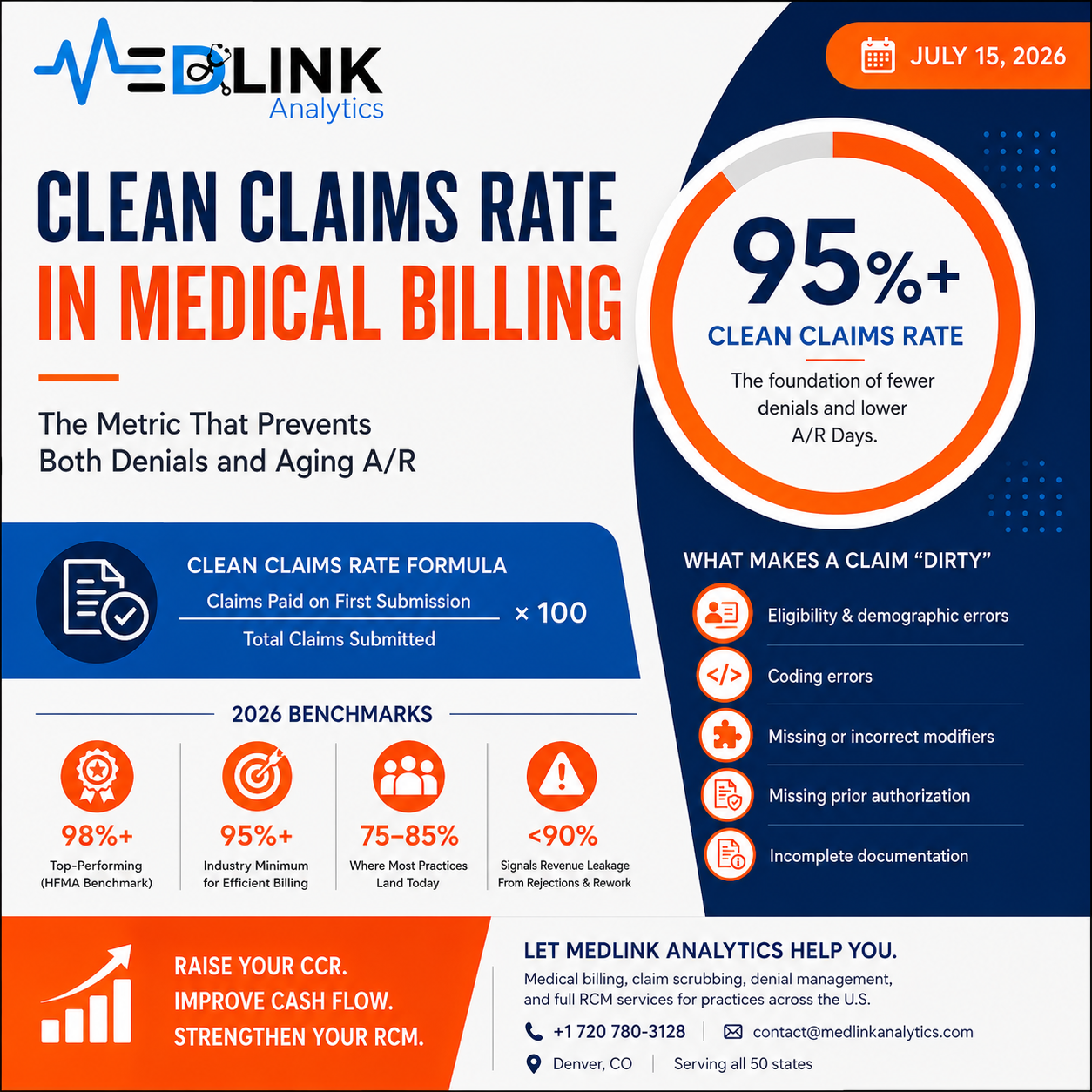
Quick answer: Clean claims rate (CCR) measures the percentage of claims paid on the first submission, with no errors, rejections, or payer follow-up required. The formula is claims paid on first submission ÷ total claims submitted × 100. Industry benchmarks for 2026 put 95% as the minimum for efficient billing, with HFMA setting 98% as the mark of a top-performing operation. Most independent and group practices actually sit closer to 75–85%, and that gap is often the single biggest reason denials and aging A/R keep coming back month after month.
Closing the Loop on This Week’s Series
We started this series with denial management, then moved into A/R aging. Clean claims rate is the metric that ties both of those together, because it sits upstream of both problems. A low clean claim rate doesn’t just cause denials directly; it also seeds the A/R aging problem, since every claim that bounces back for correction adds days before it’s ever paid.
If you fix one number in your revenue cycle, this is usually the one with the widest ripple effect.
What Is a Clean Claim? (Direct Answer)
A clean claim is an insurance claim that contains all the accurate information a payer needs on the first try: correct patient demographics, valid and active insurance, proper CPT/ICD codes and modifiers, and any required prior authorization, with no errors or missing documentation that would trigger a rejection or request for more information.
Clean Claims Rate formula: Clean Claim Rate = (Claims paid on first submission ÷ Total claims submitted) × 100
Example: a practice submits 1,000 claims in a month and 940 are paid on the first pass. That’s a 94% clean claim rate; just under the 95% efficiency threshold most benchmarks use.
2026 Clean Claims Rate Benchmarks
- 95% or higher — the general industry minimum for efficient billing
- 98% and above — HFMA’s benchmark for top-tier, high-performing billing operations
- 75–85% — where most independent and group practices actually land today
- Below 90% — typically signals meaningful revenue leakage from rejections and rework
That 75–85% range most practices sit in isn’t a small gap. On a practice submitting 500 claims a month, even a 15% first-pass failure rate means 75 claims a month requiring rework, each one adding delay before payment and consuming staff time that could go toward patient care instead.
Clean Claim Rate vs. First Pass Resolution Rate (They’re Not the Same)
These two metrics get confused constantly, and the difference matters:
- Clean claim rate measures whether a claim passes payer edits and is accepted on first submission.
- First pass resolution rate measures whether that claim is actually paid on first submission, with no follow-up needed.
A claim can be technically “clean” — accepted, no rejection — and still get denied afterward for medical necessity, a coverage limitation, or a payer-specific rule. That’s why a practice can have a solid clean claim rate and still be sitting on real denials. Tracking both numbers together gives a far more complete picture than either one alone.
What Actually Makes a Claim “Dirty”
The list of causes barely changes year to year, which is exactly why they’re preventable:
- Eligibility and demographic errors — wrong member ID, inactive coverage, misspelled name or date of birth
- Coding errors — invalid, outdated, or mismatched CPT/ICD codes
- Missing or incorrect modifiers
- Missing prior authorization
- Incomplete documentation that doesn’t support the billed service
Demographic and technical errors alone account for a large majority of first-pass claim failures industry-wide — meaning most “dirty” claims aren’t complex coding disputes at all. They’re basic data errors that a proper front-end check would have caught before submission.
How to Raise Your Clean Claims Rate
- Verify eligibility before every visit, not at check-in and never after the claim is denied.
- Scrub every claim against payer-specific edits before submission, not just generic coding rules.
- Confirm prior authorization status early, with enough lead time to resolve gaps before the date of service.
- Audit coding regularly, especially for the CPT/ICD combinations your practice bills most often.
- Track clean claim rate by payer, since certain payers often drag the average down more than others.
- Feed denial and rejection data back to registration and coding, so recurring errors get fixed at the source instead of repeating every billing cycle.
Automated claim scrubbing tools that catch eligibility, coding, and modifier errors before transmission can meaningfully improve first-pass rates, but the underlying discipline — checking things early instead of after the fact — is what actually moves the number.
Frequently Asked Questions
Q: What is a good clean claims rate in medical billing? A: 95% or higher is generally considered the minimum for efficient billing. HFMA sets 98% as the benchmark for top-performing operations. Most independent practices currently fall between 75% and 85%.
Q: How do you calculate clean claim rate? A: Divide the number of claims paid on first submission by total claims submitted, then multiply by 100. For example, 940 clean claims out of 1,000 submitted equals a 94% clean claim rate.
Q: What’s the difference between a rejected claim and a denied claim? A: A rejection happens before adjudication and is usually fixable immediately, often a data or formatting error caught before the claim is even processed. A denial happens after adjudication and typically requires a formal appeal.
Q: Does a high clean claim rate guarantee full payment? A: Not necessarily. A claim can pass payer edits and still be denied afterward for medical necessity or a coverage limitation. That’s why clean claim rate and first pass resolution rate should be tracked as separate, complementary metrics.
Q: What’s the fastest way to improve clean claim rate? A: Front-end eligibility verification and pre-submission claim scrubbing typically produce the fastest gains, since the majority of dirty claims trace back to demographic or basic data errors rather than complex coding issues.
Q: How does clean claim rate affect Days in A/R? A: Directly. Every claim that fails on first submission adds rework time and delay before it’s paid, which pushes Days in A/R higher. Raising clean claim rate is one of the most reliable ways to bring Days in A/R down.
The Metric Behind the Other Two Metrics
Denial management and A/R aging both matter, but they’re largely downstream effects. A practice with a strong clean claims rate simply generates fewer denials and less aging A/R to manage in the first place. It’s the difference between a revenue cycle that’s constantly playing defense and one that rarely needs to.
If there’s one number to start tracking out of this week’s three-part series, this is the one that moves the other two along with it.
Let MedLink Analytics Raise Your Clean Claims Rate
MedLink Analytics provides medical billing, claim scrubbing, denial management, and full revenue cycle management services for independent physician practices across the United States.
If you don’t currently know your clean claims rate, that’s usually the first sign there’s a fast, fixable revenue leak in your billing process.
✉ contact@medlinkanalytics.com
📍 Denver, CO | Serving all 50 states
That wraps this week’s three-part revenue cycle series: denial management, A/R aging, and clean claims rate. Next week, we’ll look at what a proper monthly RCM performance review should actually cover.

Pingback: Value-Based Care MIPS in 2026