What CMS’s New Rules Mean for Your Practice
CMS’s Interoperability and Prior Authorization Final Rule (CMS-0057-F) took effect January 1, 2026, requiring impacted payers, Medicare Advantage, Medicaid, CHIP, and ACA marketplace plans, to move from fax and portal-based prior authorization to standardized electronic workflows, with decisions required within 72 hours for urgent requests and 7 days for standard ones. Full API-based interoperability compliance is required by January 1, 2027. A newer proposed rule (CMS-0062-P), released in April 2026, would extend these same electronic requirements to drug prior authorizations for the first time. Meanwhile, Medicare Advantage denial rates are projected to climb from roughly 13–15% in 2025 to 15–17% in 2026, making this reform arrive at exactly the moment prior authorization friction is getting worse, not better.
Why Prior Authorization Reform Belongs in This Series
We’ve spent this series on denial management, clean claims rate, and coding accuracy, all things a practice controls directly. Prior authorization sits in a different category: it’s a payer-controlled bottleneck that, when mishandled or delayed, creates some of the most disruptive denials a practice faces, not because anything was billed incorrectly, but because a step that should have happened before the visit never got resolved in time.
CMS’s 2026 reform is significant because it’s the first major regulatory attempt to force that process onto a predictable, electronic, deadline-driven track, rather than leaving it to fax machines and payer portals with no enforced turnaround time.
What’s Already in Effect: CMS-0057-F (Final Rule)
- Effective date: January 1, 2026, for core provisions
- Applies to: Medicare Advantage organizations, state Medicaid and CHIP fee-for-service programs, Medicaid managed care plans, CHIP managed care entities, and Qualified Health Plan issuers on the ACA marketplaces
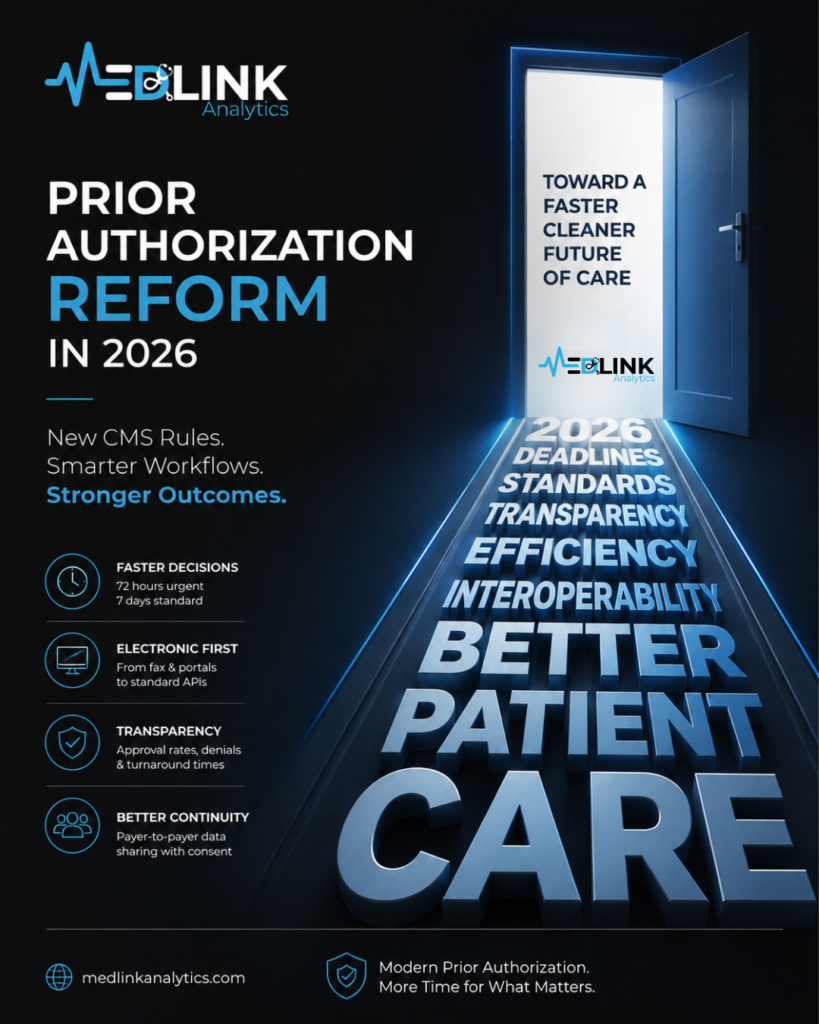
- Turnaround requirements: 72 hours for urgent prior authorization requests, 7 calendar days for standard requests
- Format shift: Payers must move away from manual fax and portal submissions toward standardized electronic workflows
- Payer-to-payer data sharing: When a patient switches plans, the new payer must request the patient’s prior authorization and claims history from the previous payer within one week of coverage starting, if the patient has opted in
- Public transparency reporting: Impacted payers must annually report prior authorization approval rates, denial rates, appeal outcomes, and average decision turnaround times
- Full API compliance deadline: January 1, 2027, giving payers (and the practices working with them) a transition window through this year
What’s Coming Next: CMS-0062-P (Proposed Rule)
Released in April 2026, this proposed rule extends the same electronic prior authorization framework specifically to drugs, covering both medical-benefit and pharmacy-benefit drugs, an area the 2024/2026 final rule did not originally address. Key elements include:
- Electronic prior authorization required for drug requests, not just non-drug items and services
- Shorter, standardized decision timeframes aligned across CMS programs
- More specific denial explanations required from payers
- Mandatory standardized APIs for real-time prior authorization status and requirement checks
The public comment period closed June 15, 2026. Practices in specialties with high drug prior authorization volume, oncology, specialty pharmacy, rheumatology, and similar fields, should watch this rule’s progress closely, since it directly targets one of their most persistent administrative burdens.
Why This Matters More Now Than It Would Have Two Years Ago
Prior authorization reform is landing at a genuinely difficult moment: Medicare Advantage denial rates are trending upward, from roughly 13–15% in 2025 toward a projected 15–17% in 2026. That means the same practices this reform is meant to help are simultaneously facing more denials overall, some tied to prior authorization gaps, some not.
The practical upside for practices that adapt early: standardized electronic workflows and enforced turnaround times should, over time, reduce the ambiguity and delay that currently make prior authorization one of the least predictable parts of the revenue cycle. The risk for practices that don’t adapt: continuing to rely on manual fax and portal processes while payers shift to API-based systems will likely mean slower approvals and higher denial exposure relative to practices that modernize alongside the payers.
How This Connects to What We’ve Already Covered
- AI-enabled prior authorization tools, the kind we covered in our AI in medical billing article, are becoming significantly more valuable under this framework, since automated systems can track payer-specific API requirements and turnaround deadlines far more reliably than manual staff tracking.
- Denial prevention, covered in our denial management article, increasingly depends on prior authorization status being resolved before the date of service, exactly the workflow CMS is now pushing payers to standardize.
- Practices with weaker documentation processes may find the new “more specific denial explanations” requirement cuts both ways: clearer payer denials also mean less ambiguity about what documentation was actually missing, which can either speed up appeals or expose gaps that were previously easy to overlook.
What Practices Should Do Now
- Confirm which of your practice’s payers are subject to CMS-0057-F (Medicare Advantage, Medicaid, CHIP, and ACA marketplace plans), and check whether they’ve begun shifting away from fax/portal submission.
- Track actual turnaround times you’re experiencing against the 72-hour/7-day standards, and flag payers that aren’t meeting them.
- Evaluate whether your practice management or EHR system supports API-based prior authorization submission, since manual processes will increasingly lag behind payer-side automation.
- Watch CMS-0062-P’s progress if your specialty involves significant drug prior authorization volume.
- Use payer transparency reporting, once available, to identify which payers have the slowest or highest-denial prior authorization processes, and adjust scheduling and documentation timelines accordingly.
Frequently Asked Questions
Q: When did the new CMS prior authorization rules take effect? A: Core provisions of the CMS-0057-F final rule took effect January 1, 2026, including 72-hour and 7-day decision turnaround requirements. Full API-based interoperability compliance is required by January 1, 2027.
Q: Which payers are affected by the 2026 prior authorization rule? A: Medicare Advantage organizations, state Medicaid and CHIP fee-for-service programs, Medicaid managed care plans, CHIP managed care entities, and Qualified Health Plan issuers on the ACA federally-facilitated marketplaces.
Q: Does the 2026 rule cover prior authorization for medications? A: Not yet, fully. The 2026 final rule primarily addressed non-drug items and services. A separate proposed rule (CMS-0062-P), released in April 2026, would extend similar electronic prior authorization requirements to drugs, but it remains in the rulemaking process following its June 2026 comment period.
Q: How long can a payer take to decide on a prior authorization request now? A: Under the 2026 final rule, impacted payers must decide within 72 hours for urgent requests and 7 calendar days for standard requests.
Q: Are Medicare Advantage denial rates actually increasing in 2026? A: Industry reporting projects Medicare Advantage denial rates rising to roughly 15–17% in 2026, up from approximately 13–15% in 2025, even as prior authorization reform is being implemented.
Q: How can a practice prepare for these changes? A: Confirm which payers are subject to the new rules, monitor actual turnaround times against the required standards, evaluate whether current systems support electronic/API-based prior authorization, and stay current on the drug-specific proposed rule if relevant to your specialty.
Reform on Paper, Discipline in Practice
New turnaround standards and electronic requirements will help over time, but they don’t remove the need for a practice to track prior authorization status closely in the meantime. The practices that benefit most from this reform will be the ones already treating prior authorization as a proactive, tracked step, not the ones waiting for payers to simply get faster on their own.
References
- CMS — 2026 CMS Interoperability Standards and Prior Authorization for Drugs Proposed Rule (CMS-0062-P)
- CMS — Interoperability and Prior Authorization Final Rule (CMS-0057-F)
- CMS Newsroom — 2026 CMS Interoperability Standards and Prior Authorization for Drugs Proposed Rule Fact Sheet
- AJMC — Prior Authorization in 2026: CMS Is Rebuilding the Operating Model
- Federal Register — Interoperability Standards and Prior Authorization for Drugs Proposed Rule
- Pro Medical Billing Solutions — Prior Auth 2026: Provider Compliance Guide
This article reflects CMS rules and proposals as published through mid-2026. Given that CMS-0062-P remains in the proposed rulemaking process, practices should confirm current requirements at CMS.gov before making compliance decisions.
Let MedLink Analytics Track Prior Authorization So You Don’t Have To
MedLink Analytics provides medical billing, denial management, credentialing, and full revenue cycle management services for independent physician practices across the United States, including proactive prior authorization tracking and payer-specific turnaround monitoring as part of our standard workflow.
If prior authorization delays have been a recurring source of denials or scheduling friction in your practice, that’s exactly the kind of gap worth reviewing before the next authorization slips past deadline.
✉ contact@medlinkanalytics.com
📍 Denver, CO | Serving all 50 states
🌐 medlinkanalytics.com