How Automation Is Transforming RCM in 2026
AI in medical billing refers to machine learning and automation tools that handle tasks like medical coding, claim scrubbing, eligibility verification, and denial prediction, tasks that traditionally required manual review at every step. In 2026, roughly half of healthcare organizations already use some form of AI in their revenue cycle, and nearly three-quarters use some form of automation. The technology isn’t replacing billing teams; it’s replacing the manual, repetitive checks that used to consume most of their time, freeing staff to focus on the exceptions that actually need human judgment.
Why This Is the Defining Story in Revenue Cycle Management Right Now
Every metric we’ve covered in this series so far, clean claims rate, denial rate, Days in A/R, exists because something in the billing process didn’t get caught before it caused a problem. AI in medical billing is significant because it attacks that exact gap: catching errors, predicting denials, and flagging eligibility issues before a claim is ever submitted, rather than after.
This isn’t a future trend anymore. It’s the current operating reality for a growing share of the industry, and the practices still relying entirely on manual review are increasingly the exception, not the norm.
Where AI Is Actually Being Used in Medical Billing Today
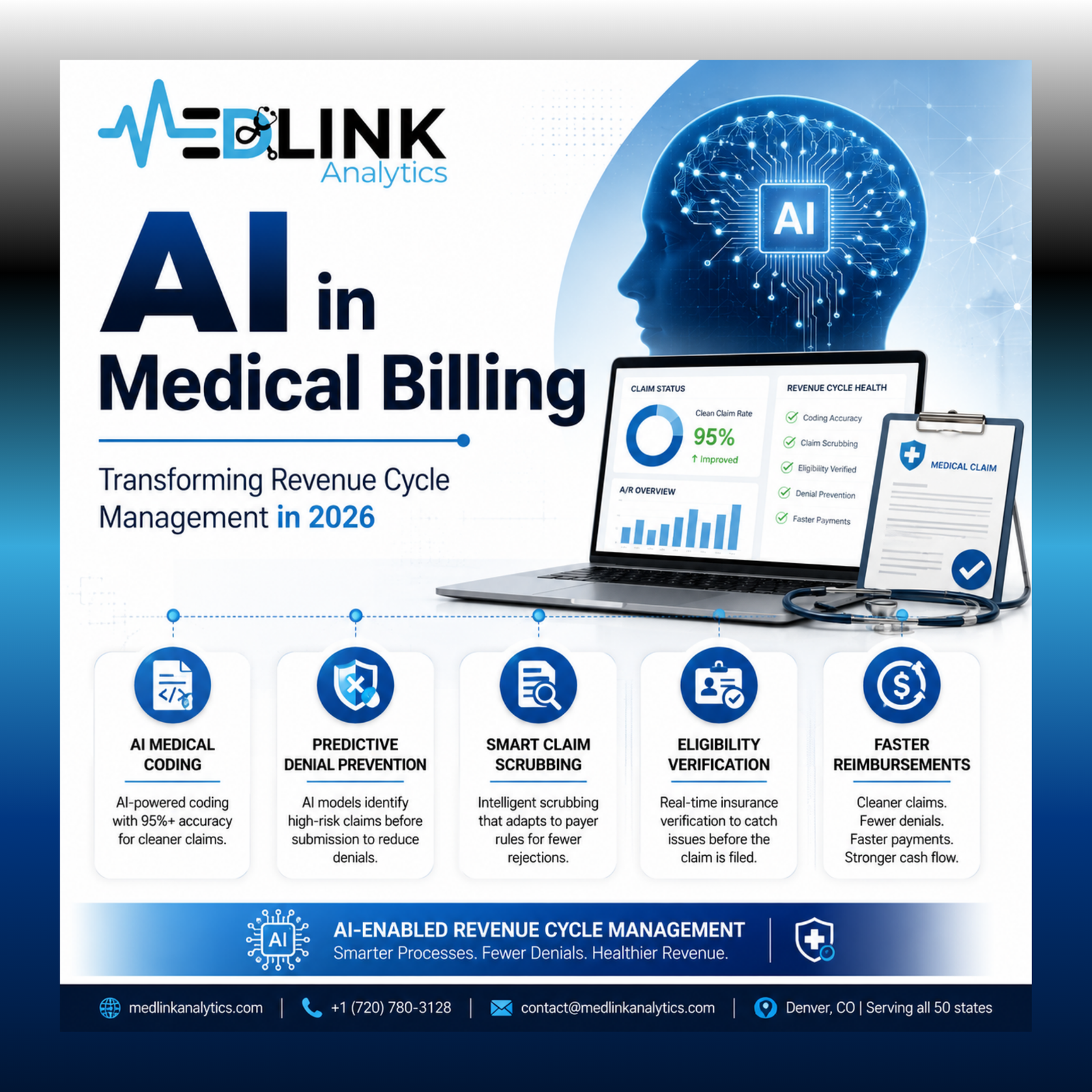
1. Automated medical coding AI systems can now read clinical documentation and suggest ICD-10, CPT, and HCPCS codes with a reported accuracy rate above 97% in leading implementations. This doesn’t eliminate the need for certified coders, it shifts their role from typing every code manually to reviewing and validating AI-suggested codes, which is a faster and less error-prone process for high-volume practices.
2. Predictive denial analytics Rather than waiting for a payer to deny a claim and then figuring out why, machine learning models can now flag claims likely to be denied before submission, based on patterns across payer, procedure, diagnosis, and historical outcome data. This is the single biggest shift in how denial management has evolved: from reactive appeals to predictive prevention.
3. Automated eligibility verification AI-driven eligibility tools check coverage status in real time, often before or during scheduling rather than at check-in, catching the demographic and coverage errors that remain one of the leading causes of claim rejections.
4. Intelligent claim scrubbing Modern claim scrubbing engines go beyond static rule sets, learning payer-specific patterns over time and adapting as payer edit rules change, which keeps clean claims rate performance from degrading as payer requirements shift.
5. Automated patient billing and communication Predictive models can estimate a patient’s expected out-of-pocket responsibility before service, supporting the price transparency and Good Faith Estimate expectations tied to the No Surprises Act, while automating routine payment reminders and payment plan communication.
The Numbers Behind the Shift
- Roughly half of healthcare organizations already use some form of AI in revenue cycle operations, with nearly three-quarters using some form of automation.
- Industry estimates suggest AI and automation could eliminate as much as $360 billion in wasteful U.S. healthcare administrative spending tied to scheduling, documentation, and basic communication tasks.
- Practices using AI in RCM commonly report 30–50% reductions in administrative costs and 15–25% faster reimbursement cycles.
- The global RCM market, driven heavily by AI and automation adoption, is projected to surpass $150 billion, with technology-driven solutions leading that growth.
- A majority of hospitals and health systems say they plan to expand RCM outsourcing specifically to gain access to automation and AI capabilities that are difficult to build in-house.
The pattern across nearly every current industry report is consistent: AI in medical billing isn’t a competitive edge anymore, it’s quickly becoming the baseline expectation for a well-run revenue cycle.
Why AI Alone Doesn’t Fix a Revenue Cycle
Here’s the part that gets lost in a lot of AI coverage: automation amplifies whatever process it’s layered on top of. If claim scrubbing rules are outdated, or a coding workflow has a structural gap, AI will execute that flawed process faster and at greater scale, not fix it.
The practices seeing the strongest results aren’t the ones that simply bought AI tools. They’re the ones that paired AI with the fundamentals we’ve covered throughout this series:
- A prevention-first approach to denial management, where AI predicts denials but a disciplined team still acts on the pattern
- Active A/R follow-up, since predictive analytics can flag a stalling claim, but someone still has to work it
- A strong baseline clean claims rate process that AI scrubbing tools enhance rather than replace
AI is a force multiplier. It multiplies good processes into excellent ones, and it multiplies weak processes into faster failures.
What This Means for Independent Practices
Most independent practices aren’t going to build in-house AI infrastructure, and they don’t need to. What matters is choosing a billing partner that has already integrated these tools into a disciplined workflow, so a practice gets the benefit, faster reimbursement, fewer denials, lower administrative cost, without needing to manage the technology itself.
This is also part of why RCM outsourcing is accelerating industry-wide: building and maintaining AI-driven billing infrastructure requires ongoing investment and specialized expertise that’s difficult to justify for a single independent practice, but scales efficiently across a billing partner’s client base.
Frequently Asked Questions
Q: What is AI in medical billing? A: AI in medical billing refers to machine learning and automation technology used to perform tasks like medical coding, claim scrubbing, eligibility verification, and denial prediction, reducing the manual review historically required at each step of the billing process.
Q: Does AI replace medical billers and coders? A: No. AI shifts their role from manual, repetitive tasks toward reviewing and validating AI-generated output and handling the exceptions that require human judgment, such as complex coding scenarios or payer disputes.
Q: How accurate is AI-assisted medical coding? A: Leading AI coding implementations report accuracy rates above 95%, though human review remains standard practice for validating suggested codes before claim submission.
Q: Can AI actually prevent claim denials? A: Predictive denial analytics can flag claims likely to be denied before submission based on historical patterns, allowing corrections to happen proactively. It reduces denials significantly but doesn’t eliminate them entirely, since some denials stem from payer-specific judgment calls that patterns alone can’t fully predict.
Q: Is AI in medical billing only for large hospital systems? A: No. While large systems often build proprietary tools, independent practices typically access the same capabilities through billing partners and RCM companies that have already integrated AI into their claim scrubbing, coding, and denial management workflows.
Q: What should a practice look for when evaluating an AI-enabled billing partner? A: Look past the marketing term “AI-powered” and ask specifically how it’s used: Is it applied to coding, denial prediction, eligibility checks, or all three? What’s the actual reported impact on clean claims rate and Days in A/R? A credible partner should have concrete, practice-level numbers, not just a general claim.
The Real Advantage Isn’t the Technology. It’s What It’s Built On.
AI in medical billing is genuinely changing the pace and accuracy of revenue cycle management in 2026. But the practices seeing real results aren’t winning because they adopted AI first, they’re winning because they paired it with the same fundamentals this entire series has covered: clean claims, disciplined denial prevention, and consistent A/R follow-up.
Technology accelerates a good revenue cycle. It doesn’t replace the need to build one.
MedLink Analytics: AI-Enabled Billing, Built on Solid Fundamentals
MedLink Analytics provides medical billing, credentialing, medical coding, virtual medical assistance, digital marketing, and full AI-enabled revenue cycle management services and Ai solution for health care for healthcare providers across the United States.
If you’re evaluating whether your current billing process is keeping pace with where the industry is headed, we’re happy to walk through where your practice stands today.
✉ contact@medlinkanalytics.com
📍 Denver, CO | Serving all 50 states