The Complete Reference Guide (2026)
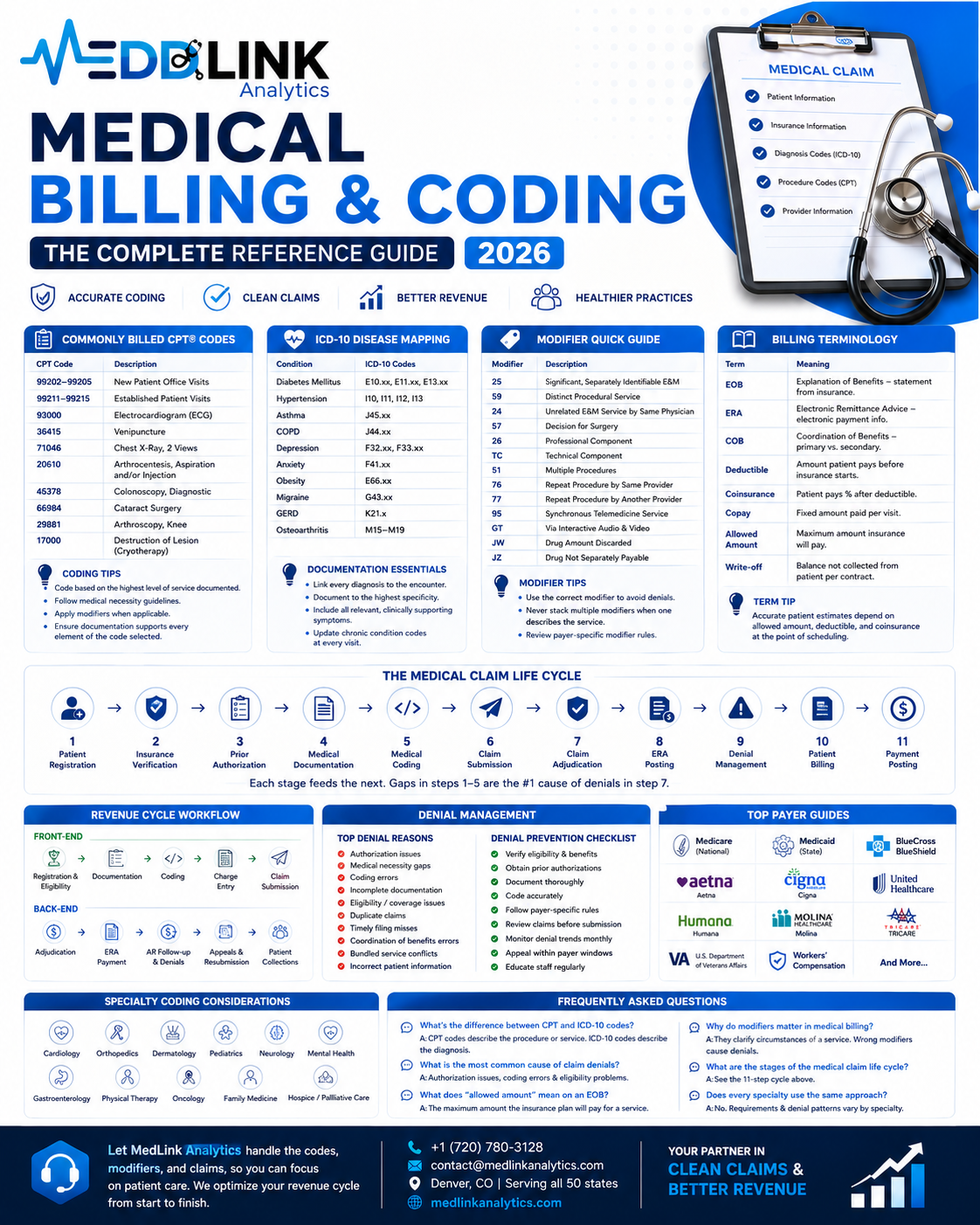
Medical billing and coding is the process of translating clinical care into standardized codes (CPT for procedures, ICD-10 for diagnoses), applying the correct modifiers, and submitting accurate claims through a defined revenue cycle, from patient registration through payment posting. Getting each piece right, codes, modifiers, documentation, and payer-specific rules, is what separates a clean claim from a denied one. This guide consolidates the reference material a billing team actually uses day to day, in one place.
Why We Built a Reference Guide Instead of Another Explainer
This series has covered individual pieces of the revenue cycle in depth: denial management, clean claims rate, A/R aging, ICD-10 updates, healthcare analytics. What’s been missing is the quick-reference layer underneath all of it, the actual codes, modifiers, and terminology a billing team needs open in another tab while working claims. This guide is that reference.
Commonly Billed CPT® Codes
| CPT Code | Description |
|---|---|
| 99202–99205 | New Patient Office Visits |
| 99211–99215 | Established Patient Visits |
| 93000 | Electrocardiogram (ECG) |
| 36415 | Venipuncture |
| 71046 | Chest X-Ray, 2 Views |
| 20610 | Arthrocentesis, Aspiration and/or Injection |
| 45378 | Colonoscopy, Diagnostic |
| 66984 | Cataract Surgery |
| 29881 | Arthroscopy, Knee |
| 17000 | Destruction of Lesion (Cryotherapy) |
Coding tips:
- Code based on the highest level of service actually documented
- Follow medical necessity guidelines for every code billed
- Apply modifiers when applicable, not by default
- Ensure documentation supports every element of the code selected
ICD-10 Disease Mapping: Common Conditions
| Condition | ICD-10 Codes |
|---|---|
| Diabetes Mellitus | E10.xx, E11.xx, E13.xx |
| Hypertension | I10, I11, I12, I13 |
| Asthma | J45.xx |
| COPD | J44.xx |
| Depression | F32.xx, F33.xx |
| Anxiety | F41.xx |
| Obesity | E66.xx |
| Migraine | G43.xx |
| GERD | K21.x |
| Osteoarthritis | M15–M19 |
Documentation essentials:
- Link every diagnosis directly to the patient encounter
- Document to the highest available specificity
- Include all relevant, clinically supporting symptoms
- Update chronic condition codes at every visit, not just at diagnosis
This is also where our recent FY2027 ICD-10 update guide becomes relevant, several of these common categories, including musculoskeletal and chronic disease codes, are affected by the October 1, 2026 changes.
Modifier Quick Guide
| Modifier | Description |
|---|---|
| 25 | Significant, Separately Identifiable E&M |
| 59 | Distinct Procedural Service |
| 24 | Unrelated E&M Service by Same Physician |
| 57 | Decision for Surgery |
| 26 | Professional Component |
| TC | Technical Component |
| 51 | Multiple Procedures |
| 76 | Repeat Procedure by Same Provider |
| 77 | Repeat Procedure by Another Provider |
| 95 | Synchronous Telemedicine Service |
| GT | Via Interactive Audio & Video |
| JW | Drug Amount Discarded |
| JZ | Drug Not Separately Payable |
Modifier tips:
- Use the correct modifier to avoid preventable denials
- Never stack multiple modifiers when one already fully describes the service
- Review payer-specific modifier rules before applying, since acceptance varies by payer
Billing Terminology Cheat Sheet
| Term | Meaning |
|---|---|
| EOB | Explanation of Benefits – statement from insurance detailing what was paid and why |
| ERA | Electronic Remittance Advice – the electronic version of payment information |
| COB | Coordination of Benefits – determines which coverage is primary vs. secondary |
| Deductible | Amount the patient pays before insurance coverage begins |
| Coinsurance | The percentage a patient pays after the deductible is met |
| Copay | A fixed amount paid per visit |
| Allowed Amount | The maximum amount the insurance plan will pay for a given service |
| Write-off | The balance a practice does not collect from the patient, per contractual agreement |
This glossary connects directly to the price transparency and patient collections requirements we covered recently, accurate patient estimates depend on getting allowed amount, deductible, and coinsurance figures right at the point of scheduling.
The Medical Claim Life Cycle
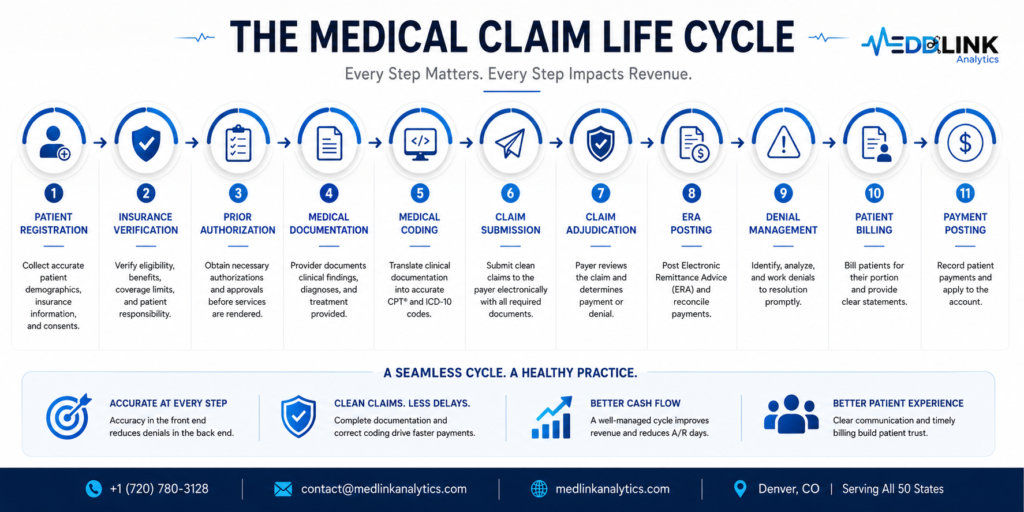
- Patient Registration
- Insurance Verification
- Prior Authorization
- Medical Documentation
- Medical Coding
- Claim Submission
- Claim Adjudication
- ERA Posting
- Denial Management (when applicable)
- Patient Billing
- Payment Posting
Each stage feeds the next. A gap anywhere in steps 1–5 (registration through coding) is what surfaces later as a denial in step 7, which is why prevention-focused billing always concentrates effort at the front of this cycle, not just at the appeals stage.
Revenue Cycle Management Workflow
Front-end: Registration & Eligibility → Medical Documentation → Coding → Charge Entry → Claim Submission
Back-end: Adjudication → ERA Payment → AR Follow-up & Denials → Appeals & Resubmission → Patient Collections
This two-part structure is exactly why we’ve dedicated separate articles to A/R aging and denial management: they sit on the back-end of this cycle, but the quality of everything upstream determines how much back-end work they generate.
Denial Management: Top Reasons & Prevention
Top denial reasons:
- Authorization issues
- Medical necessity gaps
- Coding errors
- Incomplete documentation
- Eligibility/coverage issues
- Duplicate claims
- Timely filing misses
- Coordination of benefits errors
- Bundled service conflicts
- Incorrect patient information
Denial prevention checklist:
- Verify eligibility and benefits before every visit
- Obtain prior authorizations with adequate lead time
- Document thoroughly and code accurately
- Follow payer-specific guidelines rather than generic rules
- Review claims before submission, not after rejection
- Monitor denial trends and analyze patterns monthly
- Appeal promptly, within payer-specific windows
- Educate front-desk and clinical staff regularly, not just billing staff
Top Payer Guides
Billing accuracy depends partly on knowing each payer’s specific quirks. The most commonly billed payers for independent practices include:
- Medicare (National)
- Medicaid (State-administered)
- BlueCross BlueShield
- Aetna
- Cigna
- UnitedHealthcare
- Humana
- Molina Healthcare
- TRICARE
- VA (U.S. Department of Veterans Affairs)
- Workers’ Compensation
Each payer maintains its own edit rules, modifier acceptance policies, and documentation requirements, which is exactly why the healthcare analytics consulting approach we covered previously matters: tracking denial patterns by payer surfaces payer-specific issues that generic billing rules miss.
Specialty Coding Considerations
Coding and denial patterns shift meaningfully by specialty. Practices in the following areas typically need specialty-specific coding expertise rather than generalist billing knowledge alone:
Cardiology, Orthopedics, Dermatology, Pediatrics, Neurology, Mental Health, Gastroenterology, Physical Therapy, Oncology, Family Medicine, and hospice/palliative care (covered in more depth in our healthcare analytics consulting article’s hospice billing example).
Frequently Asked Questions
Q: What’s the difference between CPT and ICD-10 codes? A: CPT codes describe the procedure or service performed. ICD-10 codes describe the diagnosis or condition being treated. A claim needs both, correctly linked, to be processed and paid.
Q: What is the most common cause of claim denials? A: Across most specialties, authorization issues, coding errors, and eligibility/coverage problems account for the largest share of denials, most of which are preventable with front-end verification and accurate documentation.
Q: What does “allowed amount” mean on an EOB? A: The allowed amount is the maximum amount a patient’s insurance plan will pay for a given service. Anything billed above that amount is generally written off per the payer contract, unless the patient owes a portion via deductible or coinsurance.
Q: Why do modifiers matter in medical billing? A: Modifiers clarify circumstances around a billed service, such as whether it was a distinct procedure or performed by a different provider. Using the wrong modifier, or none when one is required, is a common and avoidable cause of denials.
Q: What are the stages of the medical claim life cycle? A: Registration, insurance verification, prior authorization, documentation, coding, claim submission, adjudication, ERA posting, denial management (if needed), patient billing, and payment posting.
Q: Does every specialty use the same billing and coding approach? A: No. While the core process is similar, coding specificity, common denial patterns, and payer requirements vary meaningfully by specialty, which is why specialty-aware billing expertise consistently outperforms generic billing knowledge.
One Reference, Every Stage of the Cycle
This guide is meant to sit alongside the deeper dives we’ve published on denial management, clean claims rate, A/R aging, and analytics, use this as the quick reference, and those as the playbook for actually improving each number.
Let MedLink Analytics Handle the Codes, Modifiers, and Claims
MedLink Analytics provides medical billing, medical coding, credentialing, denial management, AR management, and full revenue cycle management services for independent physician practices across the United States, across the specialties and payers covered in this guide.
📞 +1 (720) 780-3128
✉ contact@medlinkanalytics.com
📍 Denver, CO | Serving all 50 states
🌐 medlinkanalytics.com