
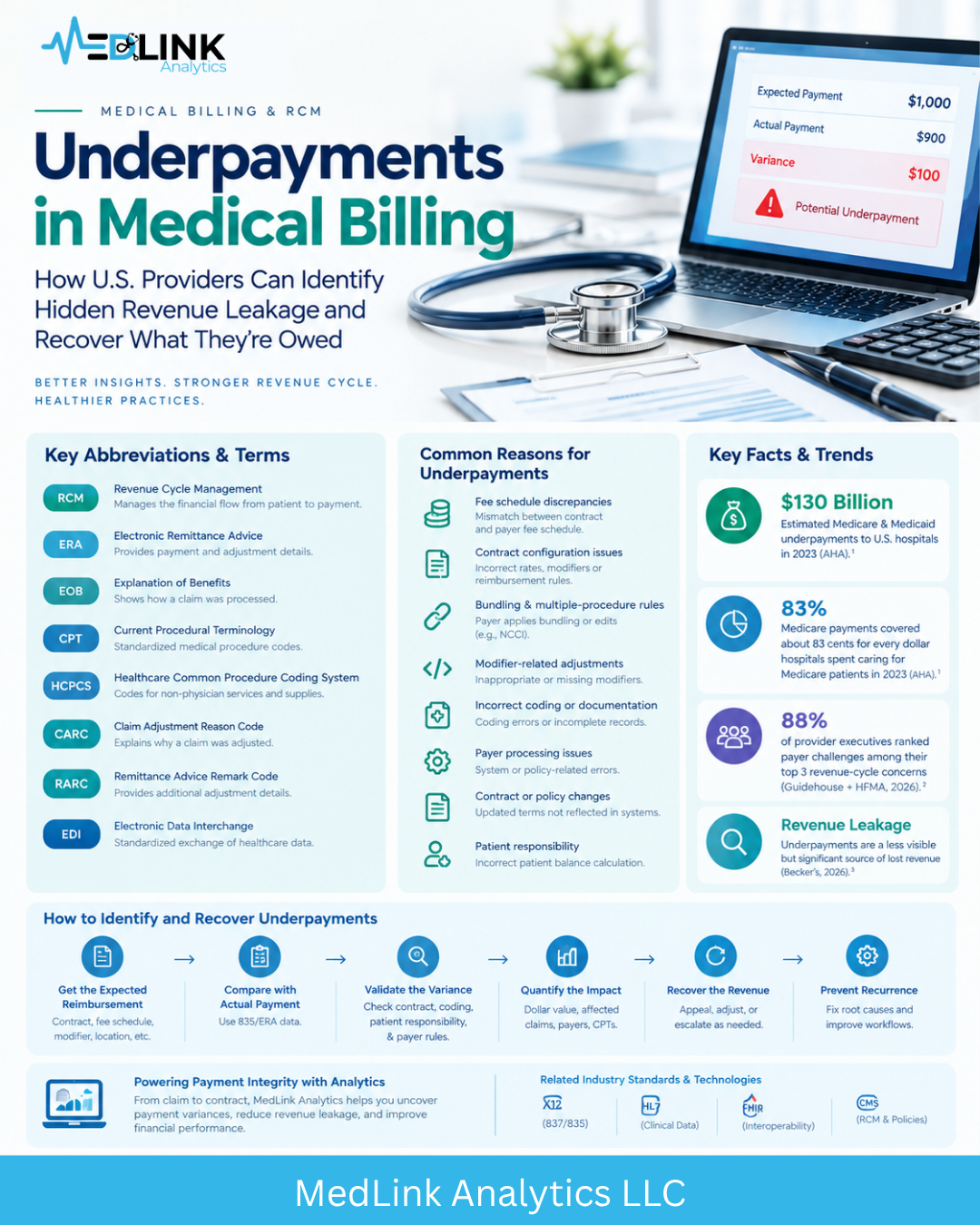
How U.S. Healthcare Providers Can Identify Payment Variances, Reduce Revenue Leakage, and Recover Reimbursement
In medical billing, a claim marked “paid” can appear to be the end of the revenue cycle.
But payment does not necessarily mean correct payment.
A healthcare provider may submit a clean claim, receive an electronic remittance advice (ERA), post the payment, and close the account, while the amount ultimately received is lower than the reimbursement supported by the applicable contract, fee schedule, reimbursement methodology, or other payment terms.
That difference can become a form of revenue leakage.
Unlike a denied claim, an underpaid claim does not necessarily generate an obvious work queue. The payer has issued a payment, the transaction may reconcile in the billing system, and the account can appear financially resolved. Recent U.S. revenue-cycle reporting has highlighted this distinction as an underappreciated source of reimbursement erosion.
For medical groups, hospitals, physician practices, ambulatory organizations, and other healthcare providers, systematic underpayment analysis is therefore becoming an important component of revenue cycle management (RCM), payment integrity, contract performance, and healthcare analytics.
This article explains what medical billing underpayments are, how they differ from denials and other payment adjustments, how providers can detect them, how the 835 Electronic Remittance Advice contributes to the analysis, and how automation and analytics can support payment variance management.
What Is an Underpayment in Medical Billing?
An underpayment in medical billing occurs when a healthcare provider receives less reimbursement than the amount it is contractually or otherwise appropriately entitled to receive for a service, after accounting for applicable payment rules and legitimate adjustments.
In simple terms:
Expected reimbursement ≠ actual reimbursement
However, a variance alone does not prove that a payer made an error.
A payment variance should be investigated against the relevant:
- Payer contract
- Fee schedule
- CPT/HCPCS code
- Modifier
- Revenue code
- Reimbursement methodology
- Claim circumstances
- Patient benefits
- Secondary insurance
- Contractual adjustments
- Applicable payer policies
Only after those factors are evaluated can an organization determine whether a payment represents a true underpayment, a legitimate contractual adjustment, a coding or billing issue, or another explanation.
This distinction is essential for accurate RCM analytics.
Underpayment vs. Denial vs. Rejection
These terms are related but represent different stages or outcomes of the revenue cycle.
| Issue | What happens? | Typical response |
|---|---|---|
| Claim Rejection | Claim fails an initial validation or submission requirement | Correct and resubmit |
| Claim Denial | Payer adjudicates the claim or service and does not allow payment | Research, correct, appeal, or rebill as appropriate |
| Underpayment | Payment is issued but may be below the amount supported by applicable reimbursement terms | Validate variance and pursue recovery when appropriate |
| Patient Responsibility | Amount is appropriately assigned to the patient under the benefit structure | Bill patient according to applicable rules |
| Overpayment | Provider receives more than it was entitled to retain | Review and follow applicable refund/recoupment requirements |
CMS explains that an ERA contains claim and service-line adjudication information, including standardized adjustment information through Claim Adjustment Group Codes, Claim Adjustment Reason Codes (CARCs), and Remittance Advice Remark Codes (RARCs).
Therefore, an RCM team should not interpret every adjustment on an ERA as a payer underpayment.
The correct question is:
Does the actual payment reconcile with the applicable reimbursement terms?
Why Underpayments Can Be Difficult to Detect
Denials are generally visible.
An account enters a denial work queue. A reason code is recorded. Someone is expected to investigate it.
Underpayments can be quieter.
A simplified workflow may look like this:
Patient receives care
↓
Provider submits claim
↓
Payer adjudicates claim
↓
Payer issues payment
↓
ERA is posted
↓
Account reaches zero balance
↓
Payment variance remains unidentified
This is one reason payment-variance analysis matters.
Recent revenue-cycle reporting has specifically highlighted situations in which payment differences can be buried within contractual adjustments and remain unidentified unless organizations compare actual reimbursement against expected reimbursement.
Why Underpayments Matter in the U.S. Healthcare Market
U.S. healthcare organizations are operating under significant financial and administrative pressure.
The American Hospital Association reported that hospitals absorbed approximately $130 billion in Medicare and Medicaid underpayments in 2023, based on its analysis of hospital costs and reimbursement. The AHA also reported that Medicare payments covered about 83 cents for every dollar hospitals spent caring for Medicare patients in 2023. These figures describe reimbursement relative to hospital costs and should not be confused with claim-level contractual underpayments.
That distinction is important.
There are at least two different concepts:
Cost-based underpayment
The amount a payer reimburses is below the provider’s cost of delivering care.
Contractual payment variance
The amount actually paid on a particular claim or service is below the amount supported by the applicable reimbursement agreement.
A sophisticated RCM program should not combine these concepts into one metric.
Instead, it should identify exactly what type of payment variance is being measured.
The Growing Importance of Payer Performance
Payment accuracy does not exist in isolation from payer-provider relationships.
Guidehouse and HFMA’s 2026 Revenue Cycle Management Trends research reported that 88% of surveyed provider executives ranked payer challenges among their top three revenue-cycle concerns. Respondents reported issues including increased denials, prior-authorization delays, unclear denial rationales or underpayments, excessive information requests, and reduced reimbursement rates.
This makes payer performance analysis increasingly important.
Instead of examining individual claims only, healthcare organizations can analyze payment patterns across:
- Payer
- Plan
- Contract
- CPT/HCPCS
- Modifier
- Provider
- Location
- Specialty
- Service line
- Date of service
- Revenue code
- Claim type
The objective is to determine whether payment problems are isolated events or recurring patterns.
Common Causes of Medical Billing Underpayments
There is no single cause of every underpayment.
Potential sources include:
1. Fee Schedule Discrepancies
A payer may reimburse according to a fee schedule that does not appear to match the provider’s applicable contractual terms.
The discrepancy needs to be validated against the actual agreement and effective dates.
2. Contract Configuration Problems
A contract may contain:
- Multiple reimbursement methodologies
- Carve-outs
- Percentage-of-charge provisions
- Case rates
- Per-diem rates
- Fee schedules
- Escalators
- Modifier-specific provisions
- Service-specific exceptions
If these terms are not correctly represented in an organization’s expected-payment logic, payment variance analysis can become unreliable.
3. Modifier-Related Adjustments
Modifiers can affect reimbursement depending on the payer’s methodology and the contract.
A payment difference associated with a modifier should therefore be evaluated against:
- The submitted modifier
- Payer processing
- Contract terms
- Applicable coding guidance
4. Bundling and Multiple-Procedure Rules
A payer may apply legitimate bundling or multiple-procedure payment rules.
These should not automatically be classified as underpayments.
The analysis should determine whether the adjustment was contractually and operationally appropriate.
5. Incorrect Contractual Adjustments
An adjustment may be posted to a contractual category even when the underlying reimbursement does not reconcile with the applicable contract.
This is one reason simply reviewing the final account balance is insufficient for payment-integrity analysis.
6. Contract or Policy Changes
Payer policies and contractual arrangements can change over time.
A fee schedule or reimbursement rule that was correct last year may not be correct for a claim submitted under a newer agreement.
7. Coding and Documentation Issues
Sometimes the payer is not the source of the variance.
Incorrect coding, missing modifiers, incomplete documentation, or other claim-level problems can affect reimbursement.
An effective underpayment program must therefore distinguish payer payment errors from provider-side billing or coding issues.
The Role of the 835 Electronic Remittance Advice
The 835 Health Care Claim Payment/Advice is one of the most important data sources for payment analysis.
X12 defines the 835 as the transaction used to communicate healthcare claim payment and remittance information, including payment and/or explanation of benefits information from a health plan to a healthcare provider.
CMS explains that an ERA provides claim and service-line adjudication information and identifies adjustments through standardized codes such as:
- Group Codes
- CARCs
- RARCs
- Provider-level adjustment codes
This makes the 835 particularly valuable for analytics.
A simplified payment-integrity architecture looks like:
837 Claim
↓
Payer Adjudication
↓
835 ERA
Payer Contract
Fee Schedule
↓
Expected vs. Actual Payment Analysis
↓
Payment Variance
↓
Investigation / Recovery
How to Read an 835 for Underpayment Analysis
An 835 should not be viewed simply as a payment file.
It contains information that can help explain why the amount paid differs from the amount billed or otherwise expected.
CMS identifies several important elements used to explain adjustments.
Group Code
Indicates the financial responsibility category associated with an adjustment.
Examples include:
- CO — Contractual Obligation
- PR — Patient Responsibility
CARC
The Claim Adjustment Reason Code provides a standardized explanation for a payment adjustment.
RARC
The Remittance Advice Remark Code can provide additional information about the adjustment.
Paid Amount
Shows the amount actually paid for the relevant claim or service.
Adjustment Amount
Shows amounts associated with the reported adjustment.
For accurate analysis, these values should be interpreted within the context of the complete claim, payer rules, benefits, and contract.
A Simple Underpayment Example
Consider a hypothetical professional claim.
A provider submits:
Billed charge: $1,200
The applicable contract indicates that the service should be reimbursed at:
Expected allowed amount: $1,000
After adjudication, the payer’s payment and patient responsibility total:
Actual recognized reimbursement: $900
If the remaining $100 cannot be explained by a legitimate contractual adjustment, secondary-payer responsibility, patient responsibility, coding issue, or other applicable rule, the organization may have a $100 payment variance requiring investigation.
The key point is that:
$1,200 billed − $900 paid ≠ automatically $300 underpayment.
The billed amount is not necessarily the expected reimbursement.
That is why proper underpayment analysis starts with the correct expected reimbursement, not simply the original charge.
How to Calculate Payment Variance
A basic payment-variance calculation is:
Payment Variance
Expected Reimbursement − Actual Reimbursement
For example:
Expected reimbursement: $1,000
Actual reimbursement: $900
Potential variance:
$1,000 − $900 = $100
The variance percentage can be calculated as:
Payment Variance %
(Expected Reimbursement − Actual Reimbursement) ÷ Expected Reimbursement × 100
In this example:
($1,000 − $900) ÷ $1,000 × 100 = 10%
Again, the calculation identifies a variance, not automatically a recoverable underpayment.
The next step is validation.
A Better Underpayment Detection Workflow
A mature RCM organization can use a structured process.
Step 1: Establish the Expected Reimbursement
Identify the applicable:
- Contract
- Fee schedule
- Reimbursement methodology
- Effective date
- CPT/HCPCS
- Modifier
- Revenue code
- Provider/location requirements
Step 2: Retrieve Actual Payment Data
Use the:
- 835 ERA
- EOB
- Payment posting data
- Claim record
- Service-line information
Step 3: Reconcile the Payment
Compare:
Expected
vs.
Allowed
vs.
Paid
vs.
Patient responsibility
vs.
Adjustments
Step 4: Validate the Variance
Ask:
- Was the contract loaded correctly?
- Was the correct payer identified?
- Was the correct fee schedule used?
- Was the service coded correctly?
- Were modifiers appropriate?
- Was bundling applicable?
- Was patient responsibility correctly calculated?
- Was there secondary insurance?
- Was the payer’s adjustment legitimate?
Step 5: Quantify the Exposure
Determine:
- Dollar variance
- Number of affected claims
- Number of affected service lines
- Payer concentration
- CPT concentration
- Provider concentration
- Date range
Step 6: Prioritize Recovery
Not every variance has the same financial or operational value.
Prioritize according to factors such as:
- Dollar value
- Recoverability
- Filing or contractual deadlines
- Frequency
- Payer pattern
- Strategic importance
- Cost of recovery
From Individual Claims to Payer-Level Intelligence
The greatest value often comes from identifying patterns.
Suppose an organization analyzes 100,000 paid claims.
It discovers:
| Payer | Claims Reviewed | Potential Variance | Affected CPTs |
|---|---|---|---|
| Payer A | 30,000 | $185,000 | 99213, 99214 |
| Payer B | 25,000 | $42,000 | Multiple |
| Payer C | 20,000 | $7,500 | Limited |
| Payer D | 25,000 | $211,000 | Several |
The important question is not merely:
“Which claims are underpaid?”
It becomes:
“Why is a recurring payment pattern appearing across a particular payer, contract, or service?”
That is where analytics becomes strategically valuable.
Underpayments and Revenue Leakage
Revenue leakage occurs when an organization does not capture revenue it is entitled to receive.
Underpayments can contribute to that leakage when payment variances are not identified and appropriately addressed.
But revenue leakage can also originate from:
- Missed charges
- Coding errors
- Incorrect contractual adjustments
- Unbilled services
- Eligibility problems
- Denials
- Timely filing issues
- Incorrect patient responsibility
- Payer processing issues
- Contract configuration problems
Therefore, an effective revenue-integrity program should examine the entire revenue cycle, not underpayments alone.
Why Zero-Balance Accounts Deserve Attention
A zero-balance account generally means that the billing system has reconciled the account balance.
It does not necessarily prove that the provider received every dollar supported by the applicable reimbursement terms.
This distinction is particularly important in underpayment analysis.
Recent HFMA chapter commentary has highlighted the concept of recovering revenue from apparently resolved or zero-balance accounts when payment has not been reconciled against contractual expectations.
That does not mean every zero-balance account should be reopened.
Instead, organizations can use analytics to determine whether certain categories of closed accounts warrant targeted review.
Underpayments vs. A/R Management
Traditional A/R management often asks:
Which accounts remain unpaid?
Underpayment analytics asks another question:
Which accounts were paid, but potentially not paid correctly?
These are different analytical problems.
A/R Management
Focuses on:
- Open balances
- Aging
- Unpaid claims
- Denials
- Follow-up
- Collections
Underpayment Management
Focuses on:
- Expected reimbursement
- Actual reimbursement
- Payment variance
- Contract performance
- Payer behavior
- Recovery opportunities
The two functions should work together.
The Role of Healthcare Analytics
This is where payment analytics can move beyond manual spreadsheet audits.
A healthcare analytics platform can organize payment information by:
Payer
Which payers generate the highest variance?
Procedure
Which CPT/HCPCS codes are most affected?
Contract
Which agreements appear to underperform?
Provider
Are specific providers or specialties experiencing unusual patterns?
Location
Are certain facilities or practices affected disproportionately?
Time
Did the pattern begin after a contract or policy change?
Dollar exposure
Where is the greatest financial opportunity?
This allows RCM teams to shift from:
Reactive claim-by-claim review
to:
Proactive payment intelligence.
Can AI Help Detect Underpayments?
Yes, but AI should be viewed as an analytical layer rather than a replacement for contract knowledge and human validation.
Potential applications include:
- Detecting unusual payment patterns
- Comparing large volumes of claim/payment records
- Identifying recurring payer variance
- Prioritizing high-value claims
- Finding anomalies in payment behavior
- Classifying adjustment patterns
- Identifying potentially affected CPT codes
- Monitoring changes over time
- Supporting payment-integrity work queues
However, AI-generated alerts still need validation.
A model may identify:
“Actual payment is lower than expected.”
That does not necessarily mean:
“The payer underpaid the claim.”
Contract terms, coding, patient benefits, secondary coverage, and adjudication rules still need to be evaluated.
Human Expertise Still Matters
Technology can identify patterns at scale.
Experienced RCM professionals provide the context necessary to determine:
- Whether a variance is legitimate
- Which contract applies
- Whether the payer followed the contract
- Whether an appeal is appropriate
- What documentation is necessary
- Whether the issue is provider-side or payer-side
- Whether a systemic contract issue exists
The strongest model is therefore:
Automation + Analytics + Contract Intelligence + Human Review
rather than automation alone.
How to Recover a Valid Underpayment
When a payment variance has been validated as a recoverable underpayment, the recovery process may include:
1. Document the variance
Maintain:
- Claim information
- Contract provision
- Expected payment
- Actual payment
- Variance
- ERA/EOB
- Relevant supporting documentation
2. Determine the appropriate payer process
Depending on the payer and agreement, this could involve:
- Reconsideration
- Corrected claim
- Payment dispute
- Appeal
- Contractual escalation
3. Submit supporting information
Provide the documentation necessary to establish the reimbursement obligation.
4. Track the response
Monitor:
- Submission date
- Payer response
- Additional requests
- Reprocessing
- Final payment
5. Identify systemic patterns
If similar variances continue occurring, the issue may require broader payer or contract analysis.
The AMA provides resources specifically addressing proper claims payment and appeals, including resources for physicians dealing with payment issues.
Important: Not Every Variance Should Be Appealed
An effective underpayment program should avoid treating every payment difference as a recoverable amount.
A variance may be legitimate because of:
- Contractual terms
- Patient responsibility
- Secondary insurance
- Correct bundling
- Modifier rules
- Benefit limitations
- Correct coding adjustments
- Provider participation status
- Applicable payer policy
Therefore:
Variance detection → Validation → Classification → Recovery
is a better workflow than:
Variance detection → Automatic appeal
Key KPIs for Underpayment Management
Healthcare organizations can monitor several metrics.
| KPI | Purpose |
|---|---|
| Underpayment Rate | Measures the percentage of reviewed claims/service lines with validated underpayment |
| Potential Variance Dollars | Quantifies identified payment differences before validation |
| Validated Underpayment Dollars | Measures confirmed recoverable variance |
| Recovery Rate | Measures recovered dollars relative to validated opportunities |
| Average Variance per Claim | Identifies the typical financial impact |
| Payer Variance Rate | Compares payment performance across payers |
| CPT Variance Rate | Identifies procedure-specific patterns |
| Contract Variance Rate | Measures performance against individual contracts |
| Recovery Turnaround Time | Measures time from identification to resolution |
| Recurring Variance Rate | Identifies systemic issues that continue after intervention |
Metrics should be clearly defined so that different departments do not calculate the same KPI differently.
What Healthcare Providers Should Do Now
A practical payment-integrity program can begin without replacing an entire billing system.
1. Establish a baseline
Review a representative period of paid claims.
2. Select high-value services
Begin with:
- High-volume CPTs
- High-dollar procedures
- High-value contracts
- Historically problematic payers
3. Validate contracts
Ensure the latest applicable reimbursement terms are available and correctly represented.
4. Analyze 835 data
Use ERA information to understand actual payment and adjustment patterns.
5. Build expected-payment logic
Compare expected reimbursement with actual reimbursement.
6. Create a variance threshold
Establish rules for which differences require manual review.
7. Prioritize by financial impact
Focus resources where the potential value and recoverability justify the effort.
8. Monitor recurring patterns
A recovered claim is useful.
A permanently corrected systemic issue is better.
Underpayment Analytics and the Future of RCM
Revenue cycle management is increasingly becoming a data discipline.
The traditional model:
Bill → Wait → Post → Follow up
is evolving toward:
Bill → Predict → Monitor → Reconcile → Analyze → Recover → Improve
This shift is supported by broader industry movement toward electronic administrative transactions, automation, and analytics.
CAQH has continued to develop operating rules intended to make healthcare administrative transactions more consistent and efficient, including work related to healthcare payments and claims processing.
At the transaction level, the relationship between the 837 claim and 835 payment/remittance provides an important foundation for automated reconciliation. X12 defines the 837 for submitting healthcare claim information and the 835 for communicating payment and remittance information.
The next analytical layer is determining whether the payment actually aligns with the expected reimbursement.
The Strategic Value of Payment Integrity
Underpayment management should not be viewed solely as a collections activity.
It can provide intelligence about:
- Payer performance
- Contract performance
- Coding accuracy
- Billing quality
- Reimbursement trends
- Operational weaknesses
- Revenue leakage
- Negotiation opportunities
For example, if a provider repeatedly identifies the same variance across a large number of claims, the issue may warrant a broader investigation rather than hundreds of individual appeals.
That can turn payment data into a contract-management and revenue-strategy resource.
Frequently Asked Questions
What is an underpayment in medical billing?
An underpayment occurs when actual reimbursement is lower than the amount supported by the applicable contract or reimbursement methodology, after legitimate adjustments and other payment factors are considered.
Is an underpayment the same as a denial?
No. A denial involves a payer not allowing payment for a claim or service. An underpayment involves payment being issued but potentially falling below the applicable expected reimbursement.
How do you identify medical billing underpayments?
Compare actual payment and adjustment information from the ERA/EOB with the applicable contract, fee schedule, reimbursement methodology, coding, patient responsibility, and other relevant payment rules.
What is payment variance?
Payment variance is the difference between an expected reimbursement amount and the actual reimbursement amount.
A variance is an analytical finding; it does not automatically establish that a payer made an error.
What is an 835 in medical billing?
The 835 Health Care Claim Payment/Advice is an X12 transaction used to communicate healthcare claim payment and remittance information.
What are CARCs and RARCs?
CARCs are Claim Adjustment Reason Codes used to explain claim-payment adjustments. RARCs are Remittance Advice Remark Codes that provide additional information. CMS identifies both as standardized components used in electronic remittance information.
Can a zero-balance account still contain an underpayment?
Potentially. A zero balance indicates that the account has been financially reconciled in the billing system; it does not by itself establish that reimbursement matched the applicable contractual expectation.
What causes healthcare underpayments?
Potential causes include contract configuration problems, fee-schedule discrepancies, payer processing issues, modifier or bundling rules, coding problems, incorrect contractual adjustments, and other reimbursement differences.
Can AI detect underpayments?
AI and analytics can help identify anomalies and prioritize payment-variance opportunities, but human and contractual validation remain important before classifying a variance as a recoverable underpayment.
How can medical billing companies help with underpayments?
A specialized RCM organization can support payment posting, ERA analysis, contract-based payment validation, variance identification, payer follow-up, recovery workflows, reporting, and ongoing revenue-cycle analytics.
Final Takeaway
Underpayments in medical billing represent a different problem from traditional claim denials.
A denial says:
“The payer did not pay this claim or service as submitted.”
An underpayment can say:
“The payer paid but the payment may not match what should have been received.”
That distinction matters.
The U.S. healthcare revenue cycle is under increasing financial and administrative pressure, while provider organizations are placing greater emphasis on payer performance, reimbursement accuracy, automation, and revenue-cycle intelligence. Current 2026 industry research and reporting identify payer challenges, including underpayments and reimbursement pressure, as significant concerns for healthcare organizations.
For providers, the objective should not be to label every payment difference as an error.
It should be to build a disciplined process:
Expected Reimbursement
↓
Actual Payment
↓
Payment Variance
↓
Contract & Claim Validation
↓
Confirmed Underpayment
↓
Recovery
↓
Root-Cause Analysis
↓
Process Improvement
When this process is supported by accurate contract data, 835/ERA analysis, RCM expertise, automation, and healthcare analytics, providers can move beyond simply asking whether claims were paid.
They can begin asking the more important financial question:
Were we paid correctly?
That is the foundation of modern payment integrity and revenue-cycle intelligence.
References & Research Sources
The following sources were selected for their authority, relevance, and usefulness to U.S. healthcare providers and revenue-cycle professionals.
Government & Standards Organizations
Centers for Medicare & Medicaid Services (CMS) – Health Care Payment and Remittance Advice
CMS – Health Care Payment and Remittance Advice
CMS explains ERA structure, claim adjustments, CARCs, RARCs, group codes, and provider-level adjustments.
X12 – Healthcare Transaction Sets
X12 – Healthcare Transaction Sets
Authoritative source for the 835 Health Care Claim Payment/Advice and 837 Health Care Claim transactions.
X12 – Health Care Transaction Flow
X12 – Health Care Transaction Flow
Provides the broader transaction flow connecting healthcare claims and payment transactions.
Major U.S. Healthcare Organizations
American Hospital Association (AHA) – The Cost of Caring
American Hospital Association – The Cost of Caring
Provides national hospital financial data, including AHA’s analysis of Medicare/Medicaid reimbursement relative to hospital costs.
Healthcare Financial Management Association (HFMA) – Claims Denial and Revenue Cycle Resources
HFMA
HFMA provides industry guidance and research on healthcare financial management, revenue cycle operations, denials, payment, and benchmarking.
American Medical Association (AMA) – Tools for Proper Payment & Appeals
AMA – Tools for Proper Payment & Appeals
Provides physician-focused resources for claims payment issues, appeals, and payment recovery.
CAQH – Healthcare Payment and Claims Processing Operating Rules
CAQH
CAQH CORE develops operating rules intended to support more consistent electronic healthcare administrative transactions and payment processes.
Current 2026 Industry Research & Analysis
Guidehouse + HFMA – 2026 Revenue Cycle Management Trends
Guidehouse – 2026 Revenue Cycle Management Trends
Current research on payer challenges, denials, reimbursement, automation, AI, and revenue-cycle priorities.
Becker’s Hospital Review — Underdiscussed Revenue Cycle Challenges
Becker’s Hospital Review – 3 Underdiscussed Revenue Cycle Challenges
2026 reporting on underpayment erosion and contract underperformance.
Becker’s Hospital Review – Where Hospitals Lose Revenue Without Realizing It
Becker’s Hospital Review – Where Hospitals Lose Revenue Without Realizing It
2026 discussion of hidden revenue leakage and payment variance.