Electronic Data Interchange (EDI) in Healthcare: Standards, Architecture, Transactions, Benefits, Challenges, and How It Works
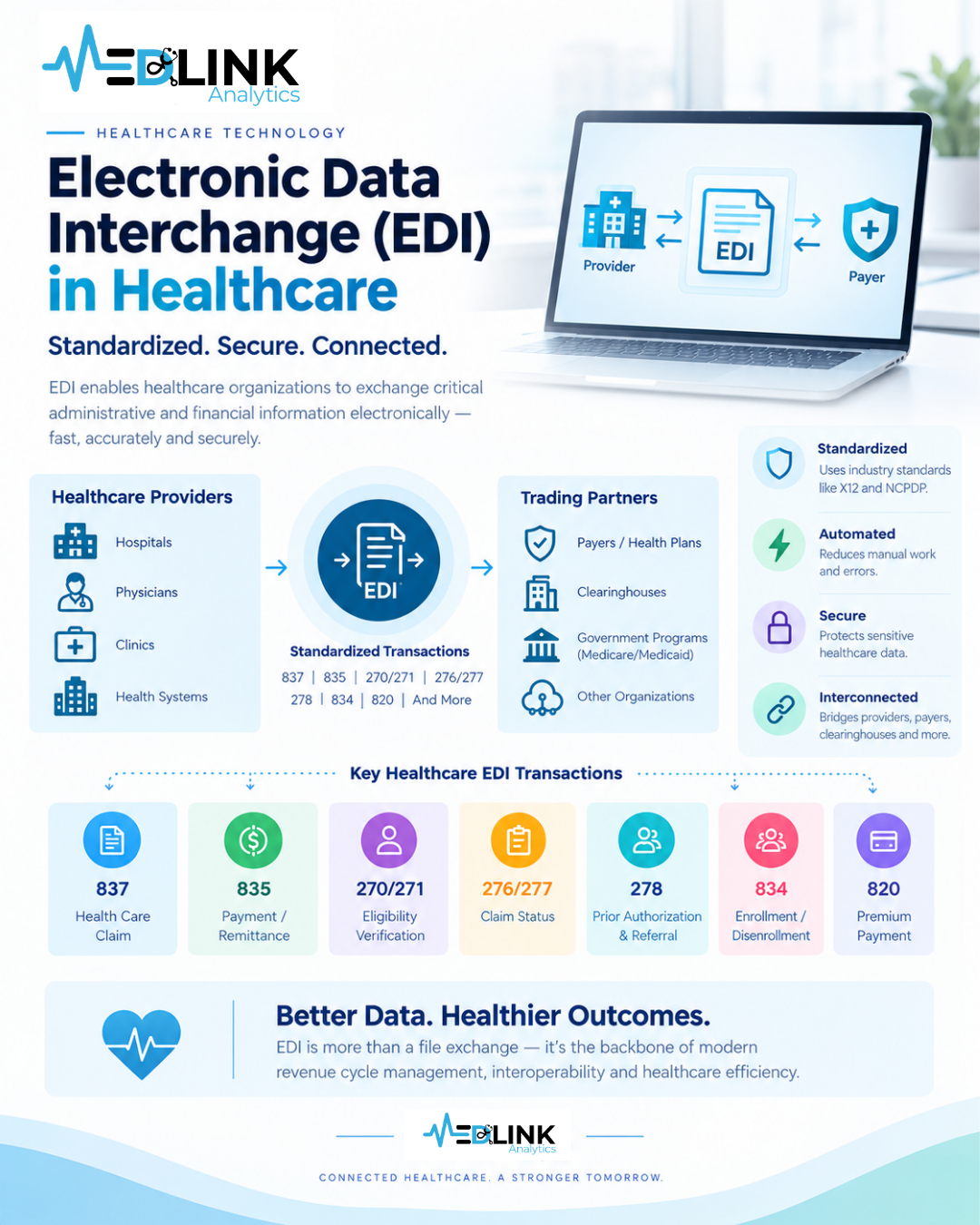
Electronic Data Interchange (EDI) in healthcare is the standardized, computer-to-computer exchange of healthcare administrative and financial information between providers, health plans, clearinghouses, government programs, and other healthcare organizations. Instead of relying on paper forms, fax, email, or manual data entry, EDI enables healthcare systems to exchange structured transaction data through standardized formats and secure electronic connections.
Today, healthcare EDI plays a foundational role in processes such as medical claims submission, eligibility verification, claim status inquiries, electronic remittance advice (ERA), enrollment, referrals, prior authorization, and payment-related workflows.
In the United States, healthcare EDI is closely associated with the HIPAA Administrative Simplification framework. HHS adopted national standards for specified electronic healthcare transactions, with ASC X12 Version 5010 serving as the adopted standard for many healthcare transactions, while retail pharmacy transactions use NCPDP standards.
For healthcare organizations, EDI is more than a method of moving files. It is an important component of the revenue cycle management (RCM), claims processing, payer connectivity, healthcare interoperability, and administrative automation ecosystem.
What Is EDI in Healthcare?
Electronic Data Interchange (EDI) is the automated exchange of standardized electronic business documents between computer systems.
In healthcare, EDI primarily facilitates the exchange of administrative and financial healthcare information between organizations.
A simplified example is:
Provider → Clearinghouse → Payer
A healthcare provider creates a claim in its practice management or electronic health record system. The claim is converted into the appropriate EDI format, commonly an X12 837 transaction, and transmitted electronically to the payer, either directly or through a clearinghouse.
The payer processes the claim and can return information such as:
Payer → Clearinghouse → Provider
This may include an 835 Electronic Remittance Advice, which communicates payment and adjustment information.
The result is an automated information flow that can connect:
- Electronic health record systems
- Practice management systems
- Medical billing platforms
- Clearinghouses
- Health insurance companies
- Government health programs
- Revenue cycle management platforms
- Payment systems
- Eligibility verification systems
The fundamental principle is simple:
EDI allows computer systems to exchange structured healthcare transactions without requiring humans to manually re-enter the information.
CData describes EDI as a computer-to-computer exchange of standardized electronic business documents, with healthcare among its major use cases.
A Brief History of EDI
EDI did not originate specifically in healthcare.
The broader concept of electronic data exchange emerged in the 1960s, as organizations began looking for ways to electronically exchange structured business information rather than depend on paper-based communication.
Over time, industries developed standardized approaches for exchanging purchase orders, invoices, shipping information, payment information, and other business documents.
The development of standards was important because two organizations could not achieve true automation if each system represented the same information differently.
For example:
- One organization might represent a date as
09/17/2026 - Another might use
20260917 - Another might use a completely different structure
Standardization created a common language that computers could interpret.
EDI and Healthcare
Healthcare eventually adopted standardized electronic transactions for administrative and financial processes.
A major turning point came with the Health Insurance Portability and Accountability Act of 1996 (HIPAA).
HIPAA’s Administrative Simplification provisions required HHS to establish national standards for specified electronic healthcare transactions, code sets, identifiers, and related administrative processes.
HHS subsequently adopted standards for transactions involving areas such as:
- Healthcare claims
- Eligibility
- Enrollment
- Payment and remittance
- Claim status
- Referrals and authorization
- Premium payments
The purpose was to create greater consistency and reduce the administrative burden associated with exchanging healthcare information.
5010 and Modern Healthcare EDI
For many HIPAA-covered healthcare transactions, ASC X12 Version 5010 became the adopted standard, with the principal compliance date for many transactions occurring in 2012.
The important distinction is that HIPAA is not itself an EDI file format.
Rather:
HIPAA → establishes regulatory requirements
X12 → defines standardized transaction structures
Implementation Guides → specify how the transaction is implemented
EDI infrastructure → transports, validates, translates, and integrates the transactions
That distinction is essential when discussing healthcare EDI.
Why Is EDI Important in Healthcare?
Healthcare generates enormous amounts of administrative and financial information.
A single patient encounter can result in a chain of transactions involving:
- Patient registration
- Insurance eligibility verification
- Benefit verification
- Authorization
- Clinical service
- Claim creation
- Claim submission
- Claim acknowledgment
- Claim adjudication
- Payment
- Remittance
- Denial or adjustment
- Account reconciliation
Without automation, many of these processes can require repetitive manual work.
EDI creates a standardized electronic pathway between systems.
For example:
Patient encounter
↓
Practice management/EHR
↓
837 claim
↓
Clearinghouse
↓
Payer
↓
Claim processing
↓
835 remittance
↓
Provider/RCM system
↓
Payment posting and reconciliation
This is one reason EDI is closely connected with modern medical billing analytics, denial management, accounts receivable management, and revenue cycle automation.
Major Types of EDI in Healthcare
Healthcare EDI can be classified in several ways.
1. Direct or Point-to-Point EDI
In a direct EDI model, two organizations establish a direct electronic connection.
For example:
Provider system → Payer system
Advantages can include:
- Direct control
- Fewer intermediaries
- Potentially lower transaction costs at high volume
- Customized integration
However, maintaining many direct connections can become difficult when a provider needs to communicate with dozens or hundreds of payers.
2. Clearinghouse-Based EDI
A healthcare clearinghouse acts as an intermediary between providers and payers.
The workflow may look like:
Provider → Clearinghouse → Multiple Payers
The clearinghouse can perform functions such as:
- EDI translation
- Data validation
- Payer routing
- Error checking
- Transaction acknowledgments
- Connectivity management
- Format conversion
For many healthcare organizations, clearinghouses simplify payer connectivity.
3. VAN-Based EDI
A Value-Added Network (VAN) provides network services for exchanging EDI transactions between trading partners.
VANs historically played an important role in EDI connectivity.
They can provide:
- Secure message exchange
- Mailbox services
- Routing
- Monitoring
- Transaction management
The trade-off can be additional costs compared with some direct connectivity models.
4. Cloud-Based EDI
Modern organizations can use cloud-hosted EDI platforms rather than maintaining all EDI infrastructure internally.
Cloud EDI can provide:
- Managed connectivity
- Translation
- Monitoring
- Partner onboarding
- Scalability
- Automated workflows
This model can be particularly useful for organizations that do not want to maintain an extensive in-house EDI environment.
5. Hybrid EDI
Many healthcare organizations use a hybrid architecture.
For example:
Internal systems
Cloud integration platform
Clearinghouses
Direct payer connections
This approach allows organizations to select different connectivity methods based on payer requirements, transaction volume, security requirements, and technical capabilities.
Common Healthcare EDI Transactions
Healthcare EDI is often discussed in terms of transaction sets.
The following transactions are particularly important in U.S. healthcare.
| Transaction | Purpose | Typical Direction |
|---|---|---|
| 270 | Eligibility/benefit inquiry | Provider → Payer |
| 271 | Eligibility/benefit response | Payer → Provider |
| 276 | Claim status inquiry | Provider → Payer |
| 277 | Claim status response | Payer → Provider |
| 837P | Professional healthcare claim | Provider → Payer |
| 837I | Institutional healthcare claim | Facility → Payer |
| 837D | Dental healthcare claim | Dental provider → Payer |
| 835 | Electronic remittance/payment advice | Payer → Provider |
| 834 | Enrollment/disenrollment | Sponsor/plan entities |
| 820 | Premium payment | Employer/sponsor → Plan |
| 278 | Referral/prior authorization-related transaction | Provider ↔ Payer |
| 275 | Additional information to support a claim/encounter | Provider ↔ Payer |
CMS identifies X12 837, 835, 270/271, 276/277, 278, 834 and 820 among the adopted HIPAA transaction standards.
EDI 835: Why It Matters in Healthcare Revenue Cycle Management
One of the most important healthcare EDI transactions is the X12 835 Health Care Claim Payment/Advice transaction.
The 835 is commonly associated with the Electronic Remittance Advice (ERA).
It communicates information about how a payer processed a healthcare claim, including payment and adjustment information.
The X12 organization defines the 835 as the Health Care Claim Payment/Advice transaction set and states that it can be used to make a payment, send an explanation of benefits/remittance advice, or both.
A simplified revenue cycle workflow looks like this:
837 Claim
↓
Payer Adjudication
↓
835 Remittance
↓
Practice Management / RCM System
↓
Payment Posting
↓
Adjustment Posting
↓
Denial Identification
↓
A/R Follow-Up
This makes the 835 particularly valuable for:
- Automated payment posting
- Contractual adjustment analysis
- Patient responsibility identification
- Denial detection
- Underpayment analysis
- Accounts receivable reconciliation
- Revenue cycle analytics
The 835 is therefore not simply a payment file. It can become an important source of structured data for financial and operational healthcare analytics.
How Does the EDI Process Work?
A typical healthcare EDI workflow contains several stages.
Step 1: Data Creation
The process begins in an operational system.
Examples include:
- EHR
- Practice management system
- Hospital information system
- Billing system
- RCM platform
The system contains information such as:
- Patient information
- Provider information
- Insurance information
- Diagnosis codes
- Procedure codes
- Charges
- Dates of service
- Place of service
- Payer information
Step 2: Data Mapping
The internal data must be mapped to the appropriate EDI structure.
For example:
Internal database field
→
X12 data element
Mapping determines where each piece of information belongs within the transaction.
Step 3: EDI Translation
The system or EDI platform converts the structured internal data into the required EDI transaction.
For example:
Billing system data
→
837P
An EDI translator can perform this transformation automatically.
Step 4: Validation
The transaction is checked against applicable structural and implementation requirements.
Validation can identify problems such as:
- Missing required data
- Invalid identifiers
- Incorrect formatting
- Invalid codes
- Incorrect segment structures
- Trading-partner-specific requirements
Step 5: Transmission
The transaction is transmitted to the receiving organization.
Possible connectivity approaches include:
- Direct connections
- Clearinghouses
- VANs
- SFTP
- AS2
- Other secure integration mechanisms
EDI technology separates the transaction standard from the transport mechanism. A transaction such as an 837 defines the business data structure; the transmission protocol determines how that transaction travels between systems. CData similarly describes EDI as involving document preparation, translation, and secure transmission.
Step 6: Payer Processing
The payer receives the transaction and performs its own processing.
For a claim, this can involve:
- Eligibility
- Coverage
- Contract rules
- Coding validation
- Medical policy
- Benefit rules
- Claim edits
- Adjudication
Step 7: Response
The payer may return another EDI transaction.
For example:
837 → claim
277 → claim status
835 → payment/remittance
The response can then be integrated into the provider’s internal system.
Healthcare EDI Architecture
A modern healthcare EDI architecture can be represented as:
Source Systems
EHR
Practice Management
Billing System
RCM Platform
↓
Integration / EDI Layer
API / Integration Engine
EDI Translator
Mapping Engine
Validation Engine
Business Rules
↓
Connectivity Layer
Clearinghouse
Direct Payer Connection
VAN
SFTP / AS2 / Other Secure Transport
↓
Payer
Health Insurance Plan
Medicare/Medicaid Program
Other Payer
↓
Response Transactions
835
277
271
Other applicable responses
↓
Provider / RCM Systems
Payment Posting
Denial Management
A/R Management
Analytics
Reporting
This architecture separates several important functions.
Application Layer
Creates and consumes business data.
Mapping Layer
Maps internal fields to EDI data elements.
Translation Layer
Converts between internal representations and standardized EDI structures.
Validation Layer
Checks transaction structure and business requirements.
Connectivity Layer
Moves the transaction between trading partners.
Monitoring Layer
Tracks transaction status, acknowledgments, errors, and failures.
How to Read an EDI Healthcare File
At first glance, an X12 file can look difficult to understand.
For example, an EDI document may contain segments separated by characters such as ~ and data elements separated by *.
A simplified illustration might look like:
ISA*00*          *00*          *ZZ*SENDER         *ZZ*RECEIVER       *...
GS*HC*SENDER*RECEIVER*20260917*0815*1*X*005010X222A1~
ST*837*0001*005010X222A1~
...
SE*...~
GE*...~
IEA*...~
This is not meant to be interpreted like a conventional human-readable document.
Instead, it should be interpreted according to the applicable X12 standard and implementation guide.
The Basic Structure of an X12 EDI File
A healthcare X12 transaction generally contains several structural levels.
ISA – Interchange Control Header
The ISA identifies the interchange and establishes control information.
GS – Functional Group Header
The GS identifies a group of related transaction sets.
ST – Transaction Set Header
The ST identifies the specific transaction.
For example:
ST*837
indicates an 837 transaction set.
Segments
The transaction contains segments that represent different categories of information.
Data Elements
Segments contain individual data elements.
Loops
Healthcare transactions frequently use hierarchical loops to represent repeating groups of related information.
SE — Transaction Set Trailer
Marks the end of the transaction set.
GE — Functional Group Trailer
Marks the end of the functional group.
IEA — Interchange Control Trailer
Marks the end of the interchange.
X12 describes transaction sets as semantically meaningful units of information and defines control structures and segments that allow systems to process the data consistently.
How to Read an EDI 835
An 835 can be approached by following the transaction structure rather than attempting to read it from left to right as ordinary text.
The analyst should identify:
- Interchange information
- Functional group
- Transaction set
- Payer
- Payee
- Patient
- Claim-level information
- Payment information
- Adjustment information
- Service-level details
- Reference numbers
- Transaction totals
For revenue cycle analysis, some of the most important information relates to:
- Total payment
- Claim control number
- Allowed amount
- Paid amount
- Patient responsibility
- Contractual adjustments
- Denial/adjustment reason codes
- Remark codes
- Service-line payment information
A healthcare organization can then transform these structured fields into a human-readable remittance view or feed them into analytics systems.
EDI Standards in Healthcare
Standards are the foundation of EDI interoperability.
Without standards, two organizations may technically exchange a file but still fail to understand its contents consistently.
ASC X12
ASC X12 is one of the most important standards used for U.S. healthcare administrative transactions.
Examples include:
- 837
- 835
- 270/271
- 276/277
- 278
- 834
- 820
HHS has adopted ASC X12 Version 5010 for many HIPAA transactions.
NCPDP
Retail pharmacy transactions use standards developed by the National Council for Prescription Drug Programs (NCPDP).
CMS identifies NCPDP D.0 for pharmacy and supplier transactions and NCPDP Version 3.0 for Medicaid subrogation.
HIPAA
HIPAA should not be confused with a single EDI syntax.
HIPAA establishes regulatory requirements for specified electronic healthcare transactions and related administrative simplification requirements.
In practical terms:
HIPAA = regulatory framework
X12/NCPDP = transaction standards
Implementation Guide = detailed implementation rules
EDI platform = technology used to exchange and process transactions
EDI Implementation Guides
A healthcare organization cannot successfully implement EDI simply by knowing that it needs an “837” or “835.”
The organization must also know:
- Which version?
- Which implementation guide?
- Which payer?
- Which trading-partner requirements?
- Which code sets?
- Which optional elements are required by the partner?
- What acknowledgments are expected?
- What connectivity method is required?
This is why healthcare EDI implementations often involve extensive payer-specific testing.
Computer-to-Computer EDI
One of the defining characteristics of EDI is computer-to-computer communication.
Traditional workflow:
Person → Email/Fax/Paper → Person → Manual Entry → Computer
EDI workflow:
Computer → EDI → Computer
This distinction is important.
EDI is not simply sending a PDF electronically.
A PDF may still require someone to read the document and manually enter information.
A structured EDI transaction is designed so that the receiving computer can process the data automatically.
CData similarly distinguishes computer-to-computer EDI from traditional paper, fax, and email workflows.
How Healthcare Organizations Use EDI
Healthcare EDI can support multiple operational functions.
Claims Management
Providers submit healthcare claims electronically through standardized transactions.
Eligibility Verification
A provider can electronically request information about a patient’s eligibility and benefits.
Claim Status
Organizations can electronically request and receive claim status information.
Electronic Remittance
Payers can return payment and adjustment information through the 835.
Enrollment
Health plan enrollment and disenrollment information can be exchanged electronically.
Prior Authorization and Referrals
EDI can support standardized transactions associated with referral and authorization workflows.
Payment Reconciliation
835 data can be matched with payments and internal accounts.
Revenue Cycle Analytics
EDI data can be transformed into datasets for analyzing:
- Denial rates
- Payment variance
- Payer performance
- A/R aging
- Adjustment patterns
- Underpayments
- Claim turnaround
- Clean claim performance
Benefits of EDI in Healthcare
1. Automation
EDI reduces repetitive manual data entry.
2. Faster Transaction Processing
Electronic transactions can move between systems significantly faster than paper-based processes.
3. Improved Data Consistency
Standardized formats reduce variation in how information is represented.
4. Fewer Manual Errors
Automation can reduce errors associated with re-keying information.
5. Better Revenue Cycle Visibility
EDI transactions create structured data that can be analyzed throughout the billing and payment lifecycle.
6. Improved Payment Posting
835 transactions can support automated or semi-automated payment and adjustment posting.
7. Better Claim Tracking
Transactions such as 276/277 provide standardized mechanisms for claim status workflows.
8. Scalability
Automated EDI can handle large transaction volumes without requiring proportional increases in manual processing.
9. Auditability
Electronic transactions can provide control numbers, timestamps, acknowledgments, and processing records that support operational tracking.
10. Reduced Administrative Burden
The broader objective of HIPAA Administrative Simplification was to reduce administrative complexity and standardize electronic healthcare transactions.
Challenges and Disadvantages of EDI
EDI is powerful, but it is not effortless.
1. Complex Data Structures
X12 files can be difficult for people unfamiliar with EDI standards.
2. Mapping Complexity
Every internal system may represent information differently.
Mapping that information to an EDI standard can require significant technical work.
3. Payer-Specific Requirements
A standard transaction does not necessarily mean every payer implements it identically.
Trading-partner requirements can create additional implementation and testing work.
4. Integration Costs
Organizations may need:
- EDI software
- Integration engines
- Clearinghouse services
- Monitoring tools
- Technical expertise
- Security infrastructure
5. Error Handling
A transaction can be technically transmitted but still rejected because of invalid or missing data.
6. Version Management
Healthcare standards evolve.
Organizations must monitor applicable versions, implementation guides, and regulatory requirements.
7. Partner Onboarding
Adding a new payer or trading partner can require configuration and testing.
8. Security Requirements
Healthcare transactions can contain sensitive information.
Organizations must implement appropriate administrative, technical, and physical safeguards.
9. Legacy Infrastructure
Many healthcare organizations operate a mixture of modern cloud platforms and older systems, making integration more complicated.
CData identifies document preparation, translation, and secure connectivity as common EDI implementation challenges.
EDI Security in Healthcare
Healthcare EDI can involve sensitive information, including protected health information (PHI).
Security therefore needs to be designed into the architecture.
Important controls can include:
- Encryption in transit
- Encryption at rest where appropriate
- Authentication
- Access controls
- Audit logging
- Secure credential management
- System monitoring
- Backup and recovery
- Business associate management
- Incident response
HIPAA’s Administrative Simplification framework includes privacy and security requirements alongside standardized electronic transactions.
A critical distinction is:
EDI standardization does not automatically make a system secure.
Security depends on the complete technical and operational environment used to create, process, store, and transmit the transactions.
EDI vs API in Healthcare
EDI and APIs are sometimes presented as competing technologies, but they serve different purposes.
| Feature | EDI | API |
|---|---|---|
| Primary purpose | Structured business transactions | Application-to-application interaction |
| Common healthcare use | Claims, remittance, eligibility | Real-time application integration |
| Data format | Often X12 | Often JSON/XML |
| Processing | Batch or transaction-oriented | Often request/response |
| Standardization | Strong transaction standards | API-specific contracts |
| Legacy healthcare adoption | Very extensive | Increasing |
| Real-time capability | Depends on implementation | Commonly well suited |
| Best use | Standardized administrative transactions | Application integration and real-time services |
Healthcare organizations increasingly use both.
A modern architecture might therefore contain:
EHR + API integrations + EDI + clearinghouse + analytics platform
rather than attempting to replace one technology entirely with another.
EDI vs Traditional Manual Processing
Consider a claim workflow.
Manual Workflow
Patient encounter
↓
Billing staff
↓
Manual claim preparation
↓
Paper/fax/email
↓
Payer
↓
Manual response processing
↓
Payment posting
This can introduce multiple opportunities for delay and manual error.
EDI Workflow
Patient encounter
↓
Billing system
↓
Automated claim generation
↓
837
↓
Clearinghouse/Payer
↓
Adjudication
↓
835
↓
Automated payment posting
↓
Analytics
The second architecture is more suitable for high-volume healthcare environments because structured information can move between systems without repeatedly requiring human re-entry.
How to Implement EDI in a Healthcare Organization
A successful implementation should begin with business requirements rather than technology selection alone.
Step 1: Identify Transactions
Determine which transactions are required.
For example:
- 837
- 835
- 270/271
- 276/277
- 278
- 834
Step 2: Identify Trading Partners
List the payers, clearinghouses, providers, employers, or other organizations with which transactions must be exchanged.
Step 3: Determine Standards and Versions
Identify the applicable standard and version for every transaction.
Step 4: Select Connectivity
Determine whether the organization will use:
- Clearinghouse
- Direct connection
- VAN
- SFTP
- AS2
- Cloud EDI provider
- Other approved connectivity
Step 5: Build Data Mapping
Map internal application fields to EDI data elements.
Step 6: Configure Validation
Implement structural and business-rule validation.
Step 7: Test
Testing should include:
- Positive test cases
- Negative test cases
- Invalid data
- Missing data
- Duplicate transactions
- Payer-specific scenarios
- Acknowledgment processing
Step 8: Monitor Production
After implementation, monitor:
- Transaction volume
- Rejections
- Errors
- Acknowledgments
- Processing time
- Failed transmissions
- Payer responses
Step 9: Integrate With Analytics
Once EDI data is available, organizations can build analytics around:
- Claims
- Payments
- Denials
- Adjustments
- A/R
- Payer behavior
- Revenue leakage
This is where EDI becomes particularly valuable for modern healthcare analytics.
EDI Data and Healthcare Analytics
EDI generates structured operational data that can be analyzed at scale.
For example, an organization could combine:
837 claims
835 remittances
276/277 claim status
270/271 eligibility
with internal billing and clinical-administrative data.
The resulting analytics layer can answer questions such as:
- Which payers generate the highest denial volume?
- Which procedures experience the highest adjustment rates?
- Which claims remain unresolved longest?
- Where are payment delays occurring?
- Which denial codes are increasing?
- Which payer contracts produce unexpected payment variance?
- Which claims require repeated intervention?
- How quickly are claims moving from submission to payment?
This turns EDI from a transaction-processing mechanism into an important data source for revenue cycle intelligence.
EDI and Denial Management
The connection between EDI and denial management is especially important.
Suppose an organization receives thousands of 835 transactions.
Instead of reviewing each remittance manually, the organization can extract structured information and classify:
- Adjustment reason codes
- Remark codes
- Claim-level adjustments
- Service-level adjustments
- Patient responsibility
- Contractual adjustments
- Payment amounts
The organization can then calculate:
Denial Rate = Denied Claims ÷ Total Claims × 100
and monitor trends over time.
More advanced analytics can identify:
- Payer-specific denial patterns
- Provider-specific patterns
- Procedure-level patterns
- Location-specific patterns
- Coding-related patterns
- Eligibility-related patterns
This allows organizations to move from simply processing transactions to understanding why revenue is being delayed or lost.
The Future of Healthcare EDI
EDI remains deeply embedded in healthcare administration, even as healthcare organizations adopt APIs, cloud platforms, automation, and artificial intelligence.
The future is likely to be increasingly hybrid.
A modern healthcare integration environment may combine:
EDI
for standardized administrative transactions,
APIs
for application and real-time data exchange,
Cloud integration
for scalable infrastructure,
Automation
for workflow orchestration,
and
AI/analytics
for prediction, anomaly detection, and operational intelligence.
Importantly, newer technologies do not automatically eliminate the need for established transaction standards.
In December 2025, X12 recommended advancing mandated healthcare transactions to newer published versions, including newer versions of the 835, 837, 270/271 and 276/277 transactions. This illustrates that healthcare EDI standards continue to evolve rather than simply disappearing as newer technologies emerge.
Frequently Asked Questions About EDI in Healthcare
What is EDI in healthcare?
EDI in healthcare is the standardized computer-to-computer exchange of administrative and financial healthcare transactions between organizations such as providers, payers, clearinghouses, and government programs.
What is an EDI 835?
An EDI 835 is the X12 Health Care Claim Payment/Advice transaction. It is commonly used to communicate electronic remittance information from a payer to a healthcare provider and can support payment posting and reconciliation.
What is an EDI 837?
An EDI 837 is the standardized X12 healthcare claim transaction used to transmit healthcare claim billing or encounter information from providers to payers, directly or through intermediaries such as clearinghouses.
What is the difference between 837 and 835?
The simplest distinction is:
837 = healthcare claim
835 = payment/remittance advice
The 837 generally moves claim information toward the payer, while the 835 communicates payment and remittance information back toward the provider.
What are 270 and 271 transactions?
270 is an eligibility and benefit inquiry.
271 is the corresponding eligibility and benefit response.
CMS lists 270/271 among the adopted HIPAA healthcare transaction standards.
What are 276 and 277 transactions?
276 is a healthcare claim status inquiry.
277 is used for claim status information and, in relevant implementations, claim acknowledgment/status reporting. X12 describes the 277 as capable of communicating whether submitted claim data has been accepted, rejected, or forwarded.
Is EDI the same as HIPAA?
No.
HIPAA establishes federal requirements for specified electronic healthcare transactions and related administrative simplification requirements. EDI describes the electronic exchange of structured business information, while standards such as X12 define specific transaction structures.
Is EDI the same as an API?
No.
EDI is commonly used for standardized business transactions such as healthcare claims and remittance. APIs provide application interfaces that are often designed for real-time or near-real-time application-to-application interaction.
Healthcare organizations can use both.
Is EDI secure?
EDI can be implemented using secure transmission, authentication, encryption, access controls, monitoring, and other safeguards. However, the EDI format itself should not be treated as a complete security solution.
Why do healthcare organizations use clearinghouses?
Clearinghouses can simplify connectivity between providers and multiple payers by providing transaction translation, validation, routing, and other intermediary services.
Key Takeaways
Electronic Data Interchange remains one of the foundational technologies behind healthcare’s administrative and financial infrastructure.
Its importance can be summarized in five points:
1. EDI standardizes computer-to-computer healthcare transactions.
2. X12 provides many of the core transaction structures used for U.S. healthcare administrative transactions.
3. HIPAA Administrative Simplification established national standards for specified electronic healthcare transactions.
4. Transactions such as 837, 835, 270/271, 276/277, 278, 834, and 820 support different stages of healthcare administration and revenue cycle workflows.
5. EDI data can become a valuable foundation for automation, revenue cycle analytics, denial management, payment reconciliation, and operational intelligence.
The most important concept is that EDI should not be viewed merely as an old file-transfer technology. In healthcare, it functions as a standardized transaction layer connecting providers, payers, clearinghouses, financial processes, and healthcare information systems.
As healthcare organizations adopt APIs, cloud computing, automation, and AI, EDI continues to provide the structured transactional foundation required by many administrative workflows. The emerging healthcare technology environment is therefore less about EDI versus modern technology and more about integrating EDI with modern interoperability, analytics, automation, and intelligent workflow systems.
Sources and Further Reading
- U.S. Department of Health & Human Services – HIPAA for Professionals
- CMS – Adopted Standards and Operating Rules
- X12 – Healthcare Transaction Sets
- X12 – Healthcare Transaction Flow
- CData – What Is EDI and How It Works
Editorial note: Healthcare EDI requirements can vary by transaction, payer, trading partner, jurisdiction, and applicable implementation guide. Organizations should verify current regulatory and trading-partner requirements before implementing or modifying production EDI workflows.