
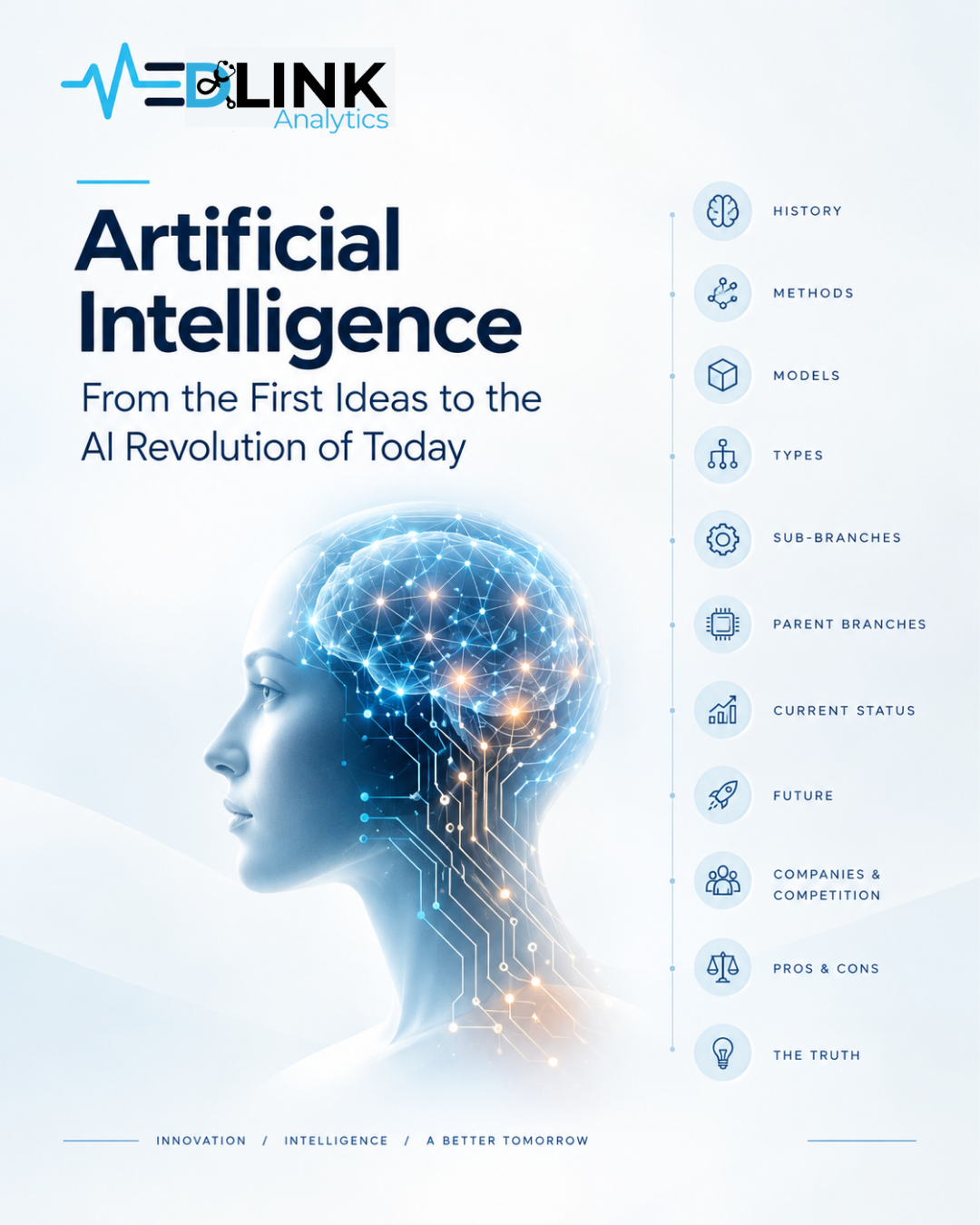
Artificial Intelligence: From the First Ideas to the AI Revolution of 2026
Artificial intelligence did not begin with ChatGPT, generative AI, or modern chatbots.
Its roots reach back through centuries of human attempts to understand reasoning, logic, mathematics, language, and machines.
The story of AI is therefore connected to several older disciplines: philosophy asked whether reasoning could be formalized; mathematics developed symbolic logic; computer science made programmable machines possible; statistics created methods for learning from data; neuroscience inspired artificial neural networks; and engineering transformed these ideas into systems that could act in the real world.
Today, AI has become one of the fastest-adopted technologies in modern history. Stanford’s 2026 AI Index reports that generative AI reached nearly 53% population-level adoption within three years, while organizational AI adoption reached 88% in the surveyed data
But what exactly is artificial intelligence, where did it come from, how does it work, and where is it going?
What Is Artificial Intelligence?
Artificial intelligence, or AI, is the field of creating computer systems capable of performing tasks associated with human intelligence, such as learning, reasoning, recognizing patterns, understanding language, making predictions, and generating content.
AI is not one single technology.
It is an umbrella field containing many methods, models, disciplines, and applications.
A simple hierarchy looks like this:
Computer Science
↓
Artificial Intelligence
↓
Machine Learning
↓
Deep Learning
↓
Generative AI / Foundation Models
However, AI also includes many branches outside machine learning, including symbolic reasoning, robotics, computer vision, planning, optimization, and knowledge representation.
Before Artificial Intelligence: The Parent Branches of AI
To understand AI deeply, it helps to understand that AI emerged from several parent disciplines.
1. Philosophy and Logic
Long before computers existed, philosophers asked questions that are still relevant to AI:
- What is intelligence?
- What is knowledge?
- Can reasoning follow formal rules?
- Can a machine represent knowledge?
- Can decisions be made through logic?
Ancient and modern systems of formal reasoning eventually influenced mathematical logic and computer science.
The fundamental idea was powerful:
If some forms of reasoning can be represented as rules, perhaps a machine can execute those rules.
2. Mathematics
AI depends heavily on mathematics.
Important areas include:
- Logic
- Algebra
- Calculus
- Probability
- Statistics
- Linear algebra
- Optimization
- Information theory
Modern machine learning, for example, depends extensively on matrices, vectors, probability distributions, optimization algorithms, and statistical inference.
Without mathematics, modern AI models would not exist.
3. Statistics and Probability
Not every problem can be solved with fixed rules.
Statistics introduced another important idea:
A system can make useful decisions from uncertain or incomplete information.
This became essential to machine learning.
Instead of programming every rule manually, developers could give systems data and use mathematical methods to identify patterns.
For example:
Traditional programming:
Rules + Data → Answer
Machine learning:
Data + Answers → Model
The trained model can then process new data and produce predictions.
4. Neuroscience and Cognitive Science
Scientists studying the brain helped inspire another major area of AI: artificial neural networks.
Biological neurons and artificial neural networks are not identical, but the idea that networks of connected units could process information influenced the development of neural-network research.
This eventually contributed to deep learning and many modern AI systems.
5. Computer Science
Computer science provided the machinery and theoretical foundation required to make AI practical.
It contributed:
- Algorithms
- Data structures
- Programming languages
- Computation theory
- Software engineering
- Databases
- Computer architecture
AI needed computers capable of storing information and executing increasingly complex calculations.
The History of Computers and the Birth of Programming
Artificial intelligence could not become a practical technology until computing itself developed.
Early calculating machines demonstrated that mechanical systems could perform mathematical operations.
The development of programmable computing introduced a more important concept:
A machine could follow a sequence of instructions and perform different tasks depending on the program it received.
This created the foundation for modern software.
Programming languages later made it easier for humans to describe instructions at increasingly higher levels of abstraction.
The history of programming moved broadly from:
Machine instructions → Assembly languages → High-level languages → Modern software ecosystems
As computing power increased, developers could create more complex algorithms.
This created the environment from which artificial intelligence emerged.
When Did Artificial Intelligence Officially Begin?
The modern field of AI is commonly associated with the Dartmouth Summer Research Project on Artificial Intelligence in 1956, where the term artificial intelligence became central to a new research field.
The early vision was ambitious.
Researchers believed that machines might eventually be able to:
- Reason
- Learn
- Use language
- Solve problems
- Represent knowledge
Progress, however, was not linear.
AI experienced periods of major optimism, disappointment, reduced funding, and renewed growth.
A Brief Timeline of AI
The 1940s and 1950s: The Foundations
Modern computing developed, and researchers began asking whether machines could simulate intelligent behavior.
Important foundations included:
- Electronic computing
- Mathematical logic
- Information theory
- Early theories of computation
Alan Turing’s work became particularly influential in discussions about computation and machine intelligence.
The 1950s and 1960s: The Birth of AI
AI emerged as a formal research field.
Early systems focused heavily on:
- Logic
- Search
- Problem solving
- Symbolic reasoning
- Game playing
Researchers often believed that human-level intelligence might be achieved much sooner than later proved possible.
The 1970s: Growing Difficulty
Researchers discovered that real-world intelligence was much more difficult than solving small, controlled problems.
AI systems struggled with:
- Common-sense knowledge
- Ambiguity
- Context
- Large search spaces
- Real-world uncertainty
Progress slowed in some areas.
The 1980s: Expert Systems
AI experienced renewed commercial interest through expert systems.
These systems attempted to capture human expertise through large collections of rules.
For example:
IF a condition occurs
AND another condition is present
THEN recommend a particular conclusion.
Expert systems proved useful in specific domains but were difficult to maintain at scale.
They also struggled when rules became too numerous or when environments changed.
The 1990s and 2000s: Machine Learning
AI increasingly shifted toward learning from data.
Instead of manually programming every decision rule, researchers developed algorithms capable of finding patterns.
This era accelerated the use of:
- Statistical learning
- Decision trees
- Support vector machines
- Bayesian methods
- Neural networks
- Reinforcement learning
More digital data and improved computing infrastructure made these approaches increasingly practical.
The 2010s: The Deep Learning Revolution
Deep learning achieved major advances in areas including:
- Image recognition
- Speech recognition
- Translation
- Natural language processing
Artificial neural networks with many layers became more effective when supported by large datasets and powerful computing hardware.
This was one of the most important transitions in modern AI.
The 2020s: Generative AI and Foundation Models
The AI industry entered a new phase.
Large-scale models demonstrated the ability to work across:
- Text
- Images
- Audio
- Video
- Code
- Documents
- Multimodal information
Modern AI increasingly moved from prediction toward generation and interaction.
A user could describe a task in natural language rather than writing a complex program for every operation.
How Does Artificial Intelligence Work?
There is no single answer because different AI systems use different methodologies.
However, a simplified AI development process often looks like this:
1. Define the Problem
First, determine what the system should do.
Examples:
- Detect fraud
- Classify medical images
- Predict demand
- Translate language
- Generate text
- Recommend products
- Identify anomalies
A poorly defined problem can produce a poorly designed AI system, regardless of model quality.
2. Collect and Prepare Data
Many machine-learning systems learn patterns from data.
Data may include:
- Text
- Images
- Audio
- Video
- Transactions
- Sensor data
- Medical records
- Documents
Data quality matters enormously.
Poor, incomplete, biased, or irrelevant data can create poor outputs.
3. Select a Method or Model
Developers select an approach based on the problem.
Possible choices include:
- Rules
- Decision trees
- Regression
- Neural networks
- Transformers
- Reinforcement learning
- Hybrid systems
There is no universally best model.
The right approach depends on the task, data, cost, speed, reliability, and risk.
4. Train the Model
Training generally involves adjusting model parameters so that the system improves at a task.
A simplified process is:
Input → Model → Output → Compare → Calculate Error → Adjust
This process may be repeated millions or billions of times.
5. Evaluate the Model
A model should not be judged only by whether it works on its training data.
Developers test performance on new data.
Evaluation may include:
- Accuracy
- Precision
- Recall
- Reliability
- Robustness
- Safety
- Bias
- Security
For high-impact systems, evaluation must go beyond a single benchmark.
6. Deploy and Monitor
AI is not finished when the model is trained.
Real-world deployment introduces new problems:
- Data changes
- User behavior changes
- Security threats
- Unexpected inputs
- Model drift
- Misuse
Responsible AI requires continuous monitoring.
NIST’s AI Risk Management Framework describes AI risk management across the AI lifecycle and highlights characteristics including validity, reliability, safety, security, accountability, transparency, explainability, privacy, and management of harmful bias.
The Major Types of Artificial Intelligence
AI can be classified in several ways.
By Capability
Narrow AI
Narrow AI is designed for particular tasks.
Examples include:
- Spam filters
- Recommendation systems
- Voice recognition
- Medical-image analysis
- Language models
- Navigation systems
Most AI used today falls into this broad category.
Artificial General Intelligence
Artificial General Intelligence, or AGI, generally refers to a hypothetical or future category of systems capable of performing a broad range of cognitive tasks at a highly general level.
There is no single universally accepted definition or test for AGI, and claims about when it may arrive remain uncertain.
Artificial Superintelligence
This is a theoretical concept involving AI that exceeds human intelligence across a broad range of domains.
It does not describe a verified present-day category of AI.
Major AI Sub-Branches
Artificial intelligence contains many interconnected fields.
Machine Learning
Machine learning enables systems to learn patterns from data.
Major approaches include:
- Supervised learning
- Unsupervised learning
- Semi-supervised learning
- Reinforcement learning
Deep Learning
Deep learning uses multi-layer neural networks.
It has been especially influential in:
- Computer vision
- Speech
- Language
- Generative AI
Natural Language Processing
NLP focuses on enabling machines to process and generate human language.
Applications include:
- Translation
- Summarization
- Search
- Chatbots
- Sentiment analysis
- Question answering
Computer Vision
Computer vision enables systems to analyze visual information.
Applications include:
- Object detection
- Medical imaging
- Quality inspection
- Facial analysis
- Autonomous systems
Robotics
Robotics combines:
- AI
- Engineering
- Sensors
- Control systems
- Mechanical systems
The goal may involve systems capable of perceiving and acting in physical environments.
Reinforcement Learning
In reinforcement learning, an agent learns through interaction with an environment and feedback associated with actions.
This approach has been used in:
- Games
- Robotics
- Optimization
- Control problems
Knowledge Representation and Reasoning
This branch focuses on representing information in ways that allow a system to draw conclusions or make decisions.
It is closely connected to some of AI’s earliest symbolic approaches.
Generative AI
Generative AI creates new outputs.
These may include:
- Text
- Images
- Music
- Video
- Code
- Synthetic data
Multimodal AI
Multimodal systems work with more than one type of information.
For example:
Text + Image + Audio + Video + Documents
Modern frontier AI development increasingly focuses on multimodal capabilities.
AI Models: From Simple Algorithms to Foundation Models
An AI model is a mathematical or computational system trained or designed to perform a task.
Examples include:
- Linear models
- Decision trees
- Random forests
- Support vector machines
- Neural networks
- Convolutional neural networks
- Recurrent neural networks
- Transformer models
- Diffusion models
- Foundation models
What Are Foundation Models?
Foundation models are large models trained broadly enough to support many downstream tasks.
They can often be adapted or prompted for different applications.
A single model may support:
- Writing
- Coding
- Analysis
- Translation
- Question answering
- Image understanding
- Tool use
This is one reason modern AI is changing software development.
Instead of building a separate model from scratch for every task, developers can increasingly build systems around general-purpose models.
The Current Status of AI in 2026
The most important truth about AI in 2026 is that AI is neither magic nor a temporary novelty.
It is a rapidly advancing technology with real capabilities, real limitations, major investment, and unresolved risks.
Stanford’s 2026 AI Index reports that global corporate AI investment more than doubled in 2025, organizational AI adoption reached 88% in its surveyed data, and generative AI was being used in at least one business function at 70% of organizations surveyed. At the same time, AI agent deployment remained relatively early across most business functions.
This distinction matters.
AI adoption is already widespread. Fully autonomous AI systems are not yet a universally reliable replacement for human judgment.
The Trending Truth About AI
There are currently two extreme narratives about artificial intelligence.
The first says:
AI will solve everything.
The second says:
AI will replace everyone or destroy everything.
Neither statement is a useful complete description of reality.
The more practical truth is:
AI is already changing work.
AI can automate some tasks.
AI can improve speed and scale.
AI can also make mistakes.
AI outputs can be false, biased, insecure, or inappropriate for a particular context.
Human verification remains important, especially in high-stakes decisions.
Another important 2026 trend is the transition from chatting with AI toward AI systems that can use tools, operate software, and participate in multi-step workflows. Research on agentic AI notes that expanding action capabilities is advancing, but dependable autonomous delegation, recovery, authorization, and verification remain important unresolved challenges.
The AI Market: Competition Is Global
AI development is not being driven by one company or one country.
The market includes competition across:
- Foundation models
- Chips
- Data centers
- Cloud computing
- Open-weight models
- AI software
- Robotics
- Healthcare AI
- Enterprise AI
- AI agents
Stanford’s 2026 AI Index reports that the United States continued to lead private AI investment, while China and other regions remain significant participants in AI development and investment. The report also notes rapid growth in global corporate investment and increasingly competitive open-weight models.
The competition is therefore technological, commercial, scientific, and infrastructural.
Access to computing power, energy, semiconductors, talent, data, and capital has become strategically important to AI development.
Important AI Developers and Companies
The AI ecosystem includes major companies, research laboratories, cloud providers, semiconductor companies, startups, universities, and open-source communities.
Among the important developers are:
- OpenAI — develops frontier models, reasoning systems, multimodal AI, and AI products.
- Anthropic — focuses on frontier AI research and emphasizes reliable, interpretable, and steerable AI systems.
- Google DeepMind — conducts AI research across frontier models, science, and responsible AI.
- Meta AI — develops AI models and tools, including the Llama ecosystem.
- Mistral AI — develops commercial and open-weight models across generalist and specialized use cases.
- DeepSeek — publishes information about its released models and technical materials.
The market is broader than these organizations. The AI ecosystem also depends heavily on semiconductor, cloud, infrastructure, software, and specialized AI companies.
No single company controls every layer of AI.
Open Models vs. Closed Models
One of the major debates in AI concerns access.
Closed models
These are generally accessed through controlled products or APIs.
Potential advantages include:
- Managed infrastructure
- Centralized updates
- Controlled deployment
- Integrated safety systems
Open-weight models
These make model weights available under their applicable licenses, allowing developers greater flexibility to run, study, adapt, or deploy models themselves.
Potential advantages include:
- Greater developer control
- Customization
- Local deployment possibilities
- Research access
However, greater access can also create additional challenges around security, misuse, maintenance, and responsible deployment.
This competition between proprietary and open ecosystems is shaping the future AI market.
How Should People and Businesses Use AI?
The best way to use AI is not to begin with:
“Where can we use AI?”
Begin with:
“What real problem are we trying to solve?”
A practical framework is:
1. Define the task
Choose a specific problem.
For example:
- Summarizing long documents
- Analyzing customer data
- Improving internal search
- Assisting software development
- Identifying workflow bottlenecks
2. Select the right AI capability
Not every problem needs a large language model.
Some problems may be better solved with:
- Traditional software
- Statistics
- Rules
- Machine learning
- Computer vision
- Generative AI
3. Protect sensitive information
Before entering sensitive information into an AI system, organizations should understand:
- Where data goes
- How it is stored
- Who can access it
- Applicable contractual and legal requirements
- Security controls
4. Keep humans responsible
AI can assist with decisions without automatically becoming the final decision-maker.
The level of human oversight should increase with the potential impact of errors.
5. Measure results
Ask:
- Is it accurate enough?
- Is it faster?
- Does it reduce cost?
- Does it improve quality?
- Does it introduce new risks?
AI should be evaluated by measurable outcomes rather than hype.
The Advantages of Artificial Intelligence
AI can provide significant benefits.
Speed
AI can process large amounts of information quickly.
Scale
A system can assist many users or process large volumes of data.
Pattern Recognition
Machine-learning systems can identify patterns that may be difficult to detect manually.
Automation
AI can reduce repetitive work.
Accessibility
AI tools can assist with:
- Translation
- Transcription
- Writing
- Search
- Information access
Scientific Discovery
AI is increasingly being used in research, including biology, chemistry, medicine, and materials science.
Personalization
AI can help adapt services and information to individual needs, subject to appropriate privacy and fairness safeguards.
The Disadvantages and Risks of AI
AI also introduces important risks.
Incorrect Information
Generative systems can produce plausible but incorrect outputs.
This is one reason verification matters.
Bias
AI systems can reproduce or amplify harmful patterns present in data or system design.
Privacy
Poor AI implementation can expose sensitive information.
Security
AI systems may introduce new attack surfaces and can also be misused.
Overdependence
People may rely on AI even when the system is wrong.
Workforce Disruption
AI can change job tasks and potentially reduce demand for some forms of work while creating demand for new skills.
The outcome may vary significantly by industry and occupation.
Lack of Transparency
Some advanced models can be difficult to interpret.
Concentration of Power
Large-scale AI development requires substantial computing infrastructure and investment, creating concerns about market concentration.
NIST’s AI RMF provides a useful framework for thinking about trustworthy AI throughout design, development, deployment, use, and evaluation.
The Future of AI
The future is uncertain, but several directions are already visible.
More Capable Multimodal Systems
AI will increasingly work across text, images, audio, video, code, and other forms of data.
More AI Agents
Systems will increasingly perform multi-step tasks using tools and software.
The important challenge will be ensuring that greater autonomy is matched by appropriate controls and verification.
Smaller and More Efficient Models
Not every AI application requires the largest available model.
Smaller models may become increasingly important for:
- Edge devices
- Private deployment
- Lower-cost applications
- Specialized use cases
AI and Robotics
AI will increasingly connect digital intelligence with physical systems.
AI in Healthcare
AI has potential applications in:
- Clinical documentation
- Imaging
- Research
- Operations
- Revenue cycle management
- Patient communication
- Analytics
Healthcare use requires particular attention to accuracy, privacy, safety, clinical validation, and human oversight.
Human-AI Collaboration
One of the most likely near-term futures is not simply human versus AI.
It is:
Human expertise + AI capability + responsible oversight.
Final Perspective: AI Is a Continuation of a Much Older Human Story
Artificial intelligence may appear to be a completely new revolution.
In reality, it is the result of a very long chain of human knowledge.
Philosophy asked how humans reason.
Logic formalized parts of reasoning.
Mathematics created the language for computation and learning.
Statistics helped us reason under uncertainty.
Computer science created programmable machines.
Programming gave humans a way to instruct those machines.
Machine learning enabled systems to learn patterns from data.
Deep learning expanded the capability of neural networks.
Generative AI and foundation models made powerful AI accessible through natural interaction.
That journey has brought humanity to the current AI era.
The most important question is no longer whether AI will affect society.
It already is.
The more important questions are:
How should we build it?
How should we use it?
How do we verify it?
How do we manage its risks?
And how do we ensure that technological capability remains connected to human responsibility?
In 2026, AI is best understood not as magic and not as a finished technology.
It is an evolving field, one built on decades of research, now moving rapidly into everyday life, business, science, healthcare, and software.
Its future will depend not only on how intelligent machines become, but also on how responsibly humans choose to design, deploy, govern, and use them.