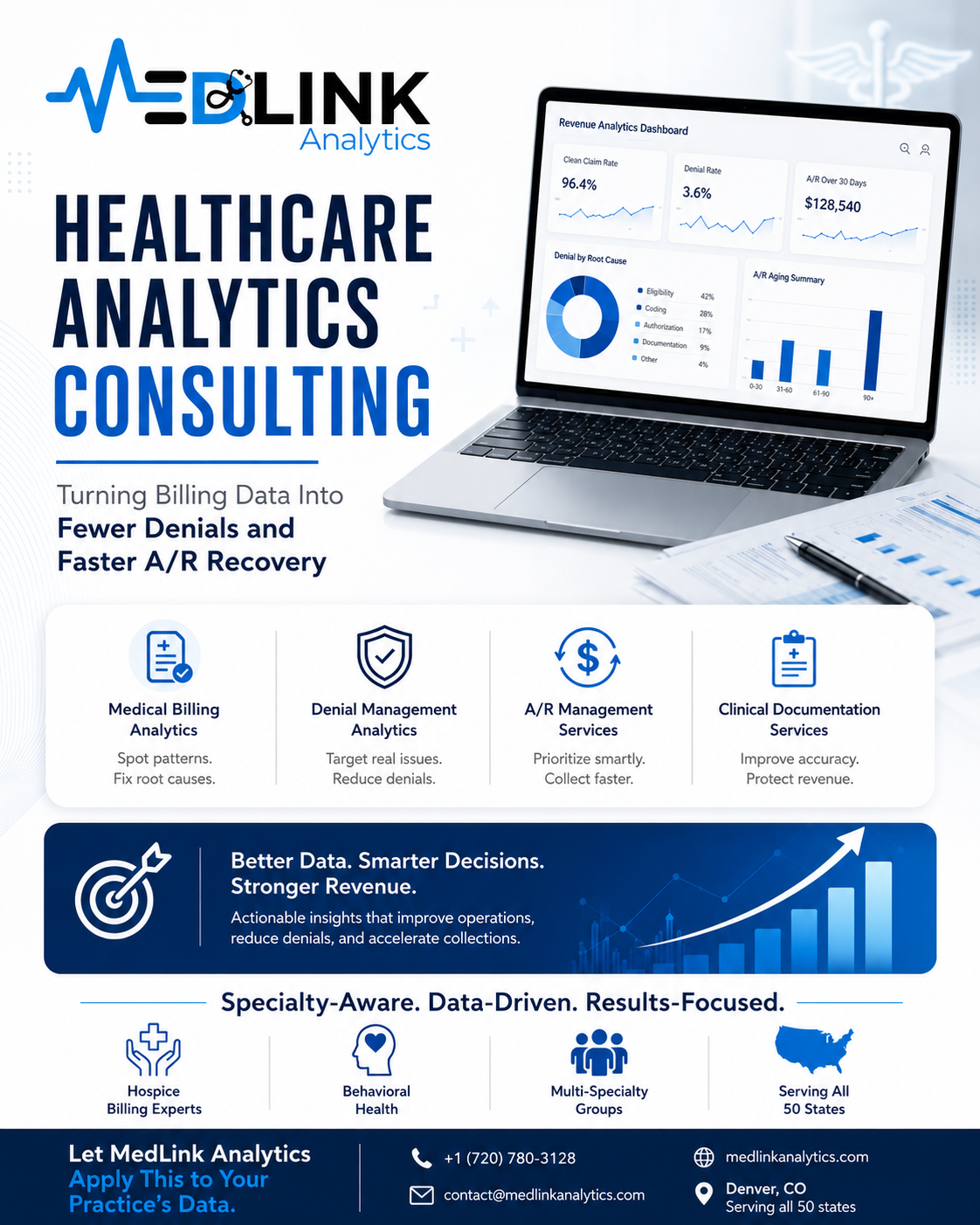
Turning Billing Data Into Fewer Denials and Faster A/R Recovery
Healthcare analytics consulting applies data analysis to a practice’s billing, coding, and documentation patterns to identify exactly where revenue is being lost, whether in denial trends, A/R aging, or documentation gaps, rather than treating each claim issue as an isolated event. When paired with hands-on medical billing analytics, denial management analytics, and structured AR management services, this approach typically improves clean claim rate and shortens A/R recovery time by turning scattered billing data into a specific, prioritized action list.
Why Analytics Is the Layer Most Practices Skip
Every topic in this series so far, denial management, clean claims rate, A/R aging, describes a single metric in isolation. Healthcare analytics consulting is the layer that sits above all of them: it’s what turns “our denial rate is high” into “72% of our denials in Q2 came from eligibility errors on three specific payers, concentrated in two providers’ schedules.” That level of specificity is the difference between a general improvement effort and a targeted fix that actually moves the number.
Most independent practices have the underlying data already, inside their billing software and EHR. What they typically lack is the dedicated analysis to turn that raw data into a clear, prioritized set of fixes.
What Healthcare Analytics Consulting Services Actually Cover
Medical billing analytics Analyzing claims data across payer, provider, and procedure to identify patterns invisible at the individual-claim level, which payers pay slowest, which codes deny most often, which providers have documentation gaps that repeatedly trigger denials.
Denial management analytics Going beyond tracking a denial rate as a single number, to segmenting denials by root cause (eligibility, coding, authorization, documentation) and by payer, so prevention efforts target the actual source instead of the most recent symptom.
AR management services Applying data to prioritize accounts receivable follow-up by recoverability and dollar value, rather than working the aging report in the order claims happen to appear, and tracking which follow-up approaches are actually converting into payment.
Clinical documentation services Reviewing documentation patterns against coding and billing outcomes to catch the gaps that don’t cause an immediate denial but do quietly erode a practice’s clean claim rate and MIPS quality data over time, connecting directly to what we covered in our value-based care and MIPS article.
How This Connects to Clean Claim Rate
A strong clean claims submission service depends on knowing which specific errors are actually causing first-pass failures for your practice, not the industry’s generic list of common causes. Analytics is what makes that specific: rather than applying the standard “check eligibility, check coding, check modifiers” checklist uniformly, a practice can see that, for example, one particular payer accounts for a disproportionate share of its rejected claims, and focus scrubbing rules there first.
This is the same logic behind the clean claim rate benchmarks we covered previously, the 95%+ efficient-billing threshold is easier to reach when you know precisely which 5-15% of claims are failing and why, rather than treating every claim as equally at risk.
A Specialty Example: Hospice Billing
Hospice billing is a useful illustration of why generic billing analytics don’t always transfer across specialties. Hospice claims carry unique requirements, election periods, level-of-care changes, physician certification timing, that create denial patterns entirely different from a typical outpatient practice. Analytics applied without specialty context can miss these patterns entirely, while specialty-aware analysis catches, for example, a recurring certification timing gap before it becomes a pattern across dozens of claims.
This is true across most specialties: the value of healthcare analytics consulting comes from applying it with the specific payer rules, documentation requirements, and billing patterns of your specialty in mind, not a one-size-fits-all dashboard.
Where Analytics and Digital Visibility Overlap
One more connection worth naming directly: the same data discipline that improves billing outcomes also supports smarter medical analytics and SEO decisions for practice growth, understanding which services generate the most revenue per patient, or which referral sources convert best, informs not just billing priorities but marketing and visibility strategy too. Practices that treat billing analytics and growth analytics as separate conversations often miss decisions that would benefit from looking at both together.
Frequently Asked Questions
Q: What is healthcare analytics consulting?
A: It’s the practice of applying data analysis to a healthcare organization’s billing, coding, and documentation patterns to identify specific, prioritized opportunities to reduce denials, speed up collections, and improve reporting accuracy, rather than addressing billing issues one claim at a time.
Q: How does denial management analytics differ from basic denial tracking?
A: Basic tracking reports a denial rate as a single number. Denial management analytics segments denials by root cause and payer, revealing which specific issues are driving the number, so prevention efforts can target the actual source.
Q: Can analytics actually improve clean claim rate?
A: Yes. Identifying which specific errors, payers, or providers account for the largest share of first-pass claim failures allows scrubbing and process fixes to target the highest-impact issues first, rather than applying generic best practices uniformly.
Q: Does hospice billing require different analytics than general medical billing?
A: Yes. Hospice billing involves unique requirements like election periods and physician certification timing that create denial patterns distinct from typical outpatient billing, meaning specialty-aware analysis catches issues generic billing analytics would miss.
Q: What’s included in AR management services?
A: Typically, prioritizing accounts receivable follow-up by dollar value and recoverability, tracking which follow-up methods actually convert to payment, and flagging claims approaching timely filing deadlines before they become unrecoverable.
Q: Is healthcare analytics consulting only useful for large health systems?
A: No. Independent and small-group practices generate the same type of billing and documentation data as larger systems, just at smaller volume. Analytics applied at that scale is often what surfaces recurring, fixable issues that would otherwise go unnoticed simply due to lack of dedicated time to look.
The Data Was Already There. The Analysis Wasn’t.
Most practices aren’t short on billing data, they’re short on the dedicated time and expertise to turn that data into a specific action plan. Healthcare analytics consulting exists to close exactly that gap, connecting denial patterns, A/R behavior, documentation quality, and clean claim performance into one coherent picture instead of four separate reports no one has time to cross-reference.
Let MedLink Analytics Apply This to Your Practice’s Data
MedLink Analytics provides medical billing, denial management, AR management services, clinical documentation review, and full healthcare analytics consulting services for independent physician practices across the United States, including specialty-specific analysis for practices like hospice, behavioral health, and multi-specialty groups.
If you have billing data sitting in your practice management system that no one has had time to analyze in detail, that’s usually the fastest place to find your next meaningful revenue improvement.
📞 +1 (720) 780-3128
✉ contact@medlinkanalytics.com
📍 Denver, CO | Serving all 50 states of United States
🌐 medlinkanalytics.com