What New CMS Rules Mean for Your Practice’s Revenue
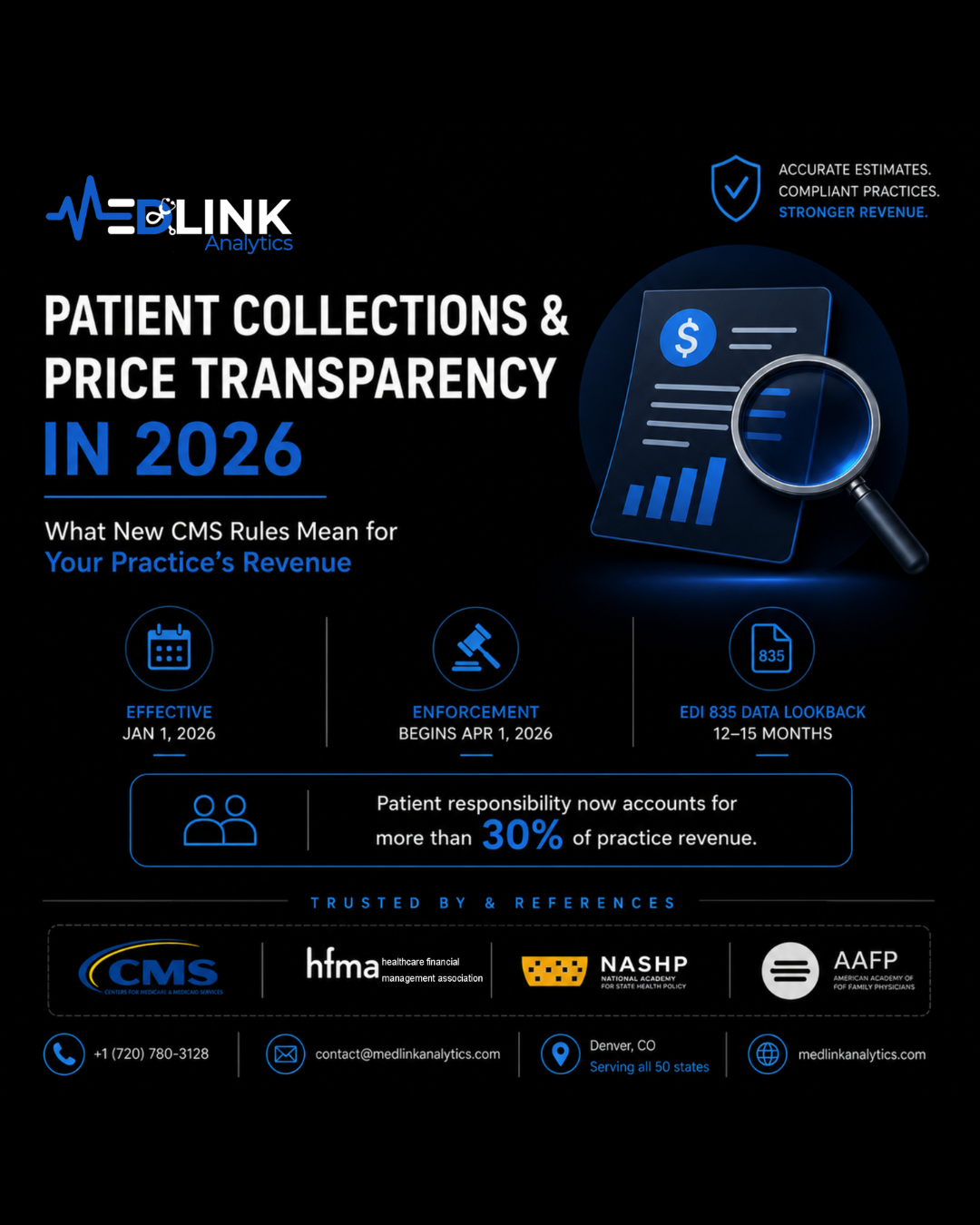
Quick answer: CMS expanded price transparency requirements took effect January 1, 2026, with enforcement beginning April 1, 2026. Practices and hospitals must now post actual payer-specific negotiated rates, not just general estimates, using machine-readable files showing median allowed amounts plus 10th and 90th percentile rates, sourced from EDI 835 remittance data with a 12–15 month lookback. This matters beyond compliance: patient responsibility now accounts for more than 30% of practice revenue, and Congress is actively debating even stricter transparency legislation right now. Practices that haven’t updated their estimate and collections process are exposed on two fronts at once, regulatory risk and preventable revenue loss.
Why This Is Suddenly Urgent, Not Theoretical
This topic has been “coming” for years. It stopped being theoretical this year. CMS’s expanded price transparency requirements are already in effect, enforcement is already active, and Congress just moved two new transparency bills, the Prices on the Wall Act and Health Care Price Certainty for All Americans, through committee votes in the past week. Whatever your position on the policy debate, the practical reality for independent practices is the same: the standard for what patients are legally owed in cost information is getting stricter, not staying still.
At the same time, patient responsibility has quietly become one of the largest single categories of practice revenue, now exceeding 30% by recent benchmarking. That combination, rising compliance obligations plus rising patient-owed revenue, is exactly why this has become one of the defining revenue cycle issues of 2026.
What Actually Changed: The CMS Price Transparency Expansion
- Effective date: January 1, 2026, with active enforcement beginning April 1, 2026
- What’s required: Posting actual payer-specific negotiated rates, not chargemaster list prices or generic estimator tools
- Format: Machine-readable files showing median allowed amounts, plus 10th and 90th percentile rates to support algorithmic pricing tools
- Data source requirement: Figures must be derived from EDI 835 remittance data with a 12–15 month lookback period
- Why chargemaster pricing no longer qualifies: List prices bear little relationship to what any patient actually owes; regulators and patients have both moved past accepting them as meaningful estimates
For independent practices, this means any patient estimate process built on flat fee schedules or outdated chargemaster data is very likely already out of step with what’s required, even if no one has flagged it yet.
The No Surprises Act Layer: Good Faith Estimates Still Apply
Separately from the CMS price transparency expansion, the No Surprises Act continues to require Good Faith Estimates (GFEs) for uninsured and self-pay patients ahead of scheduled services. The two frameworks overlap but aren’t identical, which is exactly where the guidance notes most confusion happens across hospitals, practices, and RCM teams.
What a compliant estimate actually requires:
- Based on the patient’s actual contracted rate, not chargemaster pricing
- Factoring in the patient’s current deductible and out-of-pocket status at the time of the estimate
- Delivered in writing at scheduling, with documentation retained
- Updated when fee schedules or payer contracts change, since allowed amounts directly determine what a patient owes
That last point is where a lot of practices quietly fall out of compliance without noticing: an estimate tool that isn’t refreshed when a payer contract updates will keep quoting the wrong amount, creating both a compliance gap and a patient trust problem at checkout.
Why This Also Threatens Collections, Not Just Compliance
The regulatory angle gets most of the attention, but the revenue impact deserves equal weight:
- Inaccurate estimates create checkout friction. When a patient is quoted one amount and billed a different one, collection resistance goes up immediately, and trust erodes for future visits.
- Patients increasingly delay or avoid care when cost uncertainty is high. This isn’t just a compliance statistic, it’s a direct driver of no-shows and deferred treatment that affects clinical and financial outcomes together.
- High-deductible health plans now dominate the commercial market, meaning more of every visit’s revenue depends on the practice successfully collecting directly from the patient, not just from a payer.
- OBBBA-related Medicaid eligibility changes are adding coverage stability questions on top of an already more complex patient-responsibility landscape.
Put simply: getting the estimate right at scheduling isn’t just a legal requirement anymore, it’s one of the more reliable levers a practice has to actually collect what it’s owed.
A Practical Compliance and Collections Checklist
- Audit your current estimate tool — confirm it uses actual contracted rates and current deductible/accumulator data, not flat fee schedules or list pricing.
- Verify your machine-readable file meets the median/10th/90th percentile format sourced from EDI 835 data, if your practice is subject to that requirement.
- Deliver Good Faith Estimates in writing at scheduling, with documentation retained per No Surprises Act requirements.
- Rebuild your estimate refresh process so fee schedule and payer contract changes automatically update patient-facing estimates, not just internal billing systems.
- Train front-desk and scheduling staff on what’s now required, since this is typically where estimates are generated and where gaps are most likely to surface.
- Monitor pending federal legislation. Requirements have changed multiple times since 2021 and are actively being debated in Congress again right now; a compliance approach that’s “set and forget” is already behind.
Frequently Asked Questions
Q: When did the new CMS price transparency requirements take effect? A: The expanded requirements took effect January 1, 2026, with active enforcement beginning April 1, 2026.
Q: What’s the difference between the No Surprises Act and hospital price transparency rules? A: The No Surprises Act primarily protects patients from surprise balance billing and requires Good Faith Estimates for uninsured or self-pay patients. Price transparency rules separately require hospitals and payers to publicly disclose negotiated rates through machine-readable files. The two overlap but have distinct compliance requirements.
Q: Can a practice still use chargemaster pricing for patient estimates? A: No. Current requirements call for actual payer-specific negotiated rates and the patient’s real deductible and out-of-pocket status, not chargemaster list prices, which don’t reflect what a patient actually owes.
Q: How much of practice revenue now comes directly from patients? A: Recent industry benchmarking shows patient responsibility now accounts for more than 30% of practice revenue, driven largely by the continued dominance of high-deductible health plans.
Q: Is Congress planning to make price transparency rules even stricter? A: Yes, this is an active legislative issue. Bills including the Prices on the Wall Act and Health Care Price Certainty for All Americans have recently moved through committee, and separate proposed legislation would eliminate price estimator tools as a compliant substitute for posting exact dollar amounts.
Q: What happens if a practice’s estimate is inaccurate? A: Beyond compliance risk, inaccurate estimates create collection friction and erode patient trust, both of which directly reduce how much of the patient-owed portion of revenue is ever actually collected.
Compliance and Collections Are the Same Problem Now
For years, price transparency and patient collections were treated as separate conversations, one for the compliance team, one for billing. That split doesn’t hold up anymore. An estimate process built on outdated pricing data is simultaneously a compliance exposure and a revenue leak, and fixing one fixes the other.
References
- American Hospital Association (AHA) — Fact Sheet: Hospital Price Transparency, Current Landscape and a Better Path Forward
- HFMA (healthcare financial management association) — How Price Transparency Improves Patient Trust and Collection Rates
- HFMA — Healthcare Price Transparency Legislation Gains Momentum in Congress
- HFMA — Healthcare Price Transparency Is Heading for a More Consequential Phase
- American Hospital Association — Fact Sheet: Hospital Price Transparency
- University of Pittsburgh School of Law — How Health Care Price Transparency Impacts Compliance
- One O Seven RCM — Best Practices for Patient Collections in Healthcare: Fix Your Revenue Leaks in 2026
- Bristol Healthcare Services — Navigating the No Surprises Act and Price Transparency: An Essential Guide for Compliance
This article reflects publicly available information as of July 2026. Given that price transparency and No Surprises Act requirements have been revised multiple times since 2021 and related legislation is currently active in Congress, practices should confirm current requirements directly at CMS.gov before making compliance decisions.
Let MedLink Analytics Review Your Patient Estimate and Collections Process
MedLink Analytics provides medical billing, patient billing and invoicing, denial management, and full revenue cycle management services for independent physician practices across the United States, including patient estimate accuracy reviews aligned with current CMS and No Surprises Act requirements.
If you’re not confident your current patient estimates reflect actual contracted rates and current deductible data, that’s exactly the kind of gap worth checking before it shows up as either a compliance finding or a collections shortfall.
📞 +1 (720) 780-3128
✉ contact@medlinkanalytics.com
📍 Denver, CO | Serving all 50 states of United States
🌐 medlinkanalytics.com