In-House vs. Outsourced Medical Billing: 2026 Comparative Analysis (Evidence-Based)
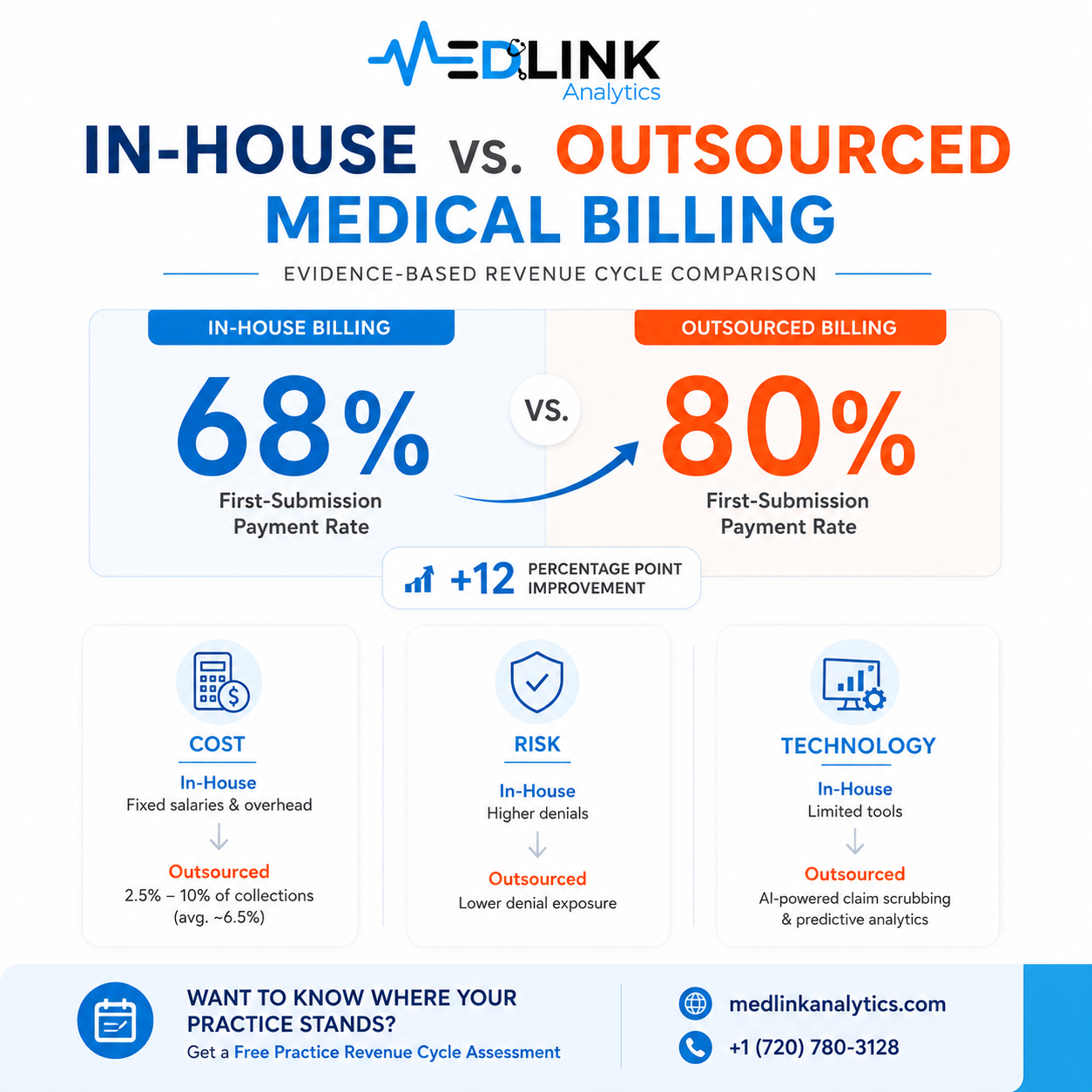
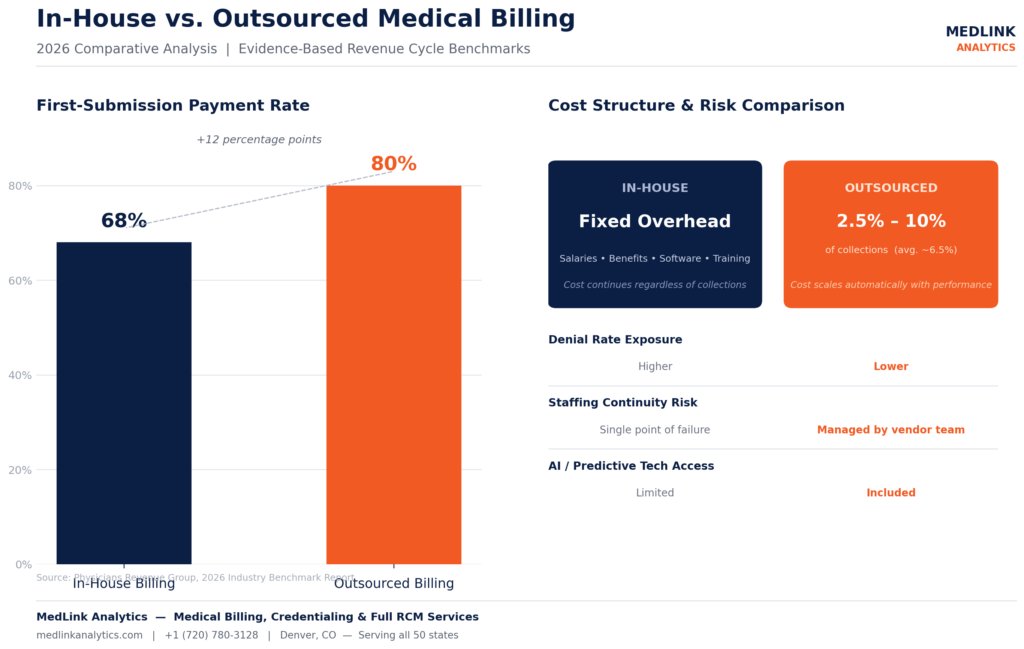
Abstract: In-house medical billing means a practice directly employs its billing staff and owns every step of the process. Outsourced medical billing means a specialized company manages some or all of that process, typically for 2.5–10% of collections (commonly around 6.5%). The clearest evidence-based difference between the two models is first-submission payment performance: outsourced billing operations report first-submission payment rates around 80%, compared to roughly 68% for in-house teams. That 12-point gap compounds every month into materially different cash flow, denial volume, and administrative cost.
What the Evidence Actually Shows
Most comparisons of in-house versus outsourced billing stay theoretical, listing “pros and cons” without numbers attached. Here’s what the current data actually shows across both models:
| Metric | In-House Billing | Outsourced Billing |
|---|---|---|
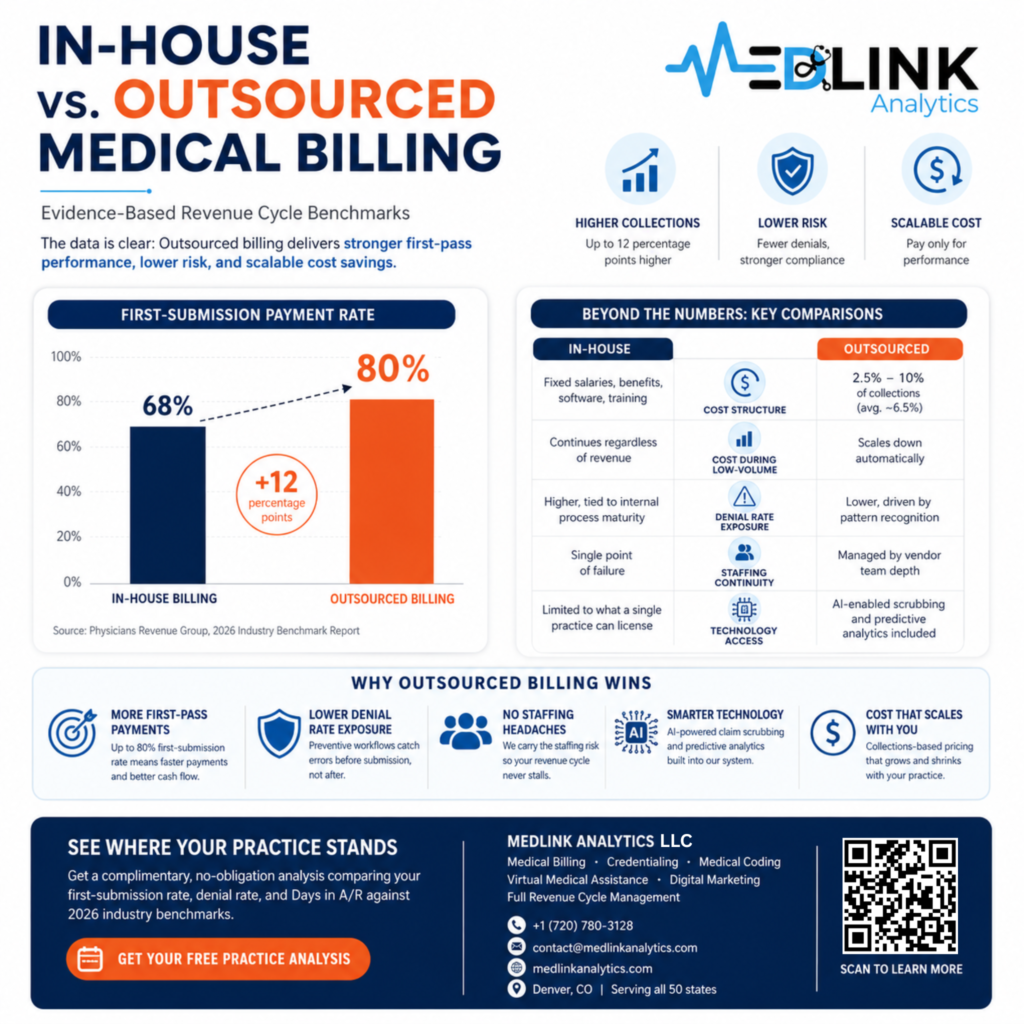
| First-submission payment rate | ~68% | ~80% |
| Cost structure | Fixed salaries, benefits, software, training | 2.5–10% of collections (avg. ~6.5%) |
| Cost during low-volume periods | Continues regardless of revenue | Scales down automatically |
| Denial rate exposure | Higher, tied to internal process maturity | Lower, driven by cross-practice pattern recognition |
| Staffing continuity | Vulnerable to single points of failure | Managed by the vendor’s team depth |
| Technology access | Limited to what a single practice can license | Often includes AI-enabled scrubbing and analytics |
That first-submission payment gap is the number worth sitting with. On a practice submitting 1,000 claims a month, moving from a 68% to an 80% first-pass rate means 120 fewer claims requiring rework, appeal, or write-off, every single month. That’s not a marginal efficiency gain; it’s a structural difference in how much staff time and cash flow delay a practice absorbs by default.
In-House Billing: The Real Cost Picture
In-house billing gives a practice full, direct oversight and same-room communication between billing staff and clinical teams. That control is real, and for some larger, high-volume groups it remains the right model.
But the evidence points to three compounding cost factors that rarely make it into a simple “keep it in-house” decision:
1. High fixed costs regardless of performance. Salaries, benefits, software licensing, and training overhead continue whether collections are strong or slow that month. A practice pays the same billing department cost in a slow quarter as a strong one.
2. Staff vulnerability. Billing operations frequently stall when a single key staff member quits, takes leave, or gets sick, because in-house teams are often thin enough that one person’s absence creates a real coverage gap. There’s no bench depth to absorb it.
3. A structurally lower first-submission rate. Without the cross-practice pattern data a dedicated RCM company accumulates across many clients and payers, in-house teams typically catch fewer preventable errors before submission, which shows up directly in that ~68% first-pass figure.
Outsourced Billing: Why the Numbers Favor It for Most Independent Practices
Outsourcing shifts the cost structure from fixed to variable, tying what a practice pays directly to what it actually collects. But the more consequential shift is operational, not financial:
1. Fewer errors, faster payment. Outsourced billing teams handle claims across many practices and payers simultaneously, which means the errors that cause denials, eligibility mismatches, coding gaps, missing modifiers, get caught and corrected across the whole client base, not relearned practice by practice. That’s the direct driver behind the ~80% first-submission benchmark.
2. Lower denial rate exposure. Outsourced RCM partners typically build denial prevention directly into pre-submission workflows, rather than only reacting to denials after they occur.
3. No hiring, training, or turnover risk absorbed by the practice. The vendor carries the staffing continuity burden. A practice never experiences a billing gap because one employee left.
4. Access to technology a single practice can’t cost-justify. AI-enabled claim scrubbing and predictive denial analytics, the tools we covered in our recent piece on AI in medical billing, are typically bundled into an outsourced RCM service rather than requiring separate practice-level investment.
5. Cost that scales with the practice, not against it. A percentage-of-collections model means cost automatically adjusts during slower periods, rather than a fixed department cost the practice carries regardless of volume.
Frequently Asked Questions
Q: What is the difference between outsourcing and in-house billing? A: In-house billing means a practice employs its own staff and manages the entire billing process internally. Outsourcing means contracting an external company to manage some or all of that process, typically for a percentage of collections rather than fixed salary costs.
Q: Is outsourcing cheaper than in-house billing? A: In most cases, yes, once fixed salary, benefits, software licensing, training, and turnover costs are factored in. Outsourced billing is usually charged as 2.5–10% of collections, commonly around 6.5%, and that cost scales down automatically during slower periods, unlike a fixed in-house department cost.
Q: Which process is best in medical billing, in-house or outsourced? A: There’s no universal answer, but the evidence favors outsourcing for most independent and small-group practices: outsourced billing operations report roughly 80% first-submission payment rates compared to approximately 68% for in-house teams, along with lower denial rate exposure and reduced staffing risk. Larger practices or groups with high, consistent claim volume and strong internal RCM leadership may still find in-house the better fit.
Q: What are the 3 P’s of medical billing? A: The 3 P’s of medical billing are Patient, Provider, and Payer, the three parties whose information and coordination determine whether a claim is billed accurately and paid correctly. Both in-house and outsourced billing models exist to manage the relationship between these three parties efficiently.
Q: How much does outsourced medical billing typically cost? A: Most outsourced medical billing services charge between 2.5% and 10% of collections, with roughly 6.5% being a common industry average, though the exact rate depends on specialty, claim volume, and the scope of services included, such as credentialing or full revenue cycle management.
Q: Does outsourcing medical billing actually reduce denial rates? A: Evidence points to yes. Outsourced RCM partners apply denial-prevention patterns learned across many practices and payers, which tends to catch preventable errors, eligibility issues, coding mismatches, missing modifiers, before submission rather than after a denial occurs.
How MedLink Analytics Applies This Evidence for Your Practice
Understanding the data is one thing. Acting on it is where most practices need a partner rather than a spreadsheet. Here’s specifically how MedLink Analytics is built around the evidence above:
- Pre-submission claim scrubbing designed to push first-submission payment rates toward the 80%+ benchmark, not just react to denials afterward
- Denial management built for prevention, feeding recurring error patterns back into the coding and eligibility verification workflow instead of just resubmitting the same mistake next month
- Transparent, collections-based pricing so your cost scales with your practice’s actual performance, not against it during slower periods
- A full team behind your account, not a single point of failure, so staffing turnover on our end never becomes a coverage gap on yours
- AI-enabled tools already integrated into our workflow, so your practice gets the benefit of predictive denial analytics and intelligent claim scrubbing without needing to build or license any of it yourself
- Monthly performance reporting on clean claims rate, Days in A/R, and denial rate, so you can see the evidence working in your own numbers, not just take our word for it
If your practice is currently seeing a first-submission rate anywhere near that 68% in-house average, that gap alone is usually enough to justify a closer look at what outsourcing would change.
See Where Your Practice Stands Against These Benchmarks
MedLink Analytics provides medical billing, credentialing, medical coding, virtual medical assistance, digital marketing, and full revenue cycle management services for healthcare providers across the United States.
We offer a complimentary, no-obligation practice analysis comparing your current first-submission payment rate, denial rate, and Days in A/R against these 2026 industry benchmarks, so you can make this decision with real numbers instead of guesswork.
✉ contact@medlinkanalytics.com
Serving all 50 states