
What a Healthy A/R Report Should Look Like in 2026
Quick answer: Accounts receivable (A/R) aging in medical billing is the practice of sorting unpaid claims and patient balances into time-based buckets , typically 0–30, 31–60, 61–90, 91–120, and 120+ days. To track how quickly billed services convert into collected revenue. The core benchmark to watch is Days in A/R. MGMA (Medical Group Management Association) generally considers under 40 days healthy, with top-performing practices operating closer to 30–35 days. The real warning sign isn’t the overall average. It’s the percentage of A/R sitting past 90 days, since collection probability drops sharply once a claim crosses that line.
Continuing the Series: From Denials to Aging A/R
Last time, we covered claim denial management, the front-end work that prevents revenue from getting stuck in the first place. But even a well-managed denial process doesn’t guarantee healthy cash flow if the back end, tracking and working what’s already been billed, isn’t just as disciplined.
That’s what an A/R aging report is for. It’s the report that tells a practice, in plain numbers, whether revenue is moving through the system on schedule or quietly stalling somewhere between submission and payment.
What Is an A/R Aging Report? (Direct Answer)
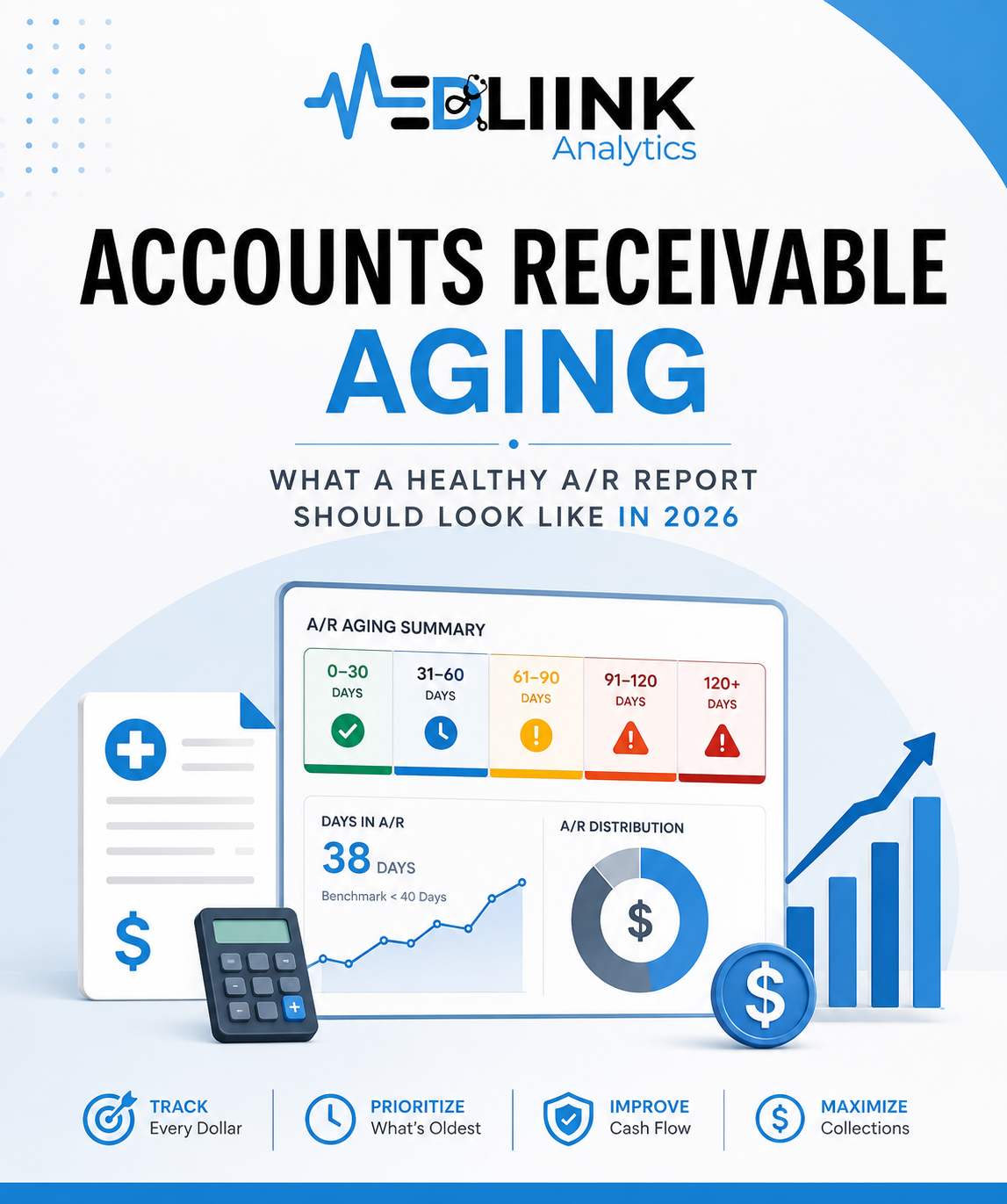
An A/R aging report is a financial report that groups every outstanding insurance claim and patient balance by how long it’s been unpaid. Most practices use five buckets:
- 0–30 days – normal, expected processing window
- 31–60 days – should be actively followed up, delays here often signal a payer issue or a claim stuck without a response
- 61–90 days – high-priority, many claims in this range are denied, pending, or lost in a payer queue
- 91–120 days – urgent, timely filing windows may be closing, and recovery odds are dropping
- 120+ days – largely at risk, many claims here are close to becoming uncollectable
The report exists so a billing team can act on the oldest, highest-risk dollars first, instead of treating every unpaid claim the same way.
The Benchmark Every Practice Should Know: Days in A/R
Days in A/R measures, on average, how many days it takes a practice to convert billed charges into collected revenue.
Formula: Total Accounts Receivable ÷ Average Daily Charges
General industry benchmarks for 2026:
- Under 40 days – considered healthy by MGMA
- 30–35 days – typical for high-performing physician groups
- 45–60 days – common in practices with recurring denial or follow-up gaps
- Over 60 days – usually signals a structural problem: aged self-pay balances, a denial rework backlog, or front-end eligibility gaps generating repeat rejections
A single Days-in-A/R number can still be misleading on its own. A practice can show a healthy 38-day average while a large share of that balance is quietly sitting past 90 days in a handful of stubborn payer buckets. That’s why aging distribution , the percentage of total A/R in each bucket – matters just as much as the headline number.
Why A/R Ages Past the Point of Recovery
A/R doesn’t get old by accident. The most common causes include:
- No structured follow-up cadence – claims that no one proactively checks on simply sit until someone happens to notice them
- Denials that are identified but never reworked. – A denial that isn’t corrected and resubmitted quickly ages right alongside claims that were never touched at all
- Delayed claim submission – batching claims weekly instead of daily can add avoidable days to the entire collection cycle before a payer even receives them
- Untracked patient balances – as patient responsibility grows under high-deductible plans, self-pay balances that aren’t billed and followed up quickly age faster than insurance claims
- Missed timely filing windows — once a payer’s filing deadline passes, the claim is often unrecoverable regardless of how valid it was
The common thread: aging A/R is rarely one big failure. It’s usually a lot of small, preventable delays compounding across hundreds of claims.
A Practical A/R Follow-Up Workflow
- Review the aging report weekly, not monthly, starting with the oldest and highest-dollar-value claims first.
- Set a hard follow-up trigger – for example, any insurance claim untouched after 30 days gets a status check that day, not “whenever there’s time.”
- Separate insurance A/R from patient A/R and track each with its own follow-up rhythm, since they recover on very different timelines.
- Flag claims approaching timely filing deadlines before they become unrecoverable, not after.
- Track A/R by payer, so chronic delays from a specific payer get escalated or addressed in contract discussions rather than absorbed quietly every month.
- Calculate net collection ratio alongside Days in A/R. – A practice can have reasonable A/R days, and still be failing to collect a meaningful share of what it’s actually owed after adjustments.
Frequently Asked Questions
Q: What is a good Days in A/R for a medical practice? A: Most benchmarks consider under 40 days healthy, with high-performing physician groups often operating between 30 and 35 days. Multi-specialty clinics and hospitals typically run somewhat higher due to more complex payer mixes.
Q: What are A/R aging buckets? A: They’re time-based categories, commonly 0–30, 31–60, 61–90, 91–120, and 120+ days, that group unpaid claims and balances by how long they’ve been outstanding. They help billing teams prioritize which claims need immediate attention.
Q: At what point does a claim become unlikely to collect? A: Collection probability drops sharply once a claim passes 90 days outstanding, and claims aged beyond 120 days are frequently close to unrecoverable due to timely filing limits and payer contract provisions.
Q: How often should a practice review its A/R aging report? A: Weekly is standard for active follow-up. Monthly reviews alone tend to let claims drift into the 90+ day range before anyone catches the trend.
Q: What’s the difference between Days in A/R and net collection ratio? A: Days in A/R measures how long it takes to collect revenue. Net collection ratio measures how much of the collectible revenue is actually recovered after contractual adjustments. A practice can look fine on one metric and be underperforming on the other, which is why both should be tracked together.
Q: Can outsourcing A/R follow-up actually reduce Days in A/R? A: Often, yes. Consistent, daily follow-up on aging claims, rather than sporadic attention squeezed between patient care duties, is usually the single biggest lever for bringing Days in A/R down, and it’s exactly the kind of repetitive, deadline-driven work a dedicated RCM team is built to sustain.
An Aging Report Is Only Useful If Someone Acts On It
A/R aging reports don’t fix revenue on their own; they just make the problem visible. What actually improves Days in A/R is what happens after the report is pulled: claims worked in age order, denials reworked instead of ignored, and patient balances followed up before they go cold.
For most independent practices, the gap isn’t a lack of data. It’s a lack of consistent bandwidth to act on that data every single week.
Let MedLink Analytics Work Your A/R So You Don’t Have To
MedLink Analytics provides medical billing, accounts receivable follow-up, denial management, and full revenue cycle management services for independent physician practices across the United States.
If you’re not sure what percentage of your A/R is sitting past 90 days right now, that’s usually the fastest way to find revenue your practice has already earned but hasn’t yet collected.
📞 +1 (720) 445-4634
✉ contact@medlinkanalytics.com
📍 Denver, CO | Serving all 50 states
Next up on Wednesday: we’re breaking down clean claims rate; what it actually measures, why it’s the metric that prevents both denials and aging A/R, and how to calculate yours.