Rural Health Transformation Program (RHTP): What U.S. Physicians and Medical Practices Need to Know
The $50 billion federal Rural Health Transformation Program is moving into implementation. Learn how state funding plans could affect rural healthcare access, physician practices, workforce development, technology adoption, and revenue cycle operations.
Quick Answer:
What Is the Rural Health Transformation Program?
The Rural Health Transformation Program (RHTP) is a five-year federal initiative administered by the Centers for Medicare & Medicaid Services (CMS). Established under Public Law 119-21, the program provides up to $50 billion to states from fiscal years 2026 through 2030 to support rural healthcare transformation.
CMS awarded funding to all 50 states for the first year. State initiatives can address healthcare workforce shortages, chronic disease prevention, technology modernization, rural hospital services, behavioral healthcare, and innovative care-delivery models.
On October 9, 2026, the American Hospital Association reported that CMS had released its first implementation report covering state activities from December 29, 2025, through July 31, 2026. A separate Government Accountability Office (GAO) review published October 6 examined early implementation and CMS’s plans to monitor state activities.
For rural physicians, practice administrators, and healthcare organizations, the important question is how states will translate their approved plans into actual projects, contracts, services, and opportunities for eligible rural communities.
Key takeaway: RHTP is a state-administered transformation initiative, not an automatic grant or guaranteed payment for every rural medical practice. Providers should monitor their state’s official program announcements and determine whether their organization or proposed project fits the applicable funding opportunity.
1. Why Rural Healthcare Transformation Matters Now
Rural healthcare organizations face a combination of operational challenges that can make it difficult to maintain reliable access to care. Depending on the community, these challenges can include limited clinician availability, long travel distances, financial constraints, aging infrastructure, gaps in specialty services, and difficulty recruiting and retaining healthcare professionals.
Smaller organizations may also have limited resources for technology implementation, cybersecurity, data analytics, and administrative functions.
The RHTP provides states with resources to develop solutions based on local needs. Rather than requiring every state to pursue an identical model, the program allows approved state initiatives to focus on different priorities within the federal program’s rules.
Examples of potential areas of investment include:
- Recruiting and retaining physicians and other healthcare professionals.
- Improving access to primary care, maternal care, and behavioral healthcare.
- Expanding technology-enabled care and remote patient monitoring.
- Modernizing rural health information technology and cybersecurity.
- Supporting chronic disease prevention and management.
- Improving care coordination across hospitals, clinics, and community providers.
- Developing sustainable models for delivering healthcare in rural areas.
The program is particularly relevant to healthcare leaders because technology and workforce decisions can affect not only clinical access but also scheduling, documentation, information exchange, billing operations, and the financial sustainability of medical practices.
However, funding announcements should be interpreted carefully. A state receiving federal funding does not mean that every rural hospital, physician group, or independent practice will receive a direct award.
2. How the $50 Billion Rural Health Transformation Program Works
The federal program provides $10 billion annually over five fiscal years, totaling $50 billion.
CMS administers the program, while states implement approved initiatives under their funding arrangements and applicable federal requirements.
Key program facts
| Program feature | What providers should know |
|---|---|
| Total federal funding | $50 billion over five years |
| Annual funding | $10 billion across the program |
| Initial funding period | Fiscal year 2026 |
| Participating states | All 50 states received first-year awards |
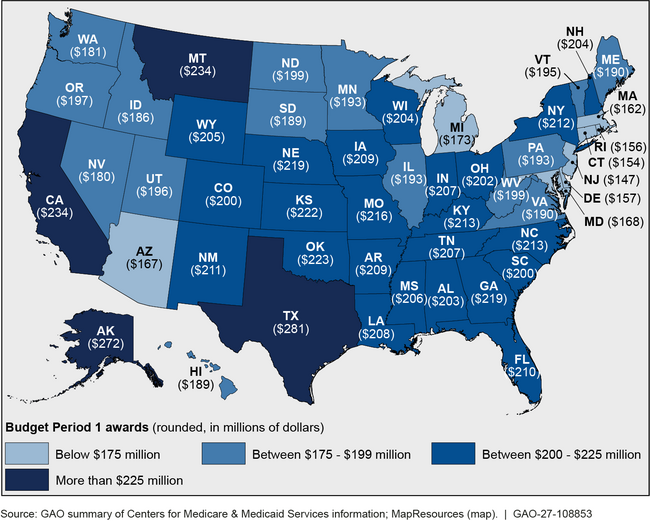
| First-year state awards | Approximately $147 million to $281 million |
| Program administrator | Centers for Medicare & Medicaid Services |
| Implementation structure | State-led initiatives subject to CMS requirements |
| Overall objective | Strengthen rural healthcare access, capacity, and sustainability |
Sources: CMS, Rural Health Transformation Program; GAO, Rural Health Transformation Program: Early Implementation Actions and Monitoring Plans.
The first-year awards were not identical because CMS considered state characteristics and proposed initiatives in its allocation process.
Importantly, the funding is not an unrestricted pool of money that individual providers can claim simply because they operate in a rural area. State implementation plans, approved uses, eligibility rules, application requirements, and available funding determine how organizations may participate.
How states can use the funding
CMS requires states to use program funds for at least three approved categories of activity. These categories cover several parts of the rural healthcare system, including:
- Evidence-based prevention and chronic disease management.
- Certain payments to healthcare providers for covered items or services.
- Consumer-facing technology for disease prevention and management.
- Training and technical assistance for technology-enabled care.
- Recruitment and retention of rural clinical staff.
- Health IT modernization, cybersecurity, software, and hardware.
- Assessment and restructuring of local healthcare service delivery where appropriate.
- Mental health and substance use disorder treatment.
- Innovative care models, including appropriate value-based arrangements.
The exact projects, eligible recipients, application procedures, and award conditions depend on the approved state initiative and applicable program requirements.
Official reference: CMS, Rural Health Transformation Program.
3. What the Latest Federal Implementation Reports Tell Us
The latest developments make this topic especially timely for healthcare leaders.
CMS releases its first state implementation report
On October 9, 2026, CMS’s first implementation report was highlighted by the American Hospital Association. It covered the period from December 29, 2025, through July 31, 2026, and described state allocations and implementation activity.
This marks a transition from the initial award stage toward the more detailed work of putting approved projects into practice.
For providers, the next questions concern execution: which organizations will participate, which projects will be funded, how milestones will be measured, and how state agencies will evaluate results.
GAO examines early implementation and oversight
On October 6, 2026, the Government Accountability Office published an early review of the program.
The report described CMS’s initial implementation steps, including the funding opportunity, awards to all 50 states, and plans to monitor state activities through communications, audits, and site visits.
GAO reported first-year allocations ranging from approximately $147 million for New Jersey to $281 million for Texas.
The report is important because a large funding announcement does not, by itself, demonstrate improved access, better clinical outcomes, or long-term financial stability. Those results depend on how the money is deployed and whether projects deliver measurable benefits.
What this means for providers: Monitor actual state program notices and project-level announcements, not just the headline funding total. The details determine whether a particular practice, hospital, health system, or community partnership can participate.
Sources: GAO, Rural Health Transformation Program: Early Implementation Actions and Monitoring Plans; American Hospital Association, October 9, 2026 report on CMS’s first state implementation report.
4. Potential Implications for Rural Physicians and Medical Practices
The effect of RHTP will differ by state, specialty, organizational structure, and project eligibility. Nevertheless, several areas deserve attention from physician leaders.
A. Workforce recruitment and retention
Recruiting clinicians can be especially difficult in communities with limited specialist availability, fewer training opportunities, or challenges supporting a long-term clinical career.
States may use approved initiatives to support workforce recruitment, training, and retention. Some workforce strategies may include commitments for clinicians to serve rural communities for a specified period.
Physician groups should monitor whether state programs support their relevant workforce needs and whether participating organizations must meet residency, service, reporting, or retention conditions.
Before committing resources, practices should establish:
- Which positions and professional categories qualify.
- Whether funding supports recruitment, training, retention, or related infrastructure.
- Whether a minimum service commitment applies.
- Which expenses are allowable.
- How performance and continued eligibility will be verified.
A workforce initiative may help address a specific local shortage, but it should not be treated as a guarantee of permanent staffing or long-term funding.
B. Telehealth and remote patient monitoring
Technology-enabled care may help rural organizations serve patients who otherwise face long travel distances or limited access to specialists.
Potential applications include remote monitoring for selected chronic conditions, virtual specialist consultations, telehealth-supported maternal care, and improved coordination between community clinics and larger facilities.
However, implementing these services requires more than purchasing software or devices.
Organizations should evaluate:
- Whether the technology meets clinical needs.
- Whether patients have suitable connectivity and technical support.
- How clinicians will receive and act on remote-monitoring data.
- How virtual encounters will be documented.
- How patient information will be exchanged securely.
- Which payer coverage, coding, billing, and documentation requirements apply.
- How ongoing staffing, maintenance, and subscription costs will be funded.
Funding eligibility does not automatically make a service reimbursable under Medicare, Medicaid, or a commercial insurance contract. Coverage and payment must be evaluated separately.
C. Electronic health records and interoperability
Rural providers may operate with different electronic health record (EHR) systems, practice management platforms, laboratory systems, and referral networks.
Improving information exchange can support care coordination and reduce the administrative burden associated with obtaining records from outside organizations.
Potential investments may include EHR modernization, secure data exchange, improved referral workflows, and technical assistance for integrating systems.
Before adopting a new platform, practice leaders should assess interoperability, migration costs, vendor support, cybersecurity, staff training, and the long-term cost of ownership.
Technology should solve a clearly identified operational or clinical problem. A new system that is poorly integrated or difficult to use can add work instead of reducing it.
D. Chronic disease management and preventive care
Chronic diseases require consistent follow-up, patient engagement, and coordination across care settings.
Approved state initiatives may support evidence-based prevention and chronic disease management. Depending on the program, this could include better care coordination, technology-enabled monitoring, or services designed to improve access to routine care.
Practices should define measurable objectives before launching a project. Examples include improving follow-up completion, reducing missed appointments, increasing the availability of relevant clinical information, or improving continuity of care.
Any clinical measure should be selected based on the target population, clinical appropriateness, and the program’s actual requirements.
E. Financial and administrative sustainability
A rural practice can provide essential care while still facing cash-flow constraints, claim denials, staffing costs, and administrative workload.
RHTP projects that improve technology or care delivery may create indirect operational benefits. For example, more reliable information exchange can help staff obtain records, while improved workflow integration may reduce duplicate administrative tasks.
But the program should not be confused with a general medical billing subsidy. Providers should not assume that routine billing expenses, outstanding accounts receivable, or ordinary operating deficits qualify for reimbursement.
The correct approach is to examine the approved project scope and distinguish eligible project expenses from normal business costs.
5. How Rural Providers Can Prepare for State Funding Opportunities
Preparation is valuable even before a state opens a specific application. Organizations that understand their needs, costs, and measurable objectives are better positioned to evaluate whether an opportunity is appropriate.
Step 1: Identify the state program and official funding channel
Start with the state’s health department, Medicaid agency, rural health office, or designated RHTP program website.
Review published notices, project descriptions, application guidance, deadlines, and contact information.
Do not rely exclusively on third-party summaries or general announcements. Confirm requirements against the actual state program documents.
Step 2: Confirm organizational and project eligibility
Determine whether the opportunity is open to rural hospitals, independent practices, community health organizations, technology partners, local coalitions, or other entities.
Check geographic definitions, service-area requirements, allowable project costs, matching requirements if applicable, and any restrictions on the use of funds.
Some projects may be available only through selected implementing organizations or formal partnerships.
Step 3: Define a specific problem
Avoid preparing a proposal that simply requests funding for broad modernization.
Instead, identify the operational or clinical issue that the project will address.
For example:
- A shortage of specialty consultations in a defined service area.
- Delays in receiving external clinical records.
- Limited capacity for chronic disease follow-up.
- An inadequate cybersecurity program.
- A workforce vacancy that affects access to essential services.
- Inefficient care coordination between local providers and regional hospitals.
A clearly defined problem makes it easier to identify an appropriate intervention and establish a credible evaluation plan.
Step 4: Build a realistic implementation budget
Estimate startup and recurring expenses separately.
A technology project, for instance, may involve equipment, software, implementation, data migration, training, connectivity, security controls, maintenance, and staff time.
The budget should identify which costs may be allowable under the specific opportunity and which will require another funding source.
Step 5: Establish baseline measures
Record the current state before implementation. Depending on the project, useful indicators might include appointment availability, referral turnaround time, staffing vacancies, follow-up completion, system downtime, or patient travel burden.
For a project involving administrative operations, organizations might also examine claim acceptance, denial trends, days in accounts receivable, and the time required to resolve billing issues.
These financial indicators should be used only where they are relevant to the project and its approved scope. They should not be presented as mandatory RHTP measures unless the relevant state program explicitly requires them.
Step 6: Plan for long-term sustainability
A project may receive time-limited funding while requiring ongoing staff, equipment, software, and maintenance expenses.
Before committing, identify how the service will continue after the grant period, what happens if projected utilization is not achieved, and whether the organization can support the recurring costs.
A sustainable project should not depend on an assumption that additional federal funding will automatically become available.
6. The Role of Healthcare Data and Revenue Cycle Analytics
Rural healthcare transformation is not only a question of acquiring funding. It is also a question of understanding where operational problems occur, measuring progress, and determining whether investments are delivering useful results.
Healthcare analytics can help organizations establish baselines and monitor changes in clinical, administrative, and financial performance.
Operational analytics
Depending on the project, useful measures may include:
- Appointment availability and time to care.
- Referral completion and turnaround time.
- Staff vacancy and retention trends.
- Technology utilization and downtime.
- Follow-up completion for targeted patient groups.
- Care coordination and information-exchange performance.
The appropriate indicators depend on the project. A telehealth initiative, workforce program, and cybersecurity upgrade should not be judged using an identical set of measures.
Revenue cycle management analytics
Revenue cycle management (RCM) includes the administrative and financial processes that support patient registration, eligibility verification, coding, claims submission, payment posting, denial resolution, and accounts receivable management.
For rural practices, financial reporting may help identify persistent billing issues that compete with other operational priorities.
Examples include:
- Clean claim rate: the proportion of claims accepted without a specified initial processing problem, based on the organization’s defined methodology.
- Denial rate: the proportion of claims or claim lines denied under a consistent calculation.
- Days in accounts receivable: a measure of how long receivables remain outstanding.
- A/R aging: the distribution of outstanding balances by age.
- Eligibility-related errors: billing problems associated with inaccurate or incomplete coverage information.
- Payment variance: differences between expected and actual payments that require investigation.
These indicators can help a practice identify workflow issues and prioritize corrective action. They do not establish that a practice qualifies for RHTP funding, and improved billing metrics alone do not prove that a rural health transformation project has improved patient outcomes.
Connecting the data to decisions
A useful analytics process follows a simple sequence:
- Establish a baseline.
- Define the problem and its likely causes.
- Select an intervention that fits the approved project.
- Track implementation and operating costs.
- Compare results with the baseline.
- Investigate unexpected results.
- Decide whether the intervention should be maintained, revised, or expanded.
This approach helps healthcare leaders distinguish between money spent, activities completed, and actual improvements achieved.
7. Risks and Limitations Providers Should Understand
RHTP offers opportunities, but organizations should avoid several common assumptions.
Funding is not guaranteed for every rural provider
Federal awards go to states. Individual organizations must follow the relevant state program’s application and participation requirements.
Announced funding is not the same as cash already received by a provider
A state announcement may describe an allocation, planned initiative, grant opportunity, or project commitment. Those terms are not interchangeable. Confirm the stage of funding and the conditions that must be met before funds are available.
The program does not eliminate rural healthcare financial pressures
RHTP is a substantial investment, but it is time-limited and does not resolve every challenge facing rural healthcare organizations.
KFF’s analysis notes that the program’s funding is smaller than the estimated rural Medicaid spending reductions associated with the same 2025 reconciliation law. The effects will vary across states and communities.
Technology requires ongoing investment
Hardware and software purchases may be only the beginning. Training, maintenance, security, interoperability, and staffing can create recurring expenses that must be addressed.
Compliance and reporting remain important
Organizations should maintain accurate financial records, document project activities, monitor milestones, and follow the conditions attached to the specific award or contract.
They should also avoid claiming clinical or financial improvements without appropriate evidence.
8. Frequently Asked Questions
What is the Rural Health Transformation Program?
The RHTP is a five-year, $50 billion federal program administered by CMS to help states strengthen and modernize rural healthcare. It supports approved activities such as workforce development, technology adoption, chronic disease management, and innovative care delivery.
How much funding is available?
The program provides $50 billion over fiscal years 2026 through 2030, with $10 billion allocated annually across the program.
Can an independent rural physician practice apply directly to CMS?
Providers should not assume that they can apply directly for a federal RHTP award. CMS distributes program funding to states, and participation opportunities depend on each state’s approved plan and funding mechanisms. Practices should consult their state’s official RHTP resources.
Can rural medical practices use RHTP funds for medical billing?
Not automatically. Funding must be used according to the program’s approved purposes and the conditions of the relevant state initiative. Routine billing expenses or general operating costs should not be assumed eligible without explicit confirmation.
Can RHTP support telehealth and remote patient monitoring?
The federal program permits approved activities involving technology-enabled care, including certain telehealth-related and remote-monitoring initiatives. Whether a particular project qualifies depends on the applicable state program and its conditions.
Is the Rural Health Transformation Program permanent?
No. The program is structured as a five-year initiative covering fiscal years 2026 through 2030. Organizations should plan for the sustainability of funded projects beyond the period of federal support.
How can providers find current opportunities?
Start with the official CMS RHTP resources and the relevant state agency’s program website. Review current notices, application deadlines, eligibility rules, and award conditions before making commitments.
What role can healthcare analytics play?
Analytics can help providers establish baselines, track project activity, evaluate operational performance, and identify financial or workflow problems. The measures used should be relevant to the specific project and its requirements.
Conclusion: Turning Rural Health Funding Into Sustainable Improvements
The Rural Health Transformation Program represents a significant federal investment in rural healthcare, but the impact will depend on implementation at the state and local levels.
For physicians and medical practice leaders, the immediate priorities are to understand state initiatives, confirm eligibility, define operational needs, prepare realistic budgets, and establish measurable objectives.
Technology modernization, workforce development, care coordination, and financial operations may all contribute to a stronger rural healthcare system when they address genuine local needs and can be sustained over time.
For healthcare organizations evaluating operational improvements, reliable data and disciplined reporting can help reveal where resources are needed and whether interventions are working. MedLink Analytics supports U.S. healthcare providers with medical billing, denial management, accounts receivable management, and healthcare analytics services designed to support informed revenue cycle decisions.
The central lesson: Rural healthcare transformation is not measured by the amount of funding announced alone. Its value will ultimately depend on whether approved projects strengthen access, improve delivery, and create sustainable benefits for the communities they serve.
References and authoritative sources
- Centers for Medicare & Medicaid Services (CMS). Rural Health Transformation Program. Official program information, approved uses, and eligibility guidance.
https://www.medicaid.gov/resources-for-states/rural-health - CMS. Rural Health Transformation Program Resources. State announcements and program updates.
https://www.medicaid.gov/resources-for-states/rural-health/rhtp-resources - CMS. CMS Announces $50 Billion in Awards to Strengthen Rural Health in All 50 States. December 29, 2025.
https://www.cms.gov/newsroom/press-releases/cms-announces-50-billion-awards-strengthen-rural-health-all-50-states - U.S. Government Accountability Office (GAO). Rural Health Transformation Program: Early Implementation Actions and Monitoring Plans. October 6, 2026.
https://www.gao.gov/products/gao-27-108853 - American Hospital Association (AHA). CMS Issues First Report on States Spending Rural Health Transformation Program Funding. October 9, 2026.
https://www.aha.org/news/headline/2026-10-09-cms-issues-first-report-states-spending-rural-health-transformation-program-funding - KFF. A Closer Look at the $50 Billion Rural Health Transformation Program. Updated September 18, 2026.
https://www.kff.org/medicaid/a-closer-look-at-the-50-billion-rural-health-transformation-program/ - Bipartisan Policy Center. Federal Policy Priorities to Strengthen Rural Health and Maximize Rural Health Transformation Program Investments. August 3, 2026.
https://bipartisanpolicy.org/report/federal-policy-priorities-to-strengthen-rural-health-and-maximize-rural-health-transformation-program-investments/
Editorial note: This article reflects publicly available information reviewed as of October 12, 2026. State implementation plans, funding opportunities, and eligibility conditions may change. Providers should verify requirements against current official federal and state program documents before making financial or operational decisions.