Healthcare Administrative Automation in 2026: How AI, Interoperability, and RCM Technology Are Reshaping U.S. Healthcare
The U.S. healthcare industry is entering a new phase of administrative modernization.
For years, healthcare organizations have invested heavily in electronic health records (EHRs), digital claims, patient portals, revenue cycle management (RCM) platforms, and cloud-based technologies. Yet many administrative workflows still depend on manual data entry, payer portals, phone calls, spreadsheets, fax-based documentation, fragmented systems, and repetitive staff intervention.
That is changing.
In 2026, healthcare administrative automation is increasingly moving beyond simple digitization. Providers, payers, health technology companies, and revenue cycle teams are focusing on interoperability, application programming interfaces (APIs), Fast Healthcare Interoperability Resources (FHIR), artificial intelligence (AI), workflow automation, electronic prior authorization, automated eligibility verification, claims status automation, and data-driven revenue cycle management.
The shift is significant because administrative inefficiency is not merely an IT problem. It can affect staff productivity, operating costs, claim accuracy, reimbursement, patient access, denial rates, and the overall financial performance of a healthcare organization.
The latest CAQH Index highlights the scale of the opportunity. Its analysis identifies approximately $20 billion in potential annual savings associated with moving healthcare administrative transactions to fully electronic workflows. It also identifies substantial opportunities in eligibility verification, claims status, and prior authorization.
Meanwhile, CMS is accelerating interoperability initiatives and preparing the healthcare ecosystem for additional electronic prior authorization and API-based workflows beginning in 2027.
The question for healthcare organizations is therefore no longer simply whether administrative automation is coming.
The more important question is:
Is the organization prepared to build automated workflows on top of clean data, interoperable systems, standardized processes, and measurable revenue-cycle intelligence?
What Is Healthcare Administrative Automation?
Healthcare administrative automation is the use of software, APIs, standardized data exchange, artificial intelligence, rules engines, and workflow technologies to reduce repetitive manual administrative activities across healthcare operations.
These activities can include:
- Patient eligibility verification
- Benefits verification
- Prior authorization
- Claims submission
- Claims status inquiries
- Medical billing
- Payment posting
- Denial identification
- Denial management
- Accounts receivable follow-up
- Clinical documentation workflows
- Referral management
- Patient registration
- Provider data management
- Revenue cycle reporting
- Compliance documentation
- Administrative data exchange
Automation does not necessarily mean eliminating human involvement.
In healthcare, effective automation is generally about moving repetitive, rules-based, data-intensive work from manual processes into controlled digital workflows while preserving appropriate human oversight for complex or consequential decisions.
This distinction is increasingly important as organizations evaluate AI and automation technologies.
Why Healthcare Administrative Automation Matters in 2026
Healthcare organizations are under simultaneous pressure to improve operational efficiency, protect margins, reduce administrative burden, and deliver timely patient care.
The American Hospital Association’s 2026 environmental assessment identifies financial constraints and workforce pressures as persistent issues affecting hospitals and health systems.
At the same time, CMS is advancing a broader technology ecosystem focused on interoperability, health data exchange, digital access, and reducing administrative friction. CMS reported in 2026 that its Health Technology Ecosystem had moved into real-world implementation involving providers, EHRs, payers, networks, and digital health organizations.
This creates several reasons for healthcare organizations to examine automation more seriously.
1. Administrative workload is expensive
Every manual eligibility check, claim status call, authorization submission, documentation request, and payment reconciliation consumes staff time.
When multiplied across thousands of encounters, even a small inefficiency can become a substantial operating expense.
2. Manual workflows create avoidable variation
Different employees may handle the same administrative process differently.
Standardized automation can establish consistent workflows, validation rules, escalation paths, and documentation requirements.
3. Data fragmentation limits efficiency
Automation is most effective when systems can exchange information reliably.
If an EHR, clearinghouse, payer portal, billing system, and analytics platform operate independently, automation becomes more difficult.
4. Revenue cycle performance depends on upstream processes
A claim denial may appear to be a billing problem when the underlying issue originated earlier.
For example:
Patient registration → eligibility → authorization → documentation → coding → claim submission → adjudication → payment → denial/appeal
A weakness early in the workflow can create financial consequences later.
The $20+ Billion Healthcare Automation Opportunity
One of the most important developments for healthcare administrators is the continued measurement of the financial value of automation.
The CAQH Index has estimated that fully electronic administrative transactions could unlock approximately $20 billion in annual savings opportunities across the healthcare industry. The organization also reports that automation already avoids hundreds of billions of dollars in administrative costs compared with fully manual processes.
This matters because healthcare automation should not be evaluated solely as a technology investment.
It should also be evaluated as an operational and financial strategy.
For example, organizations can measure:
- Cost per transaction
- Staff minutes per transaction
- Clean claim rate
- First-pass resolution rate
- Denial rate
- Days in A/R
- A/R aging
- Authorization turnaround time
- Eligibility verification time
- Claim status response time
- Payment posting productivity
- Appeal success rate
- Cost to collect
These metrics transform automation from an abstract technology initiative into a measurable business process.
Where Automation Is Transforming the Revenue Cycle
Revenue cycle management is one of the areas where administrative automation can have a direct financial impact.
1. Automated Eligibility Verification
Eligibility errors can create downstream billing problems.
Automated eligibility verification can help healthcare organizations identify information such as:
- Active coverage
- Coverage dates
- Benefit limitations
- Copay requirements
- Deductibles
- Coinsurance
- Payer information
- Patient responsibility
Instead of relying exclusively on manual portal checks, organizations can integrate eligibility workflows into registration and scheduling processes.
The objective is straightforward:
Verify coverage before services are delivered whenever possible.
2. Electronic Prior Authorization
Prior authorization is rapidly becoming one of the most visible areas of healthcare administrative automation.
CMS states that certain CMS-regulated health plans must implement. Which maintain Prior Authorization APIs beginning January 1, 2027. CMS is encouraging providers to begin preparing and testing their systems before the implementation date.
CMS also launched an Electronic Prior Authorization Acceleration initiative in 2026, bringing together healthcare organizations, EHR developers, physician practices, networks, and digital health companies to address workflow and technical barriers.
The technology stack increasingly involves:
EHR + FHIR + API + payer data + clinical documentation + automated workflow
This can reduce repetitive data entry and improve the exchange of information between providers and payers.
FHIR Is Becoming a Critical Healthcare Technology Layer
Fast Healthcare Interoperability Resources (FHIR) is increasingly important to healthcare interoperability.
FHIR provides a standardized framework for representing and exchanging healthcare information through modern web-based technologies and APIs.
In practical terms, FHIR can help systems exchange structured healthcare information instead of relying exclusively on:
- Fax
- Phone calls
- PDFs
- Manual uploads
- Proprietary portals
- Repeated data entry
CMS’s interoperability initiatives increasingly emphasize FHIR-based APIs and standardized data exchange. Its Interoperability Framework includes FHIR API requirements and references USCDI and standardized terminology such as LOINC, RxNorm, and SNOMED CT.
For healthcare organizations, this means interoperability is increasingly becoming an operational capability, not simply an IT concept.
AI Is Moving Into Healthcare Administration
Artificial intelligence is another major component of healthcare automation.
However, the most valuable use cases may not always be the most visible ones.
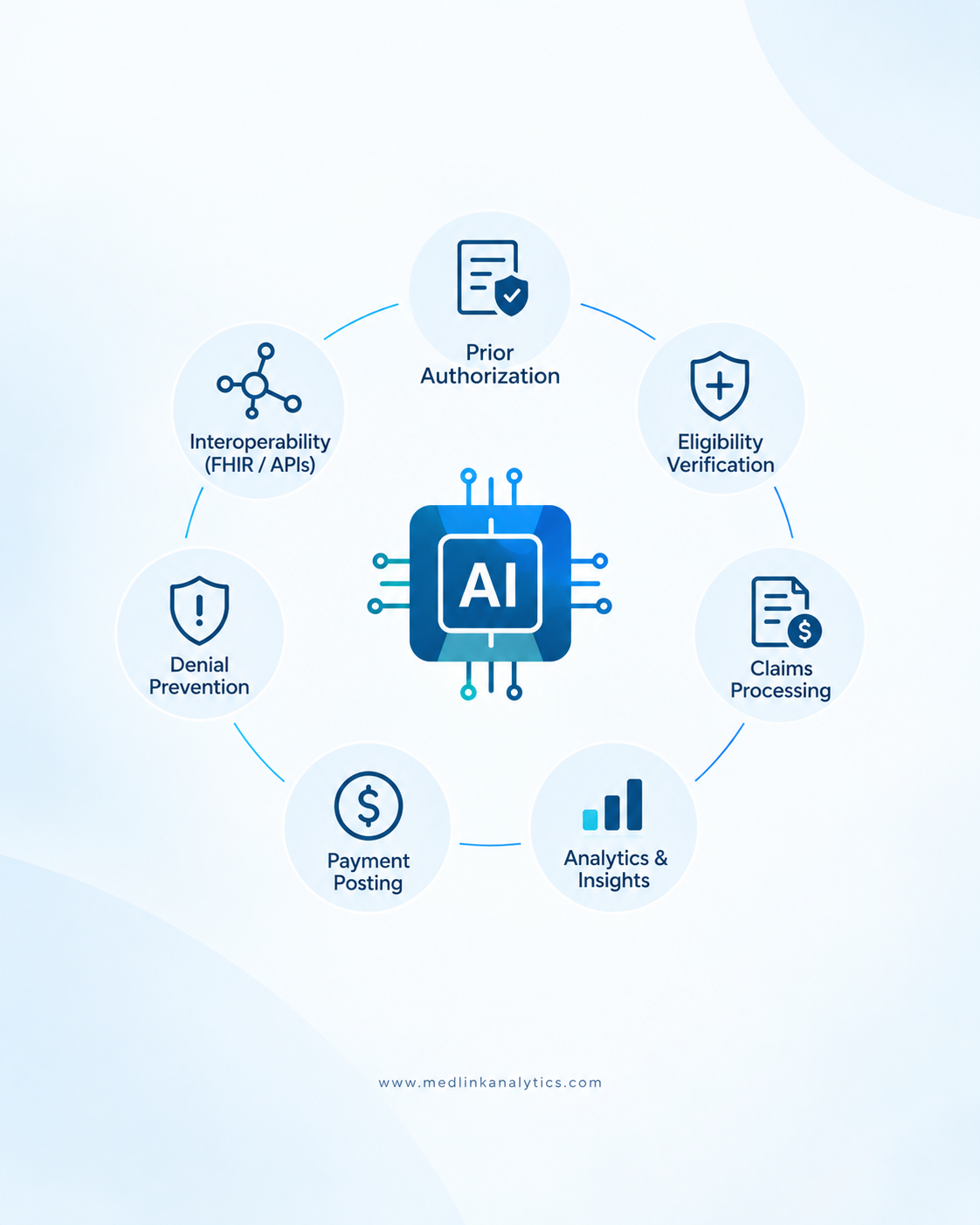
Healthcare organizations can apply AI and machine learning to administrative and revenue-cycle processes such as:
- Claims classification
- Denial prediction
- Documentation analysis
- Coding assistance
- Payment variance detection
- A/R prioritization
- Workqueue optimization
- Authorization documentation
- Eligibility data analysis
- Revenue forecasting
- Anomaly detection
- Patient communication
The goal is not simply to “add AI.”
The goal is to use AI where it can produce a measurable operational improvement.
For example, an analytics platform could identify a pattern in historical claims showing that a particular payer, procedure, location, provider specialty, or documentation condition is associated with elevated denial risk.
That insight can then trigger an operational intervention.
This creates a cycle:
Data → Analytics → Prediction → Workflow → Action → Measurement
That is significantly more valuable than simply generating another dashboard.
AI Works Better When the Underlying Workflow Is Structured
Healthcare organizations should be cautious about treating AI as a replacement for process improvement.
AI cannot reliably compensate for:
- Poor data quality
- Fragmented systems
- Inconsistent workflows
- Missing documentation
- Poorly defined business rules
- Unclear ownership
- Lack of integration
- Weak data governance
Automation should therefore be built in layers.
Layer 1: Standardize
Define the process.
Layer 2: Digitize
Move information into structured digital workflows.
Layer 3: Integrate
Connect systems using APIs and interoperable standards.
Layer 4: Automate
Remove repetitive manual steps.
Layer 5: Analyze
Measure performance and identify patterns.
Layer 6: Apply AI
Use predictive and intelligent capabilities where they add measurable value.
This progression can be particularly important for revenue cycle operations.
Claims Automation and Clean Claim Submission
Claims remain one of the most important administrative transactions in healthcare.
A claim can encounter problems because of:
- Incorrect patient information
- Eligibility issues
- Coding errors
- Missing modifiers
- Incorrect payer routing
- Authorization problems
- Documentation gaps
- Provider enrollment issues
- Duplicate claims
- Timely filing issues
Automation can introduce validation rules before submission.
The objective is not simply to submit more claims.
It is to submit more accurate claims the first time.
That makes clean claim performance an important KPI for automated revenue cycle operations.
Denial Prevention Is More Valuable Than Reactive Denial Management
Traditional denial management often focuses on what happens after a claim has already been rejected.
A more mature revenue cycle strategy focuses on identifying the conditions that create denials before the claim reaches adjudication.
For example:
Historical denial data → identify recurring pattern → create rule → flag claim before submission → correct issue → submit clean claim
This is where healthcare analytics becomes particularly valuable.
Instead of asking:
“Why was this claim denied?”
Revenue cycle teams can increasingly ask:
“Which claims are likely to be denied, why, and what can we change before submission?”
That is the transition from reactive denial management to predictive denial prevention.
A/R Management Is Also Becoming More Data-Driven
Accounts receivable is another major area where automation and analytics can work together.
Traditional A/R follow-up may prioritize accounts based primarily on age.
Modern analytics can incorporate additional variables:
- Outstanding balance
- Payer
- Claim status
- Denial reason
- Patient responsibility
- Days since submission
- Historical payer behavior
- Appeal probability
- Underpayment probability
- Timely filing risk
- Expected reimbursement
This allows revenue cycle teams to prioritize work based on financial impact and probability of recovery, rather than simply working every account in chronological order.
Healthcare Automation and Electronic Claims Attachments
Another important development is the modernization of clinical documentation exchange.
CMS has highlighted the adoption of national standards for electronic healthcare claims attachments and electronic signatures. The agency estimates that the final rule could save the healthcare industry approximately $781 million annually by replacing some fax and mailing processes with standardized electronic transactions.
For revenue cycle operations, this is important because clinical documentation frequently supports:
- Claims
- Prior authorization
- Medical necessity
- Appeals
- Utilization management
- Payment disputes
The broader direction is clear:
Documentation is increasingly becoming structured, electronic, and interoperable.
What CMS’s 2027 Prior Authorization Changes Mean for Providers
The 2027 timeline is one of the most important developments healthcare organizations should monitor.
The 2026 proposed rule would extend electronic prior authorization requirements to certain drug workflows and proposes FHIR-based standards for prior authorization transactions. CMS also proposes standards involving pharmacy-related transactions and NCPDP standards for certain drug prior authorization workflows.
Because some of these provisions remain proposed rather than finalized, healthcare organizations should distinguish between:
Current requirements
and
Proposed future requirements.
That distinction is essential for accurate healthcare compliance communication.
The Emerging Healthcare Automation Stack
The modern healthcare administrative environment can be viewed as a connected technology stack:
Data Layer
- EHR
- Claims
- Eligibility
- Clinical documentation
- Payment data
↓
Interoperability Layer
- APIs
- FHIR
- HL7
- EDI
- Clearinghouses
↓
Automation Layer
- Workflow engines
- Rules engines
- Automated transactions
- Workqueue automation
↓
Intelligence Layer
- Analytics
- Machine learning
- Artificial intelligence
- Predictive models
↓
Revenue Cycle Layer
- Claims
- Denials
- A/R
- Payments
- Appeals
- Revenue recovery
↓
Executive Intelligence
- KPIs
- Dashboards
- Forecasting
- Trend analysis
- Financial performance
This architecture illustrates why isolated automation tools may have limited value.
The greatest opportunities often exist when data, interoperability, automation, analytics, and revenue-cycle operations work together.
Five Healthcare Administrative Processes Providers Should Evaluate First
Organizations beginning an automation program can start with high-volume, repetitive workflows.
1. Eligibility Verification
Measure:
- Manual verification volume
- Verification time
- Eligibility-related denials
- Rework
2. Claims Status
Measure:
- Phone calls
- Portal checks
- Average follow-up time
- Unresolved claims
3. Prior Authorization
Measure:
- Authorization volume
- Turnaround time
- Denial rate
- Documentation requests
- Staff time
4. Denial Management
Measure:
- Denial rate
- Top denial reasons
- Dollars denied
- Appeal rate
- Recovery rate
5. A/R Follow-Up
Measure:
- Days in A/R
- Aging distribution
- High-balance accounts
- Payer-specific delays
- Recovery rate
These metrics create a baseline against which automation can be evaluated.
How Healthcare Organizations Can Prepare for 2027
Healthcare organizations should not wait until January 2027 to evaluate their technology environment.
Step 1: Map the Current Workflow
Document how authorization, eligibility, claims, denials, and A/R processes currently operate.
Step 2: Identify Manual Touchpoints
Look for:
- Fax
- Phone
- Manual portal entry
- Spreadsheet tracking
- Repeated data entry
- Manual status checks
Step 3: Evaluate EHR Capabilities
CMS specifically encourages providers to communicate with EHR vendors about electronic prior authorization capabilities and implementation timelines.
Step 4: Evaluate Interoperability
Determine whether systems support:
- APIs
- FHIR
- HL7
- EDI
- Electronic documentation exchange
Step 5: Establish KPIs
Define measurable targets before purchasing automation technology.
Step 6: Test Before Scaling
Pilot automation in one workflow, specialty, location, or payer environment.
Step 7: Add AI Where It Creates Measurable Value
AI should enhance a structured process rather than conceal a broken one.
Cybersecurity Must Remain Part of Automation Strategy
Greater digital connectivity also increases the importance of cybersecurity.
Healthcare organizations are exchanging more information across EHRs, payers, providers, clearinghouses, applications, and third-party platforms.
HHS’s Office for Civil Rights continues to enforce HIPAA Security Rule requirements in ransomware investigations. In April 2026, OCR announced four ransomware-related settlements affecting more than 427,000 individuals and emphasized the importance of accurate and thorough risk analysis.
NIST also released an updated ransomware risk-management profile in June 2026 aligned with the Cybersecurity Framework 2.0.
Therefore, healthcare automation should include:
- Access controls
- Authentication
- Encryption
- Audit logging
- Vendor risk management
- Data governance
- Backup and recovery
- Incident response
- HIPAA compliance
- Business associate oversight
Automation without appropriate security controls can create new operational and compliance risks.
The Future of Healthcare Administration Is Connected, Not Merely Digital
The healthcare industry has already passed the stage where simply converting paper forms into electronic forms represents meaningful transformation.
The next phase is about connected workflows.
A future administrative workflow may look like:
Patient encounter → eligibility verification → coverage discovery → authorization requirements → clinical documentation → electronic authorization → claim submission → automated adjudication data → payment → denial analytics → A/R prioritization
Information can move between systems instead of being repeatedly re-entered by people.
This is the larger significance of interoperability.
The objective is not simply to create more software.
It is to create a healthcare administrative environment in which information moves reliably to the right system, at the right time, with the right context.
Frequently Asked Questions
What is healthcare administrative automation?
Healthcare administrative automation uses software, APIs, standardized data exchange, workflow technology, and AI to reduce repetitive manual administrative tasks such as eligibility verification, prior authorization, claims processing, denial management, and revenue cycle activities.
Why is healthcare automation important in 2026?
Healthcare organizations are facing persistent financial and workforce pressures while managing increasingly complex administrative workflows. Automation can reduce repetitive work, improve process consistency, and provide better visibility into operational and financial performance.
How does AI help healthcare administration?
AI can support tasks such as denial prediction, documentation analysis, claims classification, A/R prioritization, anomaly detection, workflow optimization, and revenue forecasting. Human oversight remains important for complex or consequential decisions.
What is FHIR in healthcare?
Fast Healthcare Interoperability Resources (FHIR) is a standards framework used to exchange healthcare information electronically. FHIR is increasingly important to API-based healthcare interoperability and digital administrative workflows.
What is the connection between automation and RCM?
Automation can improve multiple revenue cycle processes, including eligibility verification, authorization, claims submission, denial prevention, payment posting, A/R follow-up, and revenue analytics.
How can automation reduce claim denials?
Automation can validate information before claim submission, identify missing documentation, detect eligibility or authorization issues, and use historical denial data to identify recurring patterns.
Is electronic prior authorization becoming mandatory?
CMS requires certain CMS-regulated health plans to implement Prior Authorization APIs beginning January 1, 2027. Additional drug-related electronic prior authorization requirements are also included in a 2026 CMS proposed rule. Organizations should distinguish finalized requirements from proposals.
How much can healthcare automation save?
The CAQH Index identifies approximately $20 billion in potential annual savings associated with moving administrative transactions to fully electronic workflows. Actual savings vary according to transaction volume, implementation quality, workflow design, and organizational adoption.
Conclusion
Healthcare administrative automation is becoming a strategic component of U.S. healthcare operations.
The transition is being driven by several forces at once: rising administrative complexity, financial pressure, workforce constraints, interoperability initiatives, electronic prior authorization, FHIR-based APIs, artificial intelligence, revenue cycle optimization, and growing demand for measurable operational efficiency.
For healthcare organizations, the opportunity extends beyond reducing paperwork.
A well-designed automation strategy can connect clinical information, administrative workflows, revenue cycle operations, analytics, and payer interactions into a more coordinated operating model.
The most effective approach is not to automate everything at once.
It is to identify high-volume administrative processes, establish measurable baselines, standardize workflows, connect systems through interoperable technologies, automate repetitive tasks, and then apply analytics and AI where they can generate measurable value.
As the U.S. healthcare ecosystem moves toward broader interoperability and the 2027 CMS milestones approach, organizations that understand the relationship between automation, data quality, interoperability, and revenue cycle performance will be better positioned to manage the administrative complexity of modern healthcare.
For healthcare providers and revenue cycle leaders, the strategic question is no longer simply whether to automate.
It is which workflows should be automated first, what data and technology foundations are required, and how the financial impact will be measured.
References & Further Reading
- Centers for Medicare & Medicaid Services (CMS) – Electronic Prior Authorization and 2027 implementation guidance.
- CMS – 2026 Interoperability Standards and Prior Authorization for Drugs Proposed Rule.
- CMS – Electronic Prior Authorization Acceleration Initiative.
- CMS – Health Technology Ecosystem and interoperability initiatives.
- CMS – Interoperability Framework and FHIR-based health data exchange.
- CAQH – CAQH Index and healthcare administrative automation opportunities.
- HHS Office for Civil Rights – HIPAA Security Rule and ransomware enforcement.
- NIST – Ransomware Risk Management: Cybersecurity Framework 2.0 Community Profile.