FY 2027 ICD-10-CM Code Changes: What Practices Must Fix Before October 1, 2026
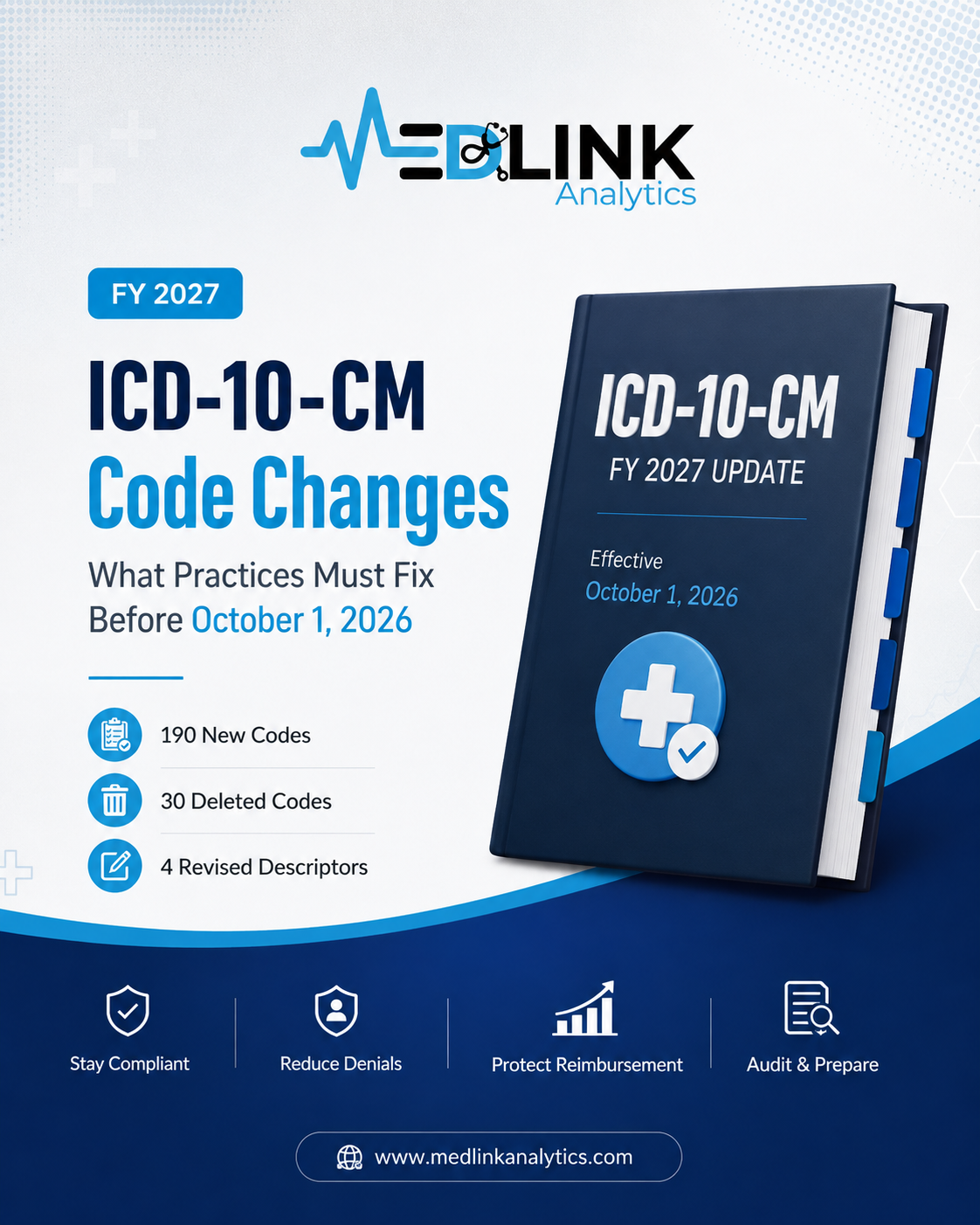
CMS finalized the FY 2027 ICD-10-CM update in its FY 2027 IPPS Final Rule, released August 4, 2026, with an effective date of October 1, 2026. The update adds 190 new diagnosis codes, deletes 30, and revises four code descriptors – smaller in volume than last year’s roughly 490 new codes, but concentrated in high-scrutiny clinical areas: veteran toxic-exposure codes tied to the PACT Act, expanded ectopic pregnancy specificity, a new hypertensive crisis category, and 56 new comorbidity/complication (CC) designations that can shift reimbursement even on claims where the diagnosis code itself doesn’t change. Practices that don’t update coding systems, retrain coders, and audit claims before and after go-live risk a denial backlog starting the first week of October.
Every October 1, CMS updates the ICD-10-CM code set that every U.S. healthcare provider is required to use under HIPAA. Most years, this is a routine maintenance task. This year, the update is smaller by code count but denser by consequence – which is exactly the kind of change that catches revenue cycle teams off guard, because a quiet-looking year on paper can still generate real denial exposure where it counts.
What ICD-10-CM Is and Why This Update Matters
ICD-10-CM – the International Classification of Diseases, 10th Revision, Clinical Modification – is the diagnosis coding system every provider uses to translate a documented diagnosis into a billable, trackable code. It replaced ICD-9-CM in October 2015 and is maintained jointly by the National Center for Health Statistics (NCHS) and CMS, with input from the American Hospital Association and AHIMA, the four “Cooperating Parties” that govern the code set and its Official Guidelines for Coding and Reporting.
The code set now contains more than 70,000 codes, and it’s updated annually, primarily on October 1, with an additional April 1 update reserved for urgent or emerging clinical needs. These codes don’t just drive claim reimbursement – they feed quality measurement, risk-adjustment models, and public health surveillance, so accuracy has consequences beyond any single claim.
What’s Actually Changing for FY 2027
According to Leigh Poland, vice president of Coding Services, Clinical Quality and Education at AGS Health, speaking to Healthcare Finance News, the FY 2027 update – finalized in CMS’s Aug. 1, 2026 IPPS Final Rule and confirmed in the FY 2027 code tables — includes exactly 190 new codes, 30 deleted codes, and four revised descriptors, effective October 1, 2026. That’s notably smaller than the roughly 490 new codes added in the FY 2026 update, but Poland was direct about why code count understates this year’s impact: several changes concentrate in areas that affect DRG (Diagnosis-Related Group) assignment and reimbursement independent of whether the diagnosis code on a given claim actually changed.
Where the 190 new codes land:
- About 44 codes in Chapter 15 (Pregnancy, Childbirth, and the Puerperium) – including new specificity for ectopic pregnancy sites (cesarean scar, interstitial, cervical, and cornual locations) and codes for continuing pregnancy after vanishing twin syndrome.
- About 60 codes in Chapter 19 (Injury, Poisoning, and Certain Other Consequences of External Causes) – primarily new toxic-exposure codes for organic solvents tied to the PACT Act, which governs veterans’ benefits for toxic exposure, plus toxicology codes that help flag adulterants like medetomidine in illicit fentanyl.
- About 31 codes in Chapter 13 (Musculoskeletal) – including a first-ever code for VEXAS syndrome, new codes for Ledderhose disease, and expanded laterality options for osteomyelitis.
- 16 codes in Chapter 21 (Factors Influencing Health Status) – covering personal history of C. difficile infection and gender-transition history.
The 30 deletions concentrate in these same high-change chapters, and the four revisions are minor descriptor corrections – Poland cited a typo fix in code Z29.14 as an example.
Separately, and arguably more consequential for reimbursement, CMS finalized 56 new CC (comorbidity/complication) designations, 22 CC deletions, and three new MCC (major complication/comorbidity) designations. These affect how severity – and therefore DRG assignment and payment – is captured, even on claims where the underlying diagnosis code isn’t new at all.
Guideline Changes That Aren’t About New Codes
Not everything coders need to adjust for is a new code. Poland flagged two guideline-level changes that alter how existing codes should be applied:
- Excludes1-to-Excludes2 conversions, which loosen some reporting restrictions that previously prevented certain codes from being reported together.
- A new I1A hypertensive crisis category, which changes how hypertensive emergency and urgency should be coded going forward.
Guideline changes like these are easy to miss in a code-count-focused review, but they can create denial risk just as readily as an outright new or deleted code – a claim using an old exclusion pattern under the new guidelines can be flagged as non-compliant even if every code on it existed the year before.
What Happens If a Practice Isn’t Ready
Poland was specific about the downstream effects of getting this update wrong:
- Denials and rework. Claims using deleted codes or missing new required specificity get kicked back, held in accounts receivable, and re-billed – slowing cash flow and adding cost to collect.
- DRG and severity-of-illness miscapture. Under-coding a CC or MCC leaves legitimate reimbursement on the table. Over-coding creates compliance and audit exposure in the other direction.
- Data-integrity effects beyond the claim. ICD-10-CM codes feed risk-adjustment models, quality measures, and public health surveillance, so inaccurate coding distorts information well past a single reimbursement decision. For this year’s veteran toxic-exposure codes specifically, miscoding isn’t just a billing problem – it can affect whether a patient’s condition is properly documented for PACT Act benefits they’re entitled to.
- Erosion of the coder-provider relationship. Every miscoded case tends to generate a post-payment query or a denial that has to be chased down, which compounds administrative burden on both sides over time.
What Revenue Cycle Teams Should Do Before October 1
Based on Poland’s recommendations, a practical readiness plan should include:
- Targeted, chapter-specific coder and CDI education – not a general memo. Given this year’s concentration areas, that means focused training for OB/maternal-fetal medicine, oncology, cardiology, musculoskeletal/rheumatology, and any emergency medicine or toxicology teams handling occupational or veteran exposure cases.
- System updates across every touchpoint – encoders, computer-assisted coding tools, EHR problem lists, charge description masters, and superbills all need the new code set loaded and tested before go-live, not discovered on October 1 when claims start failing.
- Guideline training, not just code training – coders need to understand the Excludes1-to-Excludes2 conversions and the new hypertensive crisis category, since these change how existing codes are applied even without a new code involved.
- Aligned physician query templates – CDI and coding teams should coordinate on query language that prompts the specificity the new codes require, such as laterality for ectopic pregnancy or osteomyelitis.
- Payer verification – confirm top payers’ claims-edit systems and medical policies recognize the new code set, so accurate claims aren’t rejected as invalid on a technicality.
- A 30-, 60-, and 90-day post-implementation audit of the affected chapters specifically, to catch deleted-code usage or missed specificity early – before it becomes a denial backlog.
Poland’s framing is worth repeating directly: treat this like a project with a deadline, not a memo to read.
Why This Connects to the Broader Denial Trend
This update lands at a moment when denial rates are already elevated industry-wide – a trend we covered in our earlier piece on why medical claims actually get denied. Coding errors are consistently among the top cited denial causes, and a code-set transition is exactly the kind of event that spikes coding-related denials temporarily, even at practices with otherwise solid billing operations. The practices least likely to see an October denial spike are the ones that treat this update as an operational project now, several weeks ahead of the deadline, rather than a documentation update to review after October 1 claims start bouncing back.
How MedLink Analytics Supports FY 2027 Code Transition Readiness
Coding transitions touch coding accuracy, claims scrubbing, denial tracking, and compliance risk all at once – which is why they tend to go poorly when handled as a single team’s checklist item rather than a coordinated revenue cycle effort.
- Medical coding accuracy review – auditing current coding workflows against the FY 2027 chapter-specific changes before October 1, with particular attention to the OB, musculoskeletal, and toxic-exposure code areas. See Medical Coding Services.
- Claims processing and scrubbing – ensuring claim-edit logic and charge description masters reflect the new and deleted codes before go-live, not after the first denial arrives. See Medical Billing & Claims Processing.
- Denial Management & Appeals – a structured post-go-live audit process to catch deleted-code usage or missed specificity in the 30-, 60-, and 90-day windows Poland recommends. See Denial Management & Appeals.
- Compliance Consulting – reviewing CC/MCC designation changes and DRG-impact areas for audit exposure, particularly around over-coding risk in the newly added comorbidity designations. See Compliance Consulting.
- Revenue and performance analytics – tracking denial trends by code chapter after go-live, so a practice can see exactly where the FY 2027 transition is creating friction and respond quickly. See Healthcare Analytics.
MedLink Analytics does not set CMS coding policy or make individual claim coverage determinations — those remain CMS’s and each payer’s responsibility. What MedLink Analytics provides is the coding accuracy review, claims readiness support, and denial-tracking discipline that help a practice absorb an annual code-set transition like this one without a preventable October denial spike.
Want your coding systems and top-payer claim edits checked against the FY 2027 changes before October 1? Schedule a complimentary practice analysis.
References
- Healthcare Finance News – Revenue cycle leaders need to be operationally ready for the new ICD-10 code set, interview with Leigh Poland, VP of Coding Services, Clinical Quality and Education at AGS Health. https://www.healthcarefinancenews.com/news/revenue-cycle-leaders-need-be-operationally-ready-new-icd-10-code-set
- Centers for Medicare & Medicaid Services – FY 2027 IPPS Final Rule Home Page. https://www.cms.gov/medicare/payment/prospective-payment-systems/acute-inpatient-pps/fy-2027-ipps-final-rule-home-page
- eCQI Resource Center (HealthIT.gov) – CMS Issues FY 2027 IPPS/LTCH PPS Final Rule. https://ecqi.healthit.gov/cms-issues-fy-2027-ipps/ltch-pps-final-rule
- Holland & Knight – CMS Releases Fiscal Year 2027 IPPS and LTCH Final Rule. https://www.hklaw.com/en/insights/publications/2026/08/cms-releases-fiscal-year-2027-ipps-and-ltch-final-rule
- Centers for Medicare & Medicaid Services and National Center for Health Statistics – ICD-10-CM Official Guidelines for Coding and Reporting. https://www.cms.gov
This article summarizes publicly reported regulatory guidance and expert commentary as of late August 2026. Practices should confirm final code tables, payer-specific claims-edit updates, and effective dates directly with CMS and their Medicare Administrative Contractor, as coding and reimbursement details are subject to further clarification before and after the October 1, 2026 effective date.