
What Is Revenue Cycle Management? A Physician’s Complete Guide
If you ask most physicians what revenue cycle management means, you’ll get one of two answers: a blank stare or a heavy sigh.
You went to medical school to take care of patients – not to become an expert in insurance reimbursement, CPT codes, and claim submission deadlines. But here is the uncomfortable truth: how well your practice manages its revenue cycle directly determines how much of your hard-earned clinical work actually turns into income.
And right now, that process is under more pressure than ever.
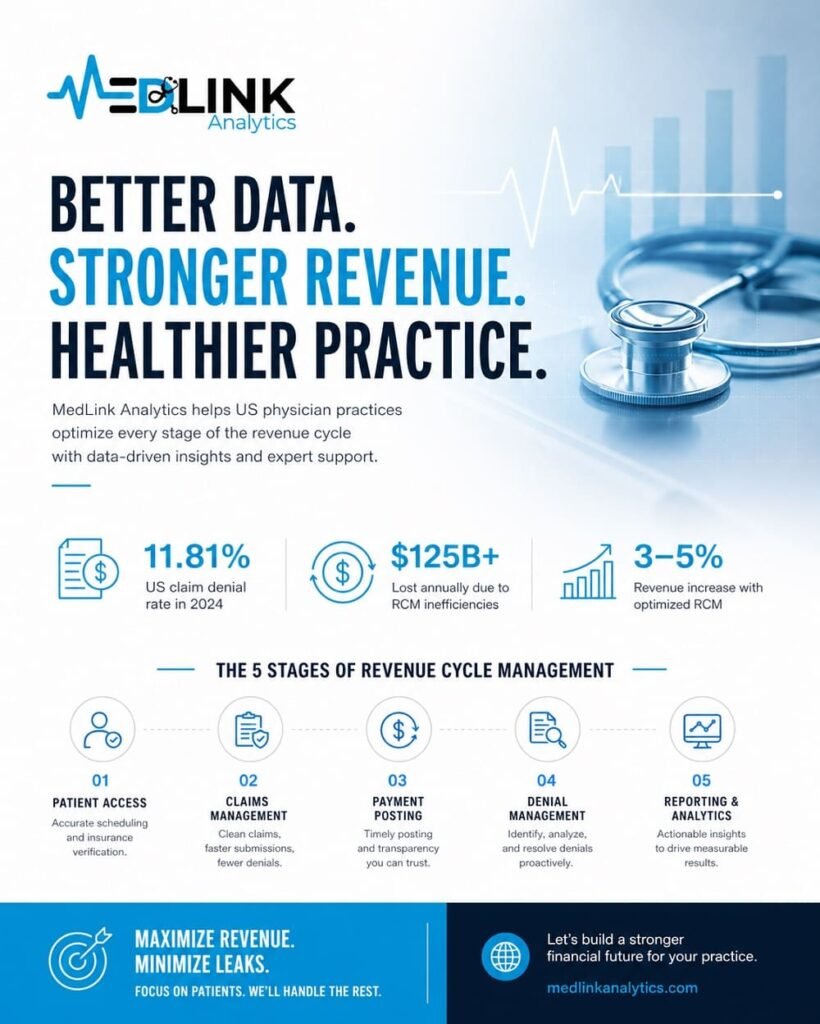
In 2024, initial claim denial rates rose to 11.81% nationally – up from 10.2% just a few years prior, according to data analyzed across more than 300,000 US physicians. Meanwhile, 54% of providers say denials are still increasing going into 2025. For the average practice, this isn’t just a billing inconvenience. It is a slow, quiet revenue leak that compounds every single month.
Understanding revenue cycle management is the first step to stopping that leak. This guide breaks it down in plain language – no billing jargon, no acronym overload.
What Is Revenue Cycle Management (RCM)?
Revenue cycle management is the end-to-end financial process a medical practice uses to track and collect payment for every patient encounter – from the moment a patient schedules an appointment to the day the final balance is paid.
It connects the clinical side of your practice (what you do) to the financial side (what you get paid for doing it). When it works well, it is almost invisible. When it breaks down at any stage, cash flow suffers, staff burns out chasing unpaid claims, and revenue that should have been collected is simply gone.
The United States RCM market was valued at over $58 billion in 2024, according to multiple industry reports, and it is projected to more than double by 2034. That growth reflects one clear reality: billing and collections in American healthcare have become too complex for most practices to manage efficiently without dedicated systems and expertise.
The 5 Core Stages of the Revenue Cycle
Here is how the process unfolds in a typical physician practice:
Stage 1 – Patient Registration and Eligibility Verification
Everything starts before the patient arrives. Accurate insurance information, demographic data, and eligibility verification need to happen upfront. When they do not, you get downstream errors that cause denials. In fact, 26% of claim denials are directly traced back to incomplete or inaccurate data collected at patient intake, according to Experian Health’s 2025 State of Claims report.
Stage 2 – Charge Capture and Medical Coding
Once the encounter happens, the services rendered need to be translated into the correct ICD-10 diagnosis codes and CPT procedure codes. A single coding error – a wrong modifier, a missing secondary diagnosis, an unbundled code – can result in a denial or, worse, a compliance audit. Getting this stage right is where practices either protect their revenue or quietly lose it.
Stage 3 – Claims Submission
The coded claim is submitted electronically to the payer, ideally within 24–48 hours of the encounter. This is the stage where first-pass acceptance rate matters most. The industry average for clean claims (claims accepted on first submission) sits around 75-85% for most practices. At MedLink Analytics, our first-pass acceptance rate is 98% – a difference that translates directly to faster payments and fewer denials to chase.
Stage 4 – Denial Management and Appeals
Even with rigorous processes in place, some claims get denied. What separates high-performing practices from struggling ones is how fast and how aggressively those denials are appealed. According to MGMA data, up to 15% of medical claims are denied or delayed – and nearly two-thirds of those denials are fully recoverable. Most practices, however, let a significant portion of denied claims age out and go uncollected because they simply do not have the bandwidth to pursue every appeal.
Stage 5 – Payment Posting and Accounts Receivable Follow-Up
When payments arrive, they need to be accurately posted and reconciled against the expected reimbursement. Any underpayments, balance billing issues, or outstanding patient balances need to be tracked and followed up. Claims sitting in accounts receivable beyond 90 days have a collection rate below 15%, making aggressive A/R follow-up one of the highest-ROI activities in billing management.
Why Most Practices Struggle With RCM
The honest answer is that healthcare billing has become genuinely difficult.
Payer rules change constantly. Prior authorization requirements expand every year. Commercial payer denial rates rose another 1.5% in 2024, while Medicare Advantage denials spiked 4.8% in the same period. The administrative cost per denied claim increased from $43.84 in 2022 to $57.23 in 2023, according to industry analysis – meaning every denial costs you money even before you start trying to recover it.
On top of that, skilled billing staff is expensive and hard to retain. MGMA estimates the average annual overhead for a full-time in-house medical coder at around $215,000. Smaller practices simply cannot maintain the level of expertise required to keep up with every payer rule, code update, and compliance requirement without outside help.
This is precisely why outsourced RCM services are growing at nearly 12% annually among small and mid-sized US physician practices.
What Good RCM Looks Like in Practice
When your revenue cycle is functioning at a high level, you experience:
- Claims submitted within 24–48 hours of the encounter
- First-pass acceptance rates consistently above 95%
- Denial rates under 5%, with all recoverable denials appealed
- A/R days trending down, not up
- Transparent monthly reporting so you always know where your money is
- Zero surprise compliance issues from coding errors
Most importantly, your time goes back to what it should be focused on: your patients.
Is Your Revenue Cycle Performing?
If you are unsure whether your practice is collecting everything it has earned, the best starting point is a free revenue assessment.
At MedLink Analytics, we provide professional medical billing, RCM management, credentialing, and coding services for physician practices across the United States. Our team reviews your current process, identifies revenue gaps, and shows you exactly what you could be recovering – with no obligation to proceed.
Schedule your free revenue assessment at medlinkanalytics.com →
📞 +1 (720) 445-4634 | ✉ contact@medlinkanalytics.com | Denver, CO
MedLink Analytics LLC Smarter Analytics. Stronger Revenue. 1500 N Grant St STE 28340, Denver, Colorado 80203
#MedicalBilling #RevenueCircleManagement #PhysicianPractice #HealthcareFinance #RCM #MedicalPractice #PracticeManagement #HealthcareBilling #DenialManagement #MedLinkAnalytics